
Scroll Saw Nativity Puzzle Pattern: From Pattern to Clean Finished Edges
Scroll Saw Nativity Puzzle Pattern: From Pattern to Clean Finished Edges
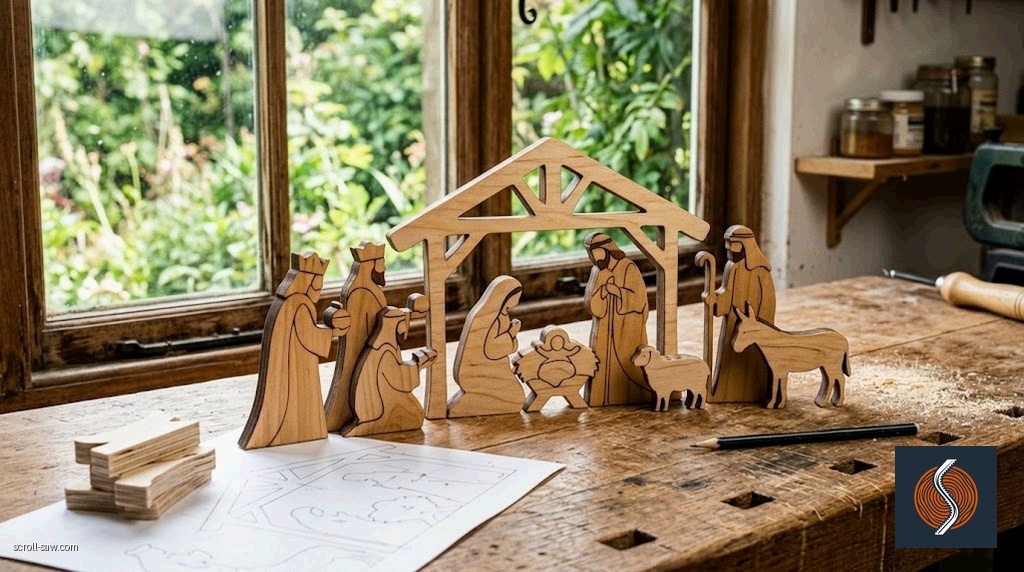
A scroll saw Nativity puzzle is a multi-piece scroll saw project representing the Nativity scene. Pieces typically include Mary, Joseph, the infant Jesus, shepherds, wise men, angels, and animals (sheep, donkey, camel). The pieces fit into a stable or manger base, or interlock as a puzzle.
The project has multiple appeals: religious significance for many families, teaching value for children (learning the story through playing with the pieces), and craft challenge (multiple pieces at consistent quality).
Short answer: 3/4-inch or 1-inch closed-grain hardwood or Baltic birch plywood, #7 skip-tooth blade for thicker stock, cut all pieces at consistent scale and finish, plan the base or backing before starting figures.
Nativity set components
A complete Nativity set includes:
Holy Family:
-
Mary
-
Joseph
-
Infant Jesus (often in a manger)
Wise Men (Three Kings):
- Traditionally three kings bearing gifts
Shepherds:
- One to three shepherd figures, sometimes with staff
Angel:
- The angel announcing the birth
Animals:
-
Sheep (one or several)
-
Donkey
-
Camel (accompanying the kings)
-
Sometimes cow or ox
Base or setting:
-
The stable structure
-
Manger for the infant Jesus
-
Sometimes a star
Total pieces range from 8 (minimal set) to 20+ (elaborate set).
Puzzle vs. standalone figures
Two approaches:
Puzzle style. Pieces interlock. Removed piece by piece, reassembled into the scene. Children can play with it. Requires precise cutting so pieces fit together consistently.
Standalone figures. Each piece stands independently, arranged on a shelf or in a stable base. No interlocking required. Easier to cut with less precision required.
Hybrid. Standalone figures with a common base that has slots for each piece.
Stock selection
3/4-inch or 1-inch hardwood. Substantial pieces that read as fine woodworking. Cherry, walnut, maple. Grain along piece length (head to feet for figures).
1/2-inch Baltic birch plywood. Cost-effective for painted sets. Handles fragile detail well.
1-inch cedar. For pieces intended to develop patina and traditional wood-colored appearance.
Basswood. For painted sets that will feature detailed painting.
For a heirloom Nativity, walnut or cherry with clear finish. For a Sunday school production set, Baltic birch with paint.
Blade choice
Primary blade: #7 skip-tooth for 3/4-inch and thicker stock. Olson FR49400 Skip Tooth.
Fine detail: #5 skip-tooth for face features and clothing detail.
Extended production: Pegas Modified Geometry #12. A full Nativity set is many hours of cutting.
Pattern selection
Look for pattern sets specifically designed as complete Nativity collections:
Steve Good’s blog has Nativity puzzle patterns as free downloads.
Sue Mey and various pattern designers offer full Nativity sets.
Big Book of Scroll Saw Woodworking includes Nativity patterns.
Fox Chapel Publishing has dedicated Nativity pattern books.
Denominational bookstores may sell Nativity patterns specific to their tradition.
Cutting sequence for a Nativity puzzle
-
Prepare the base first. If the puzzle uses a common base with cutouts, cut the base early. The pieces fit into the base’s cutouts, so knowing the exact cutout dimensions matters.
-
Cut simple pieces first. Sheep, donkey (simpler animal shapes). Refines technique before tackling detailed figures.
-
Cut human figures next. Mary, Joseph, wise men, shepherds, angel.
-
Cut the infant Jesus and manger last. Small pieces, benefit from being cut with fresh blade and refined technique.
-
Test fit as you go. For puzzle-style sets, verify pieces fit the base as you complete each one.
Per-piece cutting sequence
-
Attach pattern. 3M Super 77.
-
Drill interior entry holes.
-
Interior detail (face features, clothing lines).
-
Perimeter last.
-
Sand while pattern attached.
-
Peel pattern.
-
Verify fit if part of puzzle set.
Finishing
Clear satin polyurethane over hardwood. Heirloom appearance. The wood grain becomes part of each figure’s character.
Traditional multi-color paint. Red robes on Mary, blue on Joseph, gold or bronze on kings, white on angel and sheep. Multiple thin coats for smooth appearance.
Stain in warm tones. Walnut or cherry stain over lighter wood. Reads as traditional folk art.
Wood burning for detail. After cutting, add facial features and clothing detail with wood burning. Advanced technique.
Antique white with age glaze. Country/farmhouse Nativity appearance.
Whichever finish, do all pieces in one session with the same finish batch. Consistency matters across a set.
Assembly options
Stable base with slots. Each piece has a corresponding slot in the base. Piece stands upright when placed in slot.
Backing board. All pieces glued to a common backing board in a scene arrangement. Wall-hung display.
Freestanding figures. Each piece has a base wide enough to stand alone. Arranged on a shelf or mantle.
Puzzle with interlocking pieces. Pieces fit together jigsaw-style with a common perimeter.
Display
A Nativity set often has a fixed display location:
-
Mantelpiece during the Christmas season
-
Dedicated shelf year-round in some households
-
Table centerpiece for Christmas dinner
-
Wall-mounted (for backing-board style sets)
The display should protect the pieces from being knocked over. Small figures roll easily; consider a shelf edge or base.
Where to source patterns
Steve Good’s blog has Nativity sets as free patterns.
Big Book of Scroll Saw Woodworking includes Nativity content.
Fox Chapel Publishing has dedicated Christmas and Nativity pattern books.
Specialty Christian bookstores may carry pattern books specific to religious traditions.
Common problems and fixes
Pieces don’t fit the puzzle base. Cutting drift accumulated. Verify each piece fits before finishing. Recut pieces that don’t fit; adjust base cutouts if all pieces are consistently off.
Figures don’t stand upright. Base too narrow or piece top-heavy. Widen base or attach separate stand.
Faces indistinguishable. Interior detail too fine for stock and blade. Simplify face features or use larger scale.
Set feels incomplete. Missing standard figures. A minimum Nativity has Mary, Joseph, Jesus, and at least a manger. Elaborate sets add wise men, shepherds, angels, and animals.
Wood cracked during finishing. Solid wood with grain issue, or humidity change. Preserve set in stable environment.
Painted details look sloppy. Fine brush required. Use good-quality small brushes and steady hand; multiple thin coats better than one thick coat.
Frequently asked questions
How large should a Nativity puzzle be? Depends on display location. Table centerpiece: 12-18 inches wide overall. Mantel display: 20-36 inches wide. Wall-hung: variable.
How long does a full Nativity set take? 10-30 hours of cutting time for 8-15 pieces. Add finishing time.
Can I sell Nativity sets? Yes with appropriate pattern licensing. Religious pieces have a market at Christmas markets and church craft fairs.
Should I include animals in a Nativity set? Traditional. Sheep, donkey, and camel add scene completeness. Cow or ox represent the stable’s animals.
Can I make a Nativity set in stages, adding pieces each year? Yes. Start with Holy Family in year one. Add wise men in year two. Add shepherds and angel in year three. Add animals in year four. Family tradition builds.
What’s the theological correctness of Nativity puzzles? Different traditions have different Nativity elements. Catholic Nativity may include specific saints. Orthodox may have different figures. Verify with recipient’s tradition.
Can children play with a wooden Nativity puzzle? Yes, with age-appropriate finish (food-safe or non-toxic paint). Nativity puzzles teach the story through play.
References
-
Fox Chapel Publishing, Big Book of Scroll Saw Woodworking.
-
Steve Good, Scrollsaw Workshop (blog).


