
Scroll Saw Snowflake Patterns: Cutting Six-Fold Symmetry Without Losing Detail
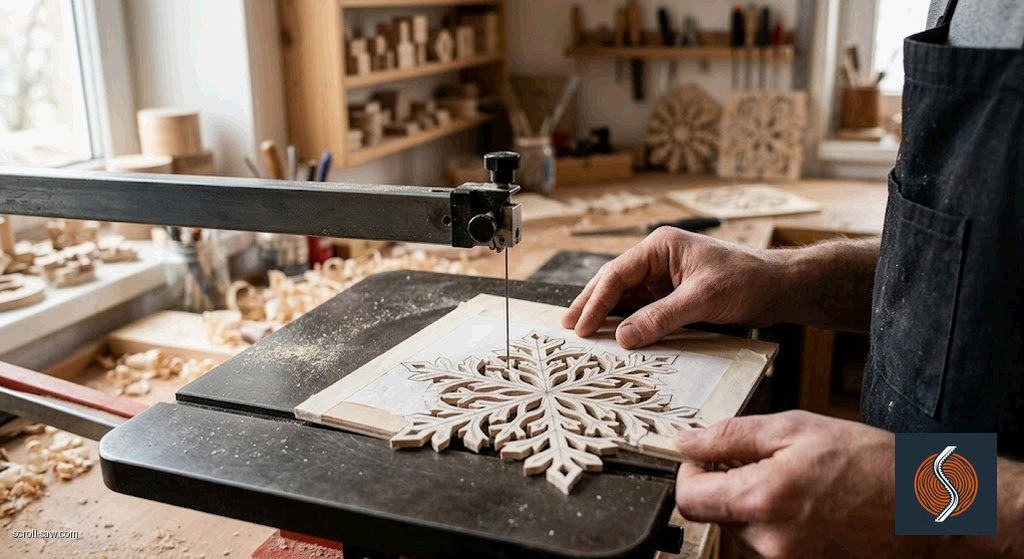
Scroll Saw Snowflake Patterns: Cutting Six-Fold Symmetry Without Losing Detail
A scroll saw snowflake pattern is a six-fold symmetric snowflake design cut on a scroll saw. Snowflakes are among the most popular Christmas ornament and window decoration subjects—the pattern reads as festive, wintery, and visually complex.
The technical challenge is fragility. Real snowflakes are ice crystals with delicate arms and fine detail. Wood snowflakes must approximate that delicacy without breaking during cutting or handling.
Short answer: 1/8-inch or 1/4-inch Baltic birch plywood, #3 or #5 reverse-tooth blade depending on detail size, cross-grain construction protects fragile arms, careful sanding with support, satin or gloss finish.
Why plywood beats solid wood for snowflakes
Solid wood has one grain direction. A snowflake’s six arms radiate in six directions. At least three of the six arms are perpendicular or nearly perpendicular to the grain in solid wood, and those arms break.
Baltic birch plywood has multiple layers with alternating grain. Every direction in the plywood has support. Snowflake arms in every direction have adequate strength.
Use Baltic birch for snowflakes. The one exception is a snowflake pattern designed as three axes (like a Y or a star of David), where two out of three axes can align with grain. For six-fold snowflakes, use plywood.
Stock selection
1/8-inch Baltic birch plywood. Delicate ornaments. Light weight. Fine detail possible. Requires careful handling.
1/4-inch Baltic birch plywood. Standard for scroll-cut snowflakes. Substantial enough to handle without excessive care, thin enough to allow fine detail.
1/2-inch Baltic birch plywood. Substantial ornaments or wall pieces. Heavier, more durable, but detail must be thicker.
Solid hardwood works only for large snowflakes or three-axis designs. Not recommended for standard six-fold patterns.
Pattern selection
Snowflake patterns range from simple six-armed stars to elaborate designs with dozens of fine detail elements per arm.
Simple six-armed: star of David-like pattern with slight decoration. Beginner-friendly.
Traditional snowflake: six main arms with side branches. Moderate detail. Standard scroll saw project.
Elaborate crystalline: dozens of fine detail elements. Advanced project. Time-consuming.
Modern geometric: stylized snowflake with clean lines. Contemporary appearance.
Steve Good’s blog has extensive snowflake patterns.
Big Book of Scroll Saw Woodworking includes snowflake pattern sections.
Dedicated snowflake pattern books collect many designs at various difficulty levels.
Blade choice
Standard snowflake: #3 reverse-tooth. Olson FR49202. Tight turns for the fine detail.
Simple large snowflake: #5 reverse-tooth. Faster cutting for less detailed patterns.
Very fine detail: #2/0 blade. Slow but clean.
Extended production (dozens of snowflakes): Pegas Regular Scroll #7.
Pattern attachment
Light 3M Super 77 mist. Two seconds from eight inches.
Optional ScotchBlue Painter’s Tape 2090 between wood and pattern for clear-finish work.
Cutting sequence
-
Drill entry holes for interior cutouts. Snowflake patterns typically have many interior regions. Drill all entry holes before cutting begins. 1/16-inch bit.
-
Cut smallest interior detail first. Fine detail at the arm tips and side branches. This work is done while the surrounding wood still supports the fragile detail.
-
Cut larger interior features. Central pattern, larger cutouts.
-
Cut perimeter last. The snowflake’s outer boundary.
-
Sand while pattern attached. 220-grit paper. Support the snowflake against a backing board while sanding. Do not sand aggressively on arm tips.
-
Peel pattern. Gentle heat helps if adhesive resists.
Finishing
Clear finish over Baltic birch: shows the light plywood color. Multiple thin coats of satin polyurethane.
White paint: traditional snowflake appearance. White primer + white top coat + optional glitter clear coat.
Metallic paint: silver or blue metallic. Reads as icy or magical.
Stain to darker color: contrast with the traditional snowflake white. Uncommon but effective for design pieces.
Multiple layers: cut two snowflakes in different sizes, layer them for depth.
Whichever finish, multiple thin coats. Snowflake fretwork gaps trap thick finish.
Hanging hardware
Ornament cord: small hole drilled at one arm tip. Gold or silver cord threaded through and knotted.
Window hangers: cord with suction cup for window display.
Standoffs: decorative brackets that hold the snowflake off the wall or window.
No hanging (freestanding): mount snowflake on a small base for tabletop display.
Common snowflake applications
Christmas ornaments. Small snowflakes (2-4 inches) for tree decoration.
Window decorations. Medium snowflakes (4-8 inches) hung in windows during winter.
Wall art. Large snowflakes (10-24 inches) as focal decoration.
Table centerpieces. Large snowflake laid flat as centerpiece under a candle or arrangement.
Gift toppers. Small snowflakes tied to gift packages.
Advent calendar pieces. 24 or 25 small snowflakes with dates.
Common problems and fixes
Snowflake arm broke during cutting. Blade too aggressive or insufficient support. Use finer blade; reduce feed pressure.
Arm broke during sanding. Sanding pressure applied to unsupported arm tip. Support arm against backing board during sanding.
Snowflake looks asymmetric. Cutting drift accumulated across six arms. Symmetric cutting requires steady technique; take breaks to reset focus.
Pattern lines showed after finishing. Pattern residue not removed. Sand or wipe with alcohol before finishing.
Snowflake broke while installing hanging cord. Cord hole too close to edge, or pressure applied wrong direction. Position hole with adequate margin.
Finish pooled in fretwork. Coats too thick. Apply multiple thin coats.
Frequently asked questions
Do real snowflakes have six-fold symmetry? Yes. Ice crystal structure produces six-fold symmetry (with some exceptions). Scroll saw snowflake patterns typically follow this convention.
Can I use solid wood for snowflakes? Not recommended for standard six-fold designs. Grain direction fails at least half the arms. Use Baltic birch plywood.
How thin can I make snowflake arms? At intended print scale, 1/8 inch minimum for stroke width. Thinner arms break during cutting or finishing.
How long does a snowflake take to cut? Simple: 20-30 minutes. Traditional: 30-60 minutes. Elaborate: 60-120 minutes.
Can I stack-cut multiple snowflakes? Yes with 1/8-inch stock. Two or three layers with double-stick tape between. Reduces per-piece time significantly.
What color paint for snowflakes? Traditional white. Metallic silver or blue for icy appearance. Clear finish for wood-tone snowflakes.
Can I sell snowflake ornaments? Yes. Christmas markets and craft fairs sell them well. Winter décor sells year-round in some markets.
References
-
Fox Chapel Publishing, Big Book of Scroll Saw Woodworking.
-
Steve Good, Scrollsaw Workshop (blog).


