
Scroll Saw Toy Patterns: Safety, Durability, and Play Value
Scroll Saw Toy Patterns: Safety, Durability, and Play Value
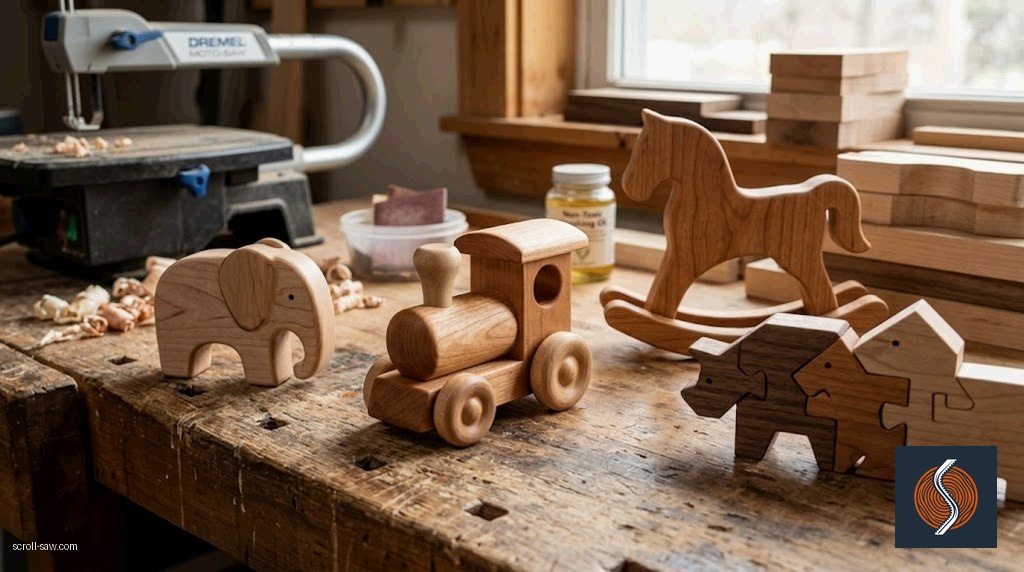
A scroll saw toy pattern is a toy design suitable for scroll saw production. Common toys include puzzles, pull toys, stack-and-sort sets, animal shapes for imaginative play, and vehicle silhouettes. Wooden toys are traditional, durable, and sell well as gifts.
Designing toys for children requires considering safety, durability, and play value simultaneously. A toy that fails on any dimension isn’t a good toy.
Short answer: 1/2-inch or 3/4-inch closed-grain hardwood, no small parts that could become choking hazards, food-safe or non-toxic finish, rounded edges without sharp points, robust construction.
Safety requirements
No small parts. For children under three, no piece smaller than about 1.25 inches in any dimension. This prevents choking hazards. Use the “toilet paper roll test”: if the piece fits through, it’s too small.
No sharp edges. All edges must be sanded to rounded profile. No sharp corners on surfaces the child touches.
No sharp points. Points on animal ears, tails, or similar features must be blunted.
Non-toxic finish. Food-safe mineral oil, beeswax, or specifically-labeled non-toxic children’s paint. No industrial polyurethane on toys for children who mouth objects.
Secure joinery. No pieces that can come apart and be swallowed. Wood glue and mechanical fasteners rather than just glue.
No lead paint or lead-containing finish. Verify all paints and finishes are lead-free.
Splinter-free. All surfaces sanded to 220-grit minimum. Verify by running hand across surfaces.
Age-appropriate design
Under 12 months: rattles, teethers, simple grasping toys. Small hands, mouth exploration.
12 months to 3 years: stack-and-sort toys, chunky puzzles with knobs, simple pull toys. Large pieces, no small parts.
3 to 6 years: puzzles with more pieces, imaginative play sets (farm animals, vehicles), stacking blocks.
6+ years: more complex puzzles, name spelling toys, working models.
Match pattern complexity and piece size to age.
Stock selection
Wood species: closed-grain hardwood. Maple, birch, cherry, beech. Avoid oak (open grain traps dirt), walnut (some children have nut allergies affecting sensitivity to walnut sawdust).
Basswood: for softer toys, painted work. Not as durable as hardwood but easier to cut.
Avoid: pine (splits easily), softwoods generally (dent from normal play), MDF (contains formaldehyde binders).
Thickness: 1/2-inch to 3/4-inch. Substantial enough to survive play. Thin toys break.
Blade choice
Toy outlines: #5 or #7 skip-tooth. Olson FR49400 Skip Tooth. Handles thicker stock well.
Fine detail (eyes, facial features): #3 reverse-tooth. Olson FR49202.
Production: Pegas Modified Geometry #12 for extended cutting sessions.
Cutting sequence
-
Attach pattern with 3M Super 77.
-
Drill entry holes for interior detail.
-
Cut interior detail.
-
Cut perimeter.
-
Round all edges with sandpaper or router. This is a mandatory step for toys, not optional.
-
Sand to 220-grit minimum. Splinter-free is a safety requirement.
-
Apply safe finish.
Popular toy patterns
Farm animal set. Cow, pig, sheep, horse, chicken, farmer. 6-10 pieces. Imaginative play.
Vehicle set. Cars, trucks, trains, boats, planes. 4-8 pieces.
Puzzle animals. 6-12 piece puzzles with animal outlines. Age-appropriate piece count.
Alphabet blocks. Individual letters. Educational play.
Nesting shapes. Concentric rings that stack together. Motor skill development.
Pull toys. Wheeled toy on a string. Classic wooden toy.
Rocking horse. Larger project combining scroll saw and other woodworking.
Musical toys. Xylophone with cut wood keys, drum stands.
Finishing for safety
Food-safe mineral oil. Safest for children who mouth toys. Multiple applications; oil penetrates the wood.
Beeswax finish. Beeswax + food-safe oil. Provides mild water resistance. Safe for children.
Non-toxic children’s paint. Specifically labeled as safe for children’s toys. Multiple thin coats.
Milk paint. Traditional non-toxic paint from milk protein. Reads as vintage.
Unfinished. Some toy makers leave toys unfinished. Safe but grays with handling; some parents prefer this.
Avoid: polyurethane (contains solvents), spray finishes with volatile organic compounds, any finish not specifically labeled child-safe.
Where to source patterns
Steve Good’s blog has toy patterns.
Big Book of Scroll Saw Woodworking includes toy pattern sections.
Judy and Dave Peterson published extensive toy pattern books.
Specialty children’s toy pattern books focus on specific age groups or toy types.
Selling wooden toys
Craft fairs. Traditional venue. Wooden toys sell well as gifts for grandchildren, nieces, nephews.
Online (Etsy). Handmade wooden toys have strong online market.
Local gift shops. Wholesale to boutiques.
Church bazaars. Local sales.
Farm markets. In agricultural regions, farm-themed wooden toys sell alongside produce.
Pricing: simple toys $10-25, complex toys $30-80, larger projects (rocking horses) $100-300.
Safety labeling: consider including safety notes with each toy (age range, choking hazard warnings for small parts, finish safety).
Common problems and fixes
Toy piece broke during play. Wood too soft or joinery too weak. Use hardwood; verify glue joints; consider mechanical fasteners.
Splinters after play. Sanding inadequate. Sand to 220-grit; verify no rough spots by hand.
Paint chipped. Paint not adequate for handling. Use tougher child-safe paint or multiple clear coats.
Choking hazard identified. Piece smaller than acceptable. Redesign with larger pieces.
Toy piece stained after mouthing. Some finishes gray or discolor with saliva. Use food-safe oil that darkens slightly but doesn’t damage.
Wood grain raised after cleaning. Wooden toys should be spot-cleaned, not soaked. Note this on care instructions.
Frequently asked questions
What wood is safest for baby toys? Maple and birch. Both are closed-grain, don’t splinter easily, and are widely regarded as safe.
Can I use magnets in wooden toys? Strong magnets (rare earth) can be dangerous if swallowed. Use only for older children (6+), and secure magnets so they can’t be pulled out.
How do I make sure a toy is safe? Size test (no small parts for under-3), splinter test (hand across surface), finish test (labeled child-safe), joinery test (piece stability under pressure). No sharp edges or points.
Should I include safety warnings with toys I sell? Yes, for legal and ethical reasons. Note age range, any potential choking hazards, and finish safety.
Can I use exterior plywood for toys? No. Exterior plywood contains formaldehyde-based glues not safe for children. Use Baltic birch (uses safer glue) or solid hardwood.
What about wooden teether toys? Maple or beech, unfinished or with only food-safe oil. Chunky shapes with rounded edges. Sold as “natural wood teethers”—growing market.
How do I make wooden toys durable for daily play? Hardwood, hardware-store finish (multiple coats of food-safe or child-safe finish), robust joinery, larger scale (thick pieces resist breakage).
References
-
Fox Chapel Publishing, Big Book of Scroll Saw Woodworking.
-
Judy and Dave Peterson, various scroll saw toy pattern books.
-
Steve Good, Scrollsaw Workshop (blog).


