
Delta 40 560 Type 2 Scroll Saw Guide
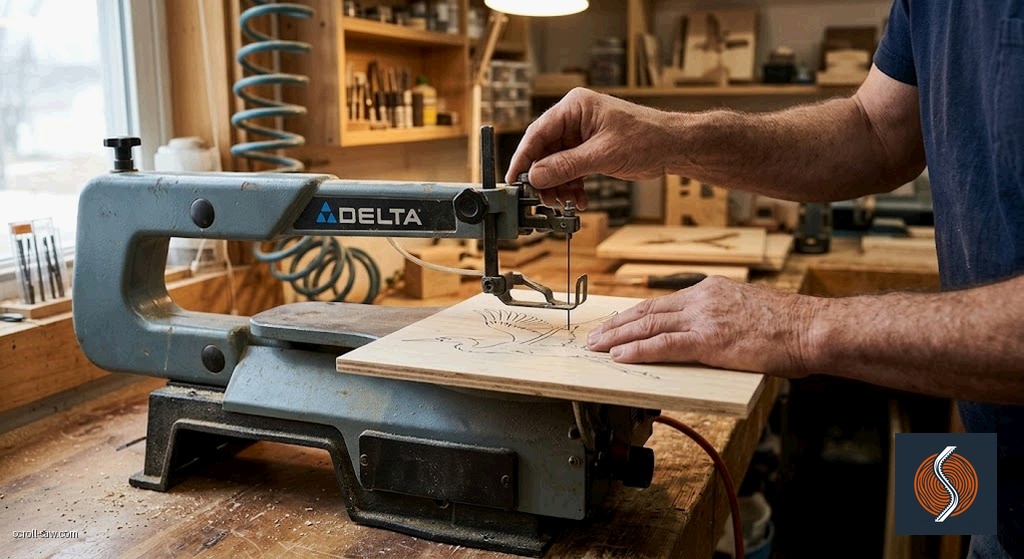
Delta 40 560 Type 2 Scroll Saw Guide
Ownership is the honest test of any scroll saw. Marketing copy sells the first day, but the delta 40 560 type 2 scroll saw either earns its bench slot over a hundred cuts or it does not. This is a closer look at the delta 40 560 type 2 scroll saw from the ownership side, with a focus on the speed range you actually get, the arm design that drives vibration and blade life, and the small notes that only come out after a few weekends of use.
The delta 40 560 type 2 scroll saw is a 16 inch scroll saw with a plain-end 5 inch. Depending on the type number, it runs the speed control shown in its service documents, driven by an induction motor sized for continuous hobby use.
Living with the delta 40 560 type 2 scroll saw teaches you three things quickly. The speed range dictates which materials cut well, the arm design decides how much vibration you feel through the table, and the blade clamp is the single failure point that costs the most hours over the life of the saw. Get those three right and the delta 40 560 type 2 scroll saw will cut cleanly for years. Miss any of them and every cut feels like a fight.
Speed range in practice
The speed control on the delta 40 560 type 2 scroll saw is set by the type number, and you should confirm it against the service document before you make blade choices. At the low end you cut thin non ferrous metals and delicate inlay stock without heat buildup. At the top end you clear chips out of three quarter inch hardwood without stalling the blade. The middle of the range is where most fret work happens.
Arm design and vibration
two speed 16 inch bench scroll saw, cast aluminum table, sold as the Delta 2 speed 16 inch. Scroll saw arm design falls into three real families: C arm, parallel link, and parallel arm. The delta 40 560 type 2 scroll saw sits in the family shown on its parts diagram, and the vibration behavior follows from that. Parallel link designs pivot from the back and cost less. Parallel arm designs move the blade in a purer vertical stroke and cost more. Either can be tuned to run smoothly with a bench mounted on rubber feet.
Blade clamps and blade life
The blade system uses plain-end 5 inch, which is the single most important detail to confirm before you spend a cent on replacements. The clamp is the wear part that decides how much of your session is cutting and how much is fiddling. On any Delta scroll saw, budget for a spare set of clamp screws and O rings, and check the clamp faces for cupping the day you buy the machine.
For plain end holders, the Olson FR49400 skip tooth assortment covers most cuts you will make, and the Olson FR49202 reverse tooth pack reduces tearout on the underside of the wood.
Ownership notes from real users
Dust management on the delta 40 560 type 2 scroll saw is a blower nozzle at the throat. It clears the cut line but it does not capture chips, so a shop vac with a magnetic base pointed at the underside of the table is the standard workshop hack. Lighting is not built in on most examples in this class. A gooseneck LED lamp clipped to the arm is worth the small outlay. Table inserts wear out where the blade tracks, and a machined aluminum replacement lasts much longer than the original stamped part.
What breaks and what does not
Bearings and blade clamps are the routine wear items. Arm castings, main frames, and induction motors almost never fail on their own. Belts, on the belt driven models in this family, are a five year replacement at the outside.
The reference machine on the bench next to it
Workshops that own a delta 40 560 type 2 scroll saw often also own or aspire to a DeWalt DW788, because the DW788 is the currently produced 20 inch scroll saw everyone benchmarks against. If your delta 40 560 type 2 scroll saw is a keeper, the two machines coexist well and you can dedicate different blade profiles to each.
Verdict
The delta 40 560 type 2 scroll saw rewards owners who understand the era it comes from and buy blades to match. It punishes owners who treat it like a modern tool free machine. Set the bench at elbow height, mount the saw on a stable stand, keep a spare blade clamp in the drawer, and you will get years of quiet fret work out of it.
Concrete takeaways
Match your blade inventory to the clamp on the delta 40 560 type 2 scroll saw. Keep a spare set of blade clamp screws in the drawer. Add task lighting from day one. Compare cut quality against a currently produced 20 inch scroll saw once a season to catch drift early.
FAQ
Is the delta 40 560 type 2 scroll saw loud in use? A scroll saw at full speed sits in the seventy five to eighty five decibel range. The delta 40 560 type 2 scroll saw is on the quieter end of that range when it is well tuned.
Does the delta 40 560 type 2 scroll saw vibrate? Vibration on a well mounted delta 40 560 type 2 scroll saw is low. If the table jumps, the fault is almost always the stand or the mounting bolts, not the saw itself.
Can I put the delta 40 560 type 2 scroll saw on a mobile base? Yes. Any bench class scroll saw benefits from a stable stand with rubber feet.
How often should I change the blade on the delta 40 560 type 2 scroll saw? Every session, at minimum, and any time the blade wanders from the cut line.
What is the maximum stock thickness on the delta 40 560 type 2 scroll saw? Two inches of softwood, one and a half inches of hardwood, as a practical ceiling.
Are replacement blades easy to find for the delta 40 560 type 2 scroll saw? Yes, provided you order the correct clamp type. plain-end 5 inch


