
Best Scroll Saw Blade for Cutting Letters: A Working Guide
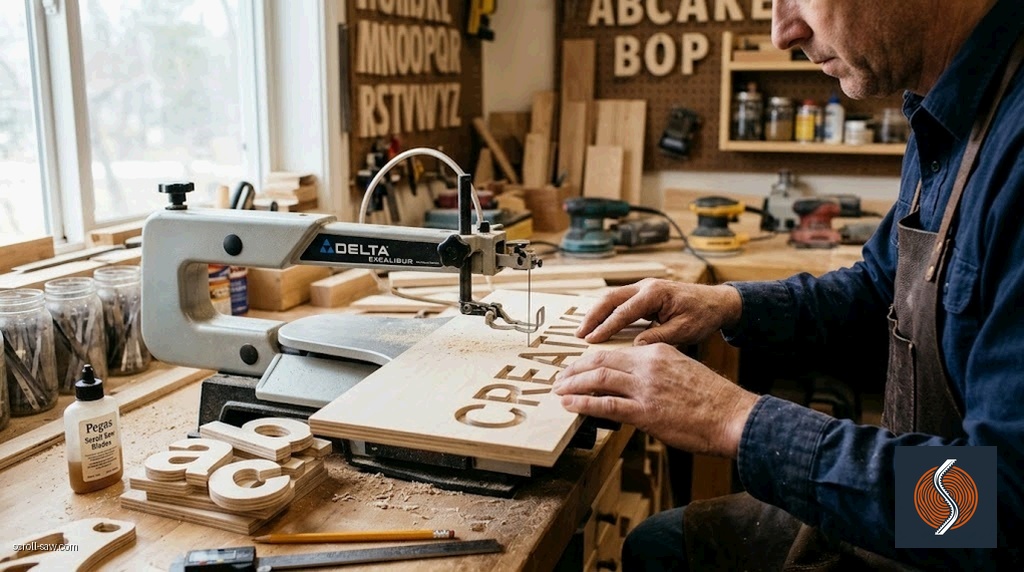
Best Scroll Saw Blade for Cutting Letters: A Working Guide
The best scroll saw blade for cutting letters depends on letter size, font style, stock thickness, and volume. Small ornate letters need different blades than large simple letters. Thick oak needs different blades than thin plywood. Production runs need different blade characteristics than one-off pieces.
Short answer: for typical letter work (1-3 inch letters in 1/4 to 1/2-inch stock), a #3 or #5 reverse-tooth blade produces clean edges. Adjust up or down for larger/smaller letters and thicker/thinner stock.
What matters for letter cutting
Tight interior curves. Letters like O, C, U, D require the blade to turn through tight curves. Narrower blades turn tighter.
Sharp interior corners. Letters like A, V, W, M have interior V-shapes. The blade width is the minimum interior corner radius.
Clean edges. Letter faces are visible from close viewing distance. Rough edges show. Fine blades produce smoother edges.
Consistent stroke width. The blade width equals the kerf. A wide blade cuts a wide kerf; the visible letter stroke is what remains, which affects font weight visually.
Blade widths for letters
Blade sizes are conventionally numbered (higher = wider for teeth-per-inch styles, or the reverse for gauge-based numbering). For letter work:
#2/0 or #1: very fine work. Letters under 1 inch tall, stock under 1/4 inch thick.
#3 reverse-tooth: standard for detailed letter work. Handles most fonts at 1-3 inch scale in 1/4 to 1/2-inch stock. Olson FR49202 Reverse Tooth is a standard choice.
#5 reverse-tooth: larger letters (3-6 inches), thicker stock (1/2 to 3/4 inch), or less detailed fonts. Faster cutting than #3.
#7 skip-tooth: large letters in thick stock (3/4 inch and up). Olson FR49400 Skip Tooth.
#9 skip-tooth: very large letters (over 6 inches) in thick stock (1 inch and up).
Blade type: reverse-tooth for letters
Reverse-tooth blades have most teeth cutting downward (like standard scroll saw blades) but the bottom few teeth cut upward. This produces clean edges on both top and bottom faces of the stock—important for letter work where both faces are often visible.
Skip-tooth blades have wider gullets between teeth for chip evacuation. Better for thick stock but slightly rougher edges.
Standard non-reverse blades leave the bottom face rougher. Fine for utility work; less good for letters where both faces show.
Recommendation for letters: reverse-tooth in most cases. Switch to skip-tooth only for thick stock (over 1/2 inch).
Specific blade recommendations by application
Name pieces in 1/4-inch Baltic birch:
-
Simple stencil fonts, 2-3 inch letters: #5 reverse-tooth
-
Cursive script, 2-3 inch letters: #3 reverse-tooth
-
Fine detail script or small letters: #2/0
Name pieces in 1/2-inch hardwood:
-
Simple fonts: #5 or #7 depending on detail
-
Detailed fonts: #5 reverse-tooth
-
Very fine detail: #3 reverse-tooth
Large signs in 3/4-inch stock:
-
Simple letters: #7 or #9 skip-tooth
-
Detailed letters: #5 or #7
Very small letters (under 1 inch) in thin stock:
- #2/0 or #1 for the finest detail
Production runs of letters:
- Pegas Regular Scroll #7 for extended cutting through many name pieces
Blade characteristics beyond size
TPI (teeth per inch). More teeth = smoother cut but slower feed and more heat. Letters benefit from more teeth for cleaner edges.
Blade material. Standard is carbon steel. Bi-metal blades last longer but cost more; useful for production. Ceramic-coated blades reduce heat and extend life.
Modified geometry. Blades like Pegas Modified Geometry #12 have unusual tooth patterns designed for cool running and long life. Extended production runs benefit.
Ground vs. stamped. Ground blades (Pegas, some Olson lines) cut smoother than stamped blades. Cost more; worth it for visible work.
Setup for clean letter cutting
Blade tension. Higher than normal for letters. Tight blade doesn’t wander and turns cleaner. Deflection of less than 1/8 inch when pressed sideways.
Feed speed. Slower than normal. Let the blade cut; don’t push. Fast feed produces wandering cuts and rough edges.
Speed setting. Medium for most letter work (800-1,200 SPM). Slower for hardwood, faster for softwood or plywood.
Table alignment. Verify blade is 90 degrees to table. Off-square blade produces beveled edges on letters.
Zero-clearance insert. A wooden insert around the blade eliminates chip-out at the bottom of the cut. Especially important for letters.
Font considerations
Different fonts have different demands:
Simple sans-serif stencil fonts: wide strokes, clean curves. #5 reverse-tooth works.
Serif fonts (with feet on letters): need to cut the serif detail cleanly. #3 or #5 reverse-tooth.
Cursive/script fonts: tight curves and thin connection lines. #3 reverse-tooth or finer.
Very fine decorative fonts: may exceed scroll saw capability. Consider laser cutting for extremely fine work.
Common problems and fixes
Fuzzy edges on letters. Blade dull or wrong type. Change blade; use reverse-tooth.
Blade wanders into curves. Blade too wide for the curve radius. Use narrower blade.
Interior corners rounded (V-shape becomes U). Blade width is the interior radius. Use narrower blade for tighter corners.
Bottom face of letter is torn. Not using reverse-tooth blade. Switch to reverse-tooth.
Letters look wobbly. Feed pressure too high or blade tension too low. Slow down feed; increase tension.
Blade broke on tight turn. Turned too fast in a tight radius. Slow down at corners.
Cut is discolored or burned. Blade dull or feed too slow (heat buildup). Change blade; increase feed speed slightly.
Blade life for letter cutting
Standard #3 reverse-tooth in 1/4-inch plywood: 4-8 name pieces before quality degrades.
#5 in 1/2-inch hardwood: 3-6 name pieces.
Pegas premium blades: 2-3x longer life than standard.
Change blades when you notice cut quality degrading, not on a fixed schedule. Cutting through dulled blades produces poor results.
Frequently asked questions
What’s the single best blade for letter work? For 1/4-inch plywood or 1/2-inch hardwood at 1-3 inch letter size, #3 reverse-tooth is the default. Adjust for specific projects.
Can I use a spiral blade for letters? Spiral blades cut in all directions but produce rougher edges. Not recommended for visible letter work. Useful for utility cuts.
Do I need different blades for different fonts? With one good #3 reverse-tooth blade, most letter work is possible. Very fine fonts benefit from finer blades; very large letters benefit from wider blades.
Should I use the same blade for interior and exterior letter cuts? Yes typically. Some professionals switch to finer blades for interior detail after cutting exteriors. For most work, one blade is fine.
How often should I change blades during a letter project? When quality degrades. Watch for fuzzy edges, wandering cuts, or increased effort to feed. Change before finishing important pieces.
Are premium blades worth it for hobby letter cutting? For occasional use, no—standard blades work. For production or premium-quality visible work, yes.
Can I sharpen scroll saw blades? No—they’re too fine to resharpen effectively. Replace when dull.
References
-
Olson Saw, blade selection guides.
-
Pegas Scroll Saw Blades, technical documentation.
-
Fox Chapel Publishing, Big Book of Scroll Saw Woodworking.


