
Best Scroll Saw Blade for Jigsaw Puzzles: A Puzzle-Maker
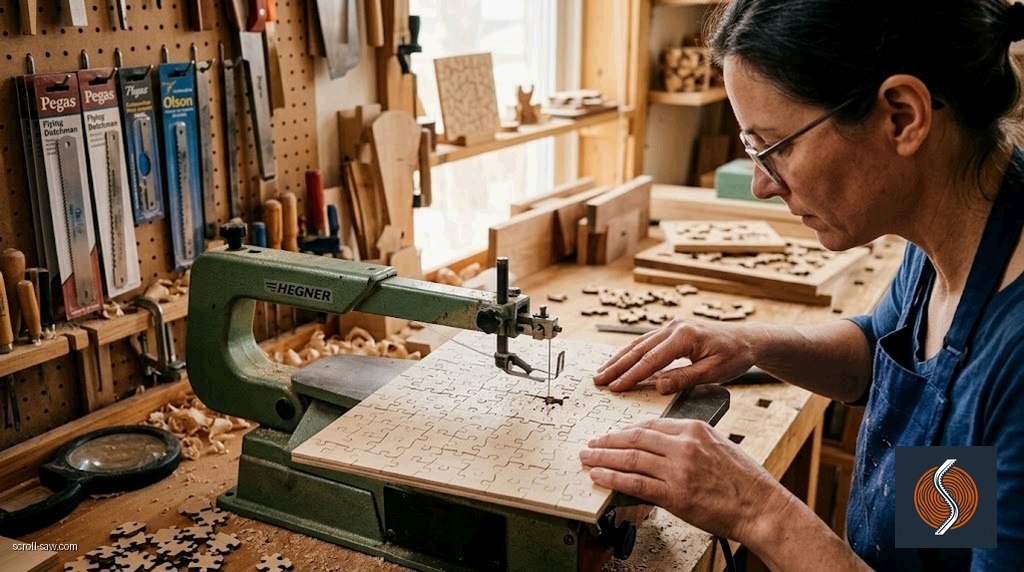
Best Scroll Saw Blade for Jigsaw Puzzles: A Puzzle-Maker
Cutting jigsaw puzzles on a scroll saw has specific technical demands. Puzzle pieces need to fit together tightly (narrow kerf, minimal wood loss), have clean interlocking edges (smooth cut without tearout), and produce consistent shapes across all pieces in the puzzle (consistent blade behavior throughout the cut).
The blade choice matters more for puzzles than for most scroll saw work because puzzle piece fit depends directly on cut quality.
Short answer: for standard jigsaw puzzle work in 1/4-inch to 1/2-inch stock, a #5 or #7 skip-tooth blade produces good results. For finer puzzles or very tight-fitting pieces, use a #3 reverse-tooth. Puzzle-specific blades exist for production use.
Why puzzle blades are different
Standard scroll saw work optimizes for clean edges and reasonable cutting speed. Puzzle work adds:
Narrow kerf. Every piece boundary loses wood equal to the blade width. Wide kerf means gaps between pieces or oversized pieces that don’t fit properly. Narrow kerf preserves piece fit.
Consistent cut across the whole puzzle. A puzzle with 50 pieces requires 50 pieces of consistent cut quality. Blade characteristics that vary (dulling, wandering) show as inconsistent pieces.
Tight curves. Puzzle piece knobs and sockets are tight curves. Narrow blades turn tighter.
Clean cut faces. Piece faces are what people touch. Roughness annoys the user.
Blade size for puzzles
Fine puzzles (small pieces, tight fit):
-
#3 reverse-tooth for detailed work
-
Kerf: approximately 0.02 inch
Standard puzzles (typical piece size in 1/4 to 1/2-inch stock):
-
#5 reverse-tooth or #5 skip-tooth
-
Kerf: approximately 0.03 inch
-
Balance of cut quality and speed
Chunky children’s puzzles (large pieces in 3/4-inch stock):
-
#7 skip-tooth
-
Kerf: approximately 0.04 inch
Production puzzle cutting:
-
Ground blades produce smoother cut faces
Skip-tooth vs. reverse-tooth for puzzles
Reverse-tooth blades produce cleaner top and bottom face cuts. Reverse teeth clean the bottom face. Better for puzzles where both faces show (children’s puzzles, decorative puzzles).
Skip-tooth blades evacuate chips better through thick stock. Better for 3/4-inch and thicker puzzle stock. Slightly rougher edges but generally acceptable.
Recommendation: reverse-tooth for 1/4 to 1/2-inch stock, skip-tooth for 1/2-inch and thicker.
Puzzle stock and matching blades
1/8-inch Baltic birch: #2/0 or #3 reverse-tooth. Fine puzzles for adults, decorative puzzles.
1/4-inch Baltic birch or hardwood: #3 or #5 reverse-tooth. Standard adult puzzles.
1/2-inch hardwood: #5 or #7 skip-tooth. Substantial adult puzzles or larger children’s puzzles.
3/4-inch hardwood: #7 or #9 skip-tooth. Chunky children’s puzzles, oversized display puzzles.
Cut characteristics for puzzles
Kerf width. Narrower = tighter piece fit. Every 0.01 inch of kerf translates to 0.01 inch of gap between pieces.
Blade tension. Higher tension for puzzles. Blade must not wander, or piece boundaries drift.
Feed pressure. Consistent light pressure. Variable pressure produces variable cut.
Speed setting. Medium for most puzzle work. Fast for softwood puzzles; slow for hardwood.
Blade squareness. Verify blade is 90 degrees to table. Off-square blade produces beveled piece edges that don’t stack or fit right.
Puzzle-specific technique
Continuous cutting. Each interior cut starts at the previous cut’s endpoint and ends at another piece boundary. Reduces number of blade entries required.
Feed direction consistency. Cutting in one direction for a piece boundary, then reversing for the return, produces asymmetric cut. Cut in one direction throughout when possible.
No sanding between pieces. Sanding piece edges after cutting increases piece gaps. Cut clean; don’t sand piece edges.
Perimeter first. Cut the puzzle’s outer perimeter first, then interior cuts. Establishes the puzzle’s boundary.
Blade brands worth trying
Olson. Standard American scroll saw blade manufacturer. Wide range of sizes and types. Good for hobby work.
Pegas. Swiss manufacturer, premium blades. Ground rather than stamped. Longer life and smoother cuts.
Flying Dutchman. Specialty scroll saw blades. Fans among fretwork specialists.
Niqua. Fine detail blades, sometimes marketed for puzzle work.
Big-box brand blades. Vary widely. Generally acceptable for occasional use, not for production.
Blade life for puzzle cutting
Standard blade in 1/4-inch hardwood: 3-6 puzzles (roughly 300-600 cuts).
Premium blade (Pegas, Flying Dutchman) in 1/4-inch hardwood: 6-15 puzzles.
Very thin stock (1/8 inch): blades last longer due to less material per cut.
Thick stock (3/4 inch): blades wear faster.
Replace when cut quality degrades—wandering cuts, rougher edges, increased feed effort.
Puzzle piece boundary design
Beyond blade choice, boundary design affects puzzle quality:
Knob and socket sizes matched. Knobs slightly wider than sockets creates a snap-fit. Equal produces loose fit.
Consistent knob shapes. Standardize knob shape so pieces interchange visually (though each piece has unique fit).
No sharp corners in boundaries. Sharp corners are hard to cut cleanly and stress the pieces.
Curve radii above blade width. Every curve should be larger radius than the blade width, or the cut won’t complete cleanly.
Common problems and fixes
Puzzle pieces don’t fit tightly. Kerf too wide. Use narrower blade.
Puzzle pieces fit too tight (won’t come apart). Sanding, expansion, or blade too narrow. Sand piece edges slightly (contradicts general advice; adjust as needed).
Cut faces rough. Blade dull or wrong type. Change to reverse-tooth for smoother finish.
Pieces don’t lay flat when assembled. Blade angle off-square. Verify and adjust.
Cut wanders on tight curves. Blade too wide for curves. Use narrower blade.
Pieces break at knob connections. Grain wrong direction or design too fragile. Redesign or reorient.
Different pieces cut different quality. Blade dulling during the puzzle. Change blade mid-puzzle if noticing quality drop.
Frequently asked questions
What’s the single best blade for puzzles? For 1/4-inch stock, #3 or #5 reverse-tooth. For 1/2-inch stock, #5 skip-tooth. No single blade works for all puzzles.
How narrow a kerf can I get? With #2/0 blade, kerf around 0.015-0.02 inch. Below that requires specialty fine blades or laser cutting.
Can I cut puzzles from cardboard or foamboard? Scroll saw can cut those materials but they’re not typical scroll saw work. Craft knives or die cutters better for cardboard.
What’s the smallest puzzle piece a scroll saw can cut? Down to about 0.5-inch piece with #2/0 blade. Smaller than that, the blade width limits piece detail.
Do I need special blades for wooden jigsaw puzzles? Standard scroll saw blades work. Specialty puzzle blades from premium manufacturers produce slightly better results but aren’t required.
Can I sell wooden puzzles? Yes. Wooden puzzles have a strong market at craft fairs and online. Children’s puzzles and adult-difficulty puzzles both sell.
How do I package wooden puzzles? Cloth bag or box. Include a photo of the completed puzzle as a guide. Note the piece count.
References
-
Olson Saw, blade selection guides.
-
Fox Chapel Publishing, Big Book of Scroll Saw Woodworking.
-
Judy and Dave Peterson, various scroll saw puzzle books.


