
Scroll Saw Puzzle Blades: Selection, Setup, and Care
Scroll Saw Puzzle Blades: Selection, Setup, and Care
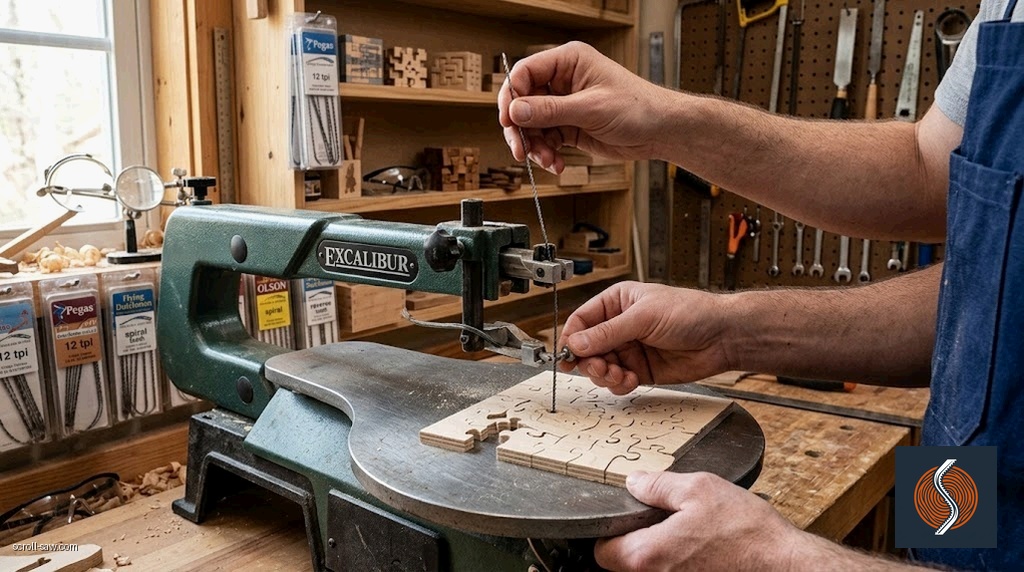
Scroll saw puzzle blades are blades selected or specifically designed for cutting jigsaw puzzles. Puzzle work has particular demands: narrow kerf (so pieces fit tightly), tight curve capability (for puzzle knobs and sockets), clean cut faces (so pieces slide together), and consistency across many pieces.
A good puzzle blade balances these characteristics. No single blade optimizes all four; puzzle-makers choose based on which characteristics matter most for their work.
Short answer: for typical wooden puzzles in 1/4 to 1/2-inch stock, a #5 or #7 skip-tooth or reverse-tooth blade works well. For fine puzzles or those with tight-fit requirements, use #3 reverse-tooth. Premium blades from Pegas or Flying Dutchman for production.
Blade characteristics for puzzles
Kerf width. Determines gap between adjacent pieces. Narrower kerf = tighter fit. Standard scroll saw blades produce kerf 0.02-0.05 inch; finer blades cut narrower kerfs.
Tooth geometry. Skip-tooth (wider gullets) evacuates chips well in thicker stock. Reverse-tooth (last teeth cutting upward) produces cleaner bottom face. Both work for puzzles; choice depends on stock thickness.
Blade width. Narrower blades turn tighter curves. Wider blades cut faster and stay straighter in straight sections.
Blade material. Carbon steel is standard. Bi-metal (steel body with high-speed steel teeth) lasts longer at higher cost.
Manufacture quality. Ground blades (premium) cut smoother than stamped blades. Ground blades are more consistent piece-to-piece.
Blade sizing for puzzle work
Fine adult puzzles (500+ pieces):
-
#2/0 or #3 reverse-tooth
-
Kerf: 0.015-0.02 inch
-
Fine detail possible
Standard adult puzzles (100-300 pieces):
-
#3 or #5 reverse-tooth
-
Kerf: 0.02-0.03 inch
-
Balance of detail and speed
Children’s puzzles (10-50 pieces, larger pieces):
-
#5 or #7 skip-tooth
-
Kerf: 0.03-0.04 inch
-
Faster cutting for larger pieces
Chunky children’s puzzles (large simple pieces):
-
#7 or #9 skip-tooth
-
Kerf: 0.04-0.05 inch
-
Thick stock (3/4 inch+)
Recommended blade brands
Olson. American manufacturer, wide selection, good quality for hobby work. Olson FR49202 Reverse Tooth or Olson FR49400 Skip Tooth.
Pegas. Swiss manufacturer, premium ground blades. Pegas Regular Scroll #7 or Pegas Modified Geometry #12. Longer life and smoother cuts.
Flying Dutchman. Specialty scroll saw blades with strong following. Particularly good for fine detail.
Niqua. European fine-detail blades.
Big-box store generic. Variable quality. Fine for occasional use, not for production.
Setup for puzzle cutting
Blade tension. Higher than for general scroll saw work. Deflection should be less than 1/8 inch when pressed sideways at midpoint. Loose blade wanders; tight blade cuts precisely.
Blade squareness. Verify 90 degrees to table. Off-square blade produces beveled piece edges that don’t lay flat.
Feed pressure. Light. Let the blade do the work. Excessive pressure produces heat, wandering, and blade wear.
Speed. Medium for most puzzle work (800-1,200 SPM). Slower for hardwood or thick stock; faster for thin plywood.
Table alignment. Verify blade is centered in the throat. Alignment issues cause pieces to shift during cutting.
Zero-clearance insert. Wooden insert around the blade eliminates bottom-face chip-out. Especially important for puzzles.
Blade life in puzzle work
Blade life depends on stock and blade quality:
Standard Olson blade in 1/4-inch Baltic birch plywood: 3-6 puzzles (roughly 500-1000 linear inches of cut).
Pegas premium blade in same conditions: 8-15 puzzles.
Hardwood cuts wear blades faster than plywood.
Very thick stock (3/4 inch+) reduces blade life to 30-50% of thinner-stock life.
Replace blades when cut quality degrades—wandering cuts, rougher edges, or increased effort to feed.
Cutting technique for puzzles
Perimeter first. Cut the puzzle’s outer boundary before interior pieces. Establishes the puzzle’s outline.
Continuous interior cuts. Each interior cut connects to the previous cut’s endpoint. Reduces blade retraction and re-entry.
Consistent feed direction. Cut in one direction throughout when possible. Bidirectional cutting can produce asymmetric piece boundaries.
No hesitation on tight curves. Slow feed through curves; consistent motion. Hesitation produces marks or wandering.
Watch for blade drift. As blade dulls, cut wanders more. Change blade before pieces become imprecise.
Puzzle piece boundary design
Blade choice affects design decisions:
Curve radius vs. blade width. Every curve in the puzzle piece boundary must be larger radius than the blade width. A #5 blade (about 0.03 inch wide) can’t cut curves tighter than about 0.06-inch radius cleanly.
Knob and socket sizes. Standard puzzle knobs are 1/4 to 1/2-inch wide. Blade width defines the minimum socket width; too-narrow blade cuts wider sockets than knobs, and the fit is loose.
Corner radii. Sharp corners in puzzle boundaries are hard to cut cleanly. Round all internal corners.
Storage and care
Store blades flat. Bent blades cut poorly. Store in the original packaging or a flat organizer.
Don’t touch blade teeth. Skin oils reduce blade life. Handle by the ends only.
Keep blades dry. Rust ruins blades. Store in dry environment.
Discard broken blades safely. Wrap the pieces in tape before disposal.
Label if you use multiple sizes. Different applications use different blades; labeling containers prevents mix-ups.
Common problems and fixes
Pieces don’t fit tightly. Kerf too wide. Use narrower blade.
Pieces stick together. Kerf too narrow or wood swelled. Sand piece edges slightly.
Cut faces rough. Blade dull or wrong type. Change to reverse-tooth for smoother edges.
Blade wanders in tight curves. Blade too wide for radius. Use narrower blade.
Pieces don’t lay flat. Blade off-square. Verify and adjust.
Cutting slow and hot. Blade dulling. Change blade.
Blade broke mid-cut. Excessive tension, aggressive feed, or fatigued blade. Reduce tension slightly; slow feed.
Different pieces cut different quality. Blade dulled during production. Change blade sooner in the puzzle sequence.
Puzzle production considerations
Blade budget. Production puzzle-making requires many blades. Bulk-buy standard sizes.
Stock consistency. Different wood species or batches require blade adjustment. Standardize stock for consistent results.
Setup time. Blade changes take time. Batch cutting minimizes changes.
Quality control. Test-fit puzzle pieces before finishing to catch cutting issues early.
Frequently asked questions
What’s the single best blade for puzzles? For 1/4-inch stock, #3 or #5 reverse-tooth. Adjust for specific projects and volume.
How narrow a kerf can I achieve? With #2/0 blade, kerf around 0.015 inch. Below that requires very fine specialty blades.
Are premium blades worth it for puzzle work? For hobby use, no—standard blades work. For production, yes—premium blades save time and produce better puzzles.
Can I use spiral blades for puzzles? Spiral blades cut in all directions but produce rougher edges. Not recommended for puzzles where piece faces need to be smooth.
How often should I change blades during a puzzle? Watch cut quality. Change when wandering, rough edges, or excessive feed effort appears. Better to change slightly early than to finish with a poor blade.
Do I need different blades for different puzzles? Blade choice depends on stock thickness and puzzle detail. One blade covers many puzzles; two or three blade types cover the range of typical puzzle work.
Can I sharpen puzzle blades? No—scroll saw blades are too fine to resharpen effectively. Replace when dull.
References
-
Olson Saw, blade selection documentation.
-
Pegas Scroll Saw Blades, technical resources.
-
Fox Chapel Publishing, Big Book of Scroll Saw Woodworking.


