
Is the Dremel 16 Scroll Saw Model 1671 the Right Scroll S...
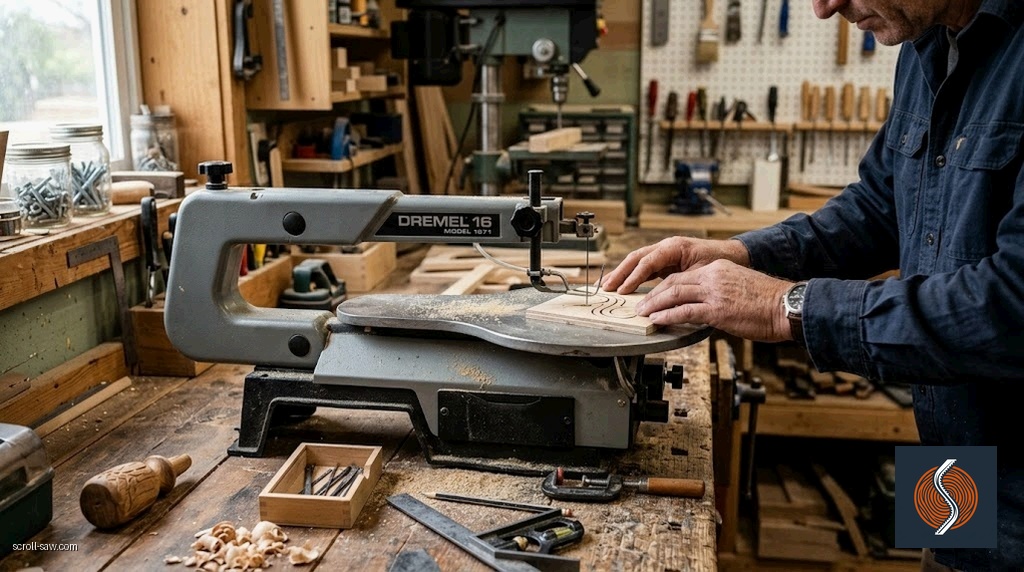
Is the Dremel 16 Scroll Saw Model 1671 the Right Scroll S…
Every scroll saw has a personality. Some are quiet and true; some are twitchy at speed; some are workshop veterans that only need brushes and a clean blade. The trick is knowing which one is in front of you.
A scroll saw is a benchtop saw that uses a fine, short blade moving up and down at high speed to cut curves and interior shapes in wood, plastic, and thin non-ferrous metal. The Dremel 16 Scroll Saw Model 1671 sits within that category, and the question this article answers is how the machine actually behaves in a home or small-production shop.
The direct answer is this. Dremel scroll saws were built for the home shop. Compact cast bases, quiet single-speed or two-speed motors, and a friendly footprint that fit on a folding workbench. If your work fits the machine’s character, it will serve you well. If it does not, no amount of tuning will make the saw feel right in your hand.
Who this machine was built for
The Dremel scroll saw line grew out of the classic Moto-Shop combination unit and evolved through a series of stand-alone models (57, 571, 1571, 1671, 1672, 1680, 1695, 1800, 1830) before Dremel exited the category.
Dremel scroll saws were built for the home shop. Compact cast bases, quiet single-speed or two-speed motors, and a friendly footprint that fit on a folding workbench.
Match the machine to your work
A scroll saw only earns its keep if it fits the kind of cutting you actually do. Sit with these four cases before you buy, and the answer usually resolves itself.
-
Puzzles, intarsia, and small ornaments in 1/4-inch to 3/4-inch stock. Almost any scroll saw in this class handles this well, including the platform under discussion. Focus your money on blade quality and lighting.
-
Fret-work and thin-stock detail in expensive hardwoods. Precision matters more than throat depth. Blade clamp quality and low-speed control are what to check.
-
Portrait cutting and heavy relief in stock up to 1-1/2 inches. Look for parallel-link arm designs and generous arm travel. This is where older heavy machines shine.
-
Occasional utility cutting alongside a full workshop. A saw that starts and stops fast and runs quietly beats one with premium precision, because the fast machine is the one you actually turn on.
The blade system, in plain terms
Most Dremel scroll saws used 5-inch pin-end blades in the standard holder. Later variants added a pinless adapter, but pin-end is the safe assumption unless the machine has been converted.
A good starter blade kit covers the three cuts you will make most often: general profile work, fine detail, and clean-face cross-cutting on figured wood.
-
For general profile work, keep a stack of Olson FR49400 skip-tooth blade assortment on hand. Skip-tooth geometry clears chips fast and does not scorch pine or poplar.
-
For fine detail and interior cuts, reverse-tooth blades produce the cleanest bottom face. The Olson FR49202 reverse-tooth 5-inch blade pack is the standard reference pack, and Flying Dutchman 60-piece pinless variety pack is what most competition scrollers keep by the machine.
-
For puzzle work or spiral cutting inside a tight radius, a set of Olson SP46500 spiral blade set or Flying Dutchman New Spiral #1 pinless pack will do work that a straight blade cannot.
-
If your machine still uses pin-end blades, the Olson FR41001 pin-end 7 TPI blades or the JTEX 48-piece pin-end blade assortment assortment will keep you supplied.
How this platform sizes up next to current machines
| Attribute | This platform | Current mid-tier (e.g., WEN 3923) | Current premium (DeWalt DW788) |
|---|---|---|---|
| Throat depth | 16-inch class benchtop | 16 to 20 inches | 20 inches |
| Blade type | pin-end or pinless (model-dependent) | pinless | pinless with tool-free clamp |
| Speed control | single or two-speed on older units | variable | variable, electronic |
| Bevel | table tilt on most | table tilt | table tilt, front-mounted lock |
| Cast base | yes | yes | yes |
| Parts support | Dremel discontinued the scroll saw line, so factory parts are limited. | active | active, factory network |
If you decide to buy new instead
Not every used scroll saw is worth the tuning it needs. If you are within a repair or two of walking away, two current machines cover most owners.
-
The DeWalt DW788 20-inch variable-speed scroll saw is the reference used by most professional scrollers. Parallel-link arm, tool-free blade clamps, front-panel controls, and a service network that will still be there in five years.
-
The WEN 3923 16-inch variable-speed scroll saw is the mid-tier value pick. Side-panel blade access, variable speed, and a light. Not as smooth as the DW788, but it holds a line and it is easy to service.
-
Pair either machine with the WEN MSA1621 adjustable scroll saw stand if your bench is short on space, and a set of Flying Dutchman 60-piece pinless variety pack to skip the learning curve on blade quality.
Verdict
So what is the verdict? The Dremel 16 Scroll Saw Model 1671 rewards owners who match the machine to their work and put in the small setup time it needs. It is not the newest platform, and for some buyers a current machine such as the WEN 3923 16-inch variable-speed scroll saw is the better call. But the platform under discussion has real strengths and a service story that keeps it useful.
Match the machine to the work you actually cut, and the decision usually makes itself.
Key takeaways
-
The Dremel 16 Scroll Saw Model 1671 fits owners who value a quiet home-shop machine with predictable service parts.
-
Blade choice matters more than most first-time owners expect. Start with a variety pack and settle on two or three geometries for the work you actually do.
-
On any used purchase, spend fifteen minutes on inspection before you spend a dollar on the price.
-
Accessories change the day-to-day experience more than the spec sheet does. A good light and a foot switch pay back within a week.
Frequently asked questions
What blades fit the Dremel 16 Scroll Saw Model 1671?
Most platforms in this family run 5-inch pinless blades. A few earlier units used pin-end holders that also accept pinless with a small adapter. When in doubt, remove the current blade and measure. If it is 5 inches with a plain end, run a set of Olson FR49202 reverse-tooth 5-inch blade pack or Flying Dutchman 60-piece pinless variety pack and you will not have to think about it again.
Is the Dremel 16 Scroll Saw Model 1671 still in production?
Dremel discontinued the scroll saw line, so factory parts are limited. Common wear items (blade holders, guards, dust blower tubing) show up through parts brokers, eBay estate lots, and cross-references to Delta and Skil parts that share tooling. If your saw is discontinued, plan around universal blades and cross-referenced replacement parts. If you need a current machine on the same footprint, the WEN 3923 16-inch variable-speed scroll saw is the closest match in most cases.
How do I identify the exact model and revision?
Look for the metal serial plate on the back of the base casting. It lists the model number, the type or revision number, and the electrical spec. Match all three lines before you order any part.
Do I need a stand?
Not required, but a stand pays back the space it takes. The WEN MSA1621 adjustable scroll saw stand adjusts in height and dampens the bench-top vibration that makes long detail cuts drift.
How much noise does a scroll saw make?
Well-tuned scroll saws run quietly. Most of the noise you hear from an older machine comes from worn arm bearings or a loose motor mount, not the motor itself. If the saw is loud, that is a service item, not a design feature.
Can I use spiral blades on it?
Yes, on any platform that accepts pinless blades. A pack of Olson SP46500 spiral blade set or Flying Dutchman New Spiral #1 pinless pack is what you want for tight radius work and for cutting figured shapes without turning the workpiece.
How do I keep the blade square to the table?
Loosen the blade tension, remove the blade, and check the clamp jaws for even wear. Reinstall a fresh blade, tension it, and check square with a small engineer’s square. If the blade still tilts, the clamp housing is worn and needs replacement or a shim.
Is a foot switch worth it?
For anyone who cuts more than an hour at a time, yes. The WEN WA0392 15-amp momentary foot pedal switch or the DCT 115V maintained foot switch lets you start and stop the saw without lifting your hands off the workpiece, which is a real safety improvement on tight cuts.
References
-
U.S. Consumer Product Safety Commission, safety guidance on stationary power tools and blade guards: cpsc.gov
-
OSHA 29 CFR 1910.213, machine guarding for woodworking machinery: osha.gov/laws-regs/regulations/standardnumber/1910/1910.213
-
National Institute for Occupational Safety and Health, wood-dust exposure guidance: cdc.gov/niosh/topics/wooddust
-
Scroll Saw Woodworking & Crafts, print magazine of record for scroll saw technique: scrollsawer.com
-
Manufacturer service documentation and parts diagrams for the specific model. Search the exact model and type number printed on the serial plate.


