
Advanced Scroll Saw Patterns: What Separates Them From Intermediate Work
Advanced Scroll Saw Patterns: What Separates Them From Intermediate Work
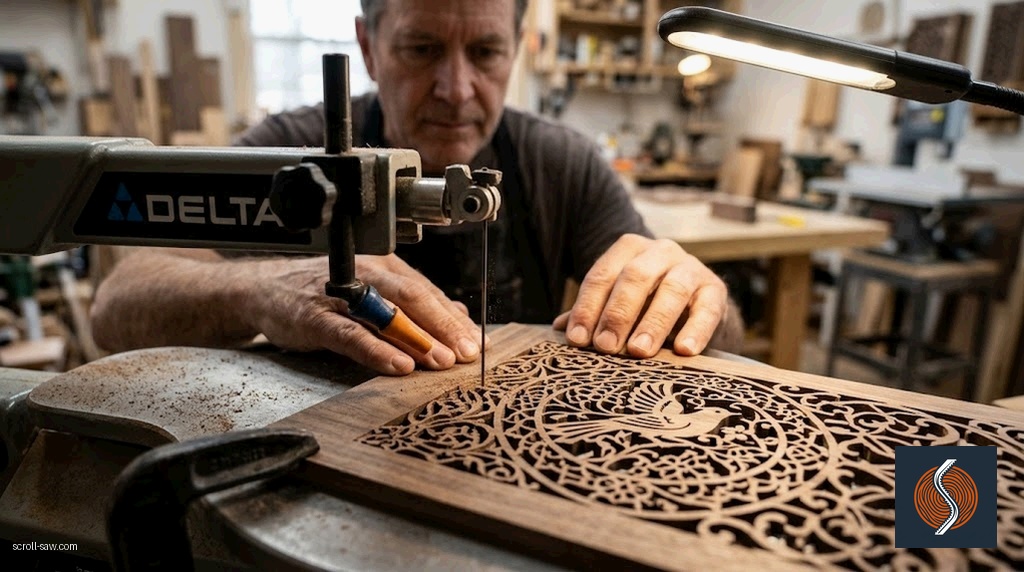
An advanced scroll saw pattern is a pattern that demands techniques or attention beyond intermediate skill. Advanced patterns typically involve very fine detail, complex fretwork with many bridges, portrait-quality subjects, layered compound work, or unusual formats.
Advanced doesn’t mean impossible. It means the pattern requires more deliberate technique and more time. A steady hand and patience matter as much as any specific skill.
Short answer: 1/8-inch or 1/4-inch Baltic birch plywood, #2/0 or #3 reverse-tooth blade, careful pattern preparation, cutting sessions with breaks to maintain focus, and acceptance that some pieces will fail.
What makes a pattern advanced
Very fine detail. Elements smaller than 1/8 inch at print scale. Requires narrow blades and steady technique.
Many bridges. Portrait and fretwork patterns can have hundreds of bridges. Each must be verified for adequate width and cut without breaking.
Portrait quality. Faces of specific people require accurate feature placement. Bad face proportions read as wrong.
Wildlife realism. Fur or feather detail that reads as texture rather than pattern.
Complex compound cutting. Multi-face compound work beyond simple two-face cuts.
Layered relief. Multiple stacked cut pieces creating dimensional depth.
Unusual formats. Curved-face work, three-dimensional puzzles, moving parts.
Stock selection
1/8-inch Baltic birch plywood is the standard for advanced fretwork. Cross-grain construction protects fragile detail. Thin enough for fine cuts; substantial enough to handle.
1/4-inch Baltic birch plywood for slightly more substantial pieces.
Solid hardwood only for advanced work where the pattern accommodates grain direction (usually simpler advanced patterns with fewer directional stresses).
Basswood for compound and 3D advanced work.
Blade choice
Very fine detail: #2/0 blade. Narrow kerf, tight turns.
Standard fretwork detail: #3 reverse-tooth. Olson FR49202 Reverse Tooth.
Ground blades for smoother cuts: Pegas Regular Scroll #7 sizing (equivalent to a fine-detail blade for the material).
Extended sessions: Pegas Modified Geometry #12 sizing runs cooler through long cutting sessions.
Pattern preparation for advanced work
-
Print pattern at exact intended size. Verify size against a ruler.
-
Verify all bridges. Every bridge in an advanced pattern is at risk. Check thickness at intended scale; 1/8 inch minimum.
-
Verify all interior regions have bridges. Isolated regions fall out.
-
Mark cutting order on the pattern. Small numbers indicating sequence for interior detail.
-
Attach pattern securely. Light 3M Super 77. Verify flat adherence.
Cutting sequence for advanced work
-
Drill all entry holes. Advanced patterns can have hundreds of entry points. Drill all before cutting begins. 1/32 to 1/16-inch bit for fine detail.
-
Cut smallest interior detail first. Fine detail is done while surrounding wood provides maximum support.
-
Progress from small to large. Small interior fretwork, then medium interior features, then large interior, then perimeter.
-
Take breaks. Advanced cutting requires sustained focus. Break every 30-45 minutes to reset.
-
Don’t rush. Advanced patterns are not the place for speed. Slow, deliberate feed produces cleaner results.
-
Sand while pattern attached.
-
Peel pattern.
Common advanced pattern categories
Portraits. Specific people (family members, celebrities, historical figures). Face proportions and feature placement matter.
Wildlife realism. Detailed animal patterns with fur texture, feather detail, and accurate anatomy.
Landscape scenes. Multi-element scenes with foreground, midground, background.
Fretwork architecture. Detailed miniature buildings, castles, cathedrals.
Celtic knotwork. Interlocking pattern designs. Complex bridge planning.
Religious iconography. Detailed crosses, saints, sacred figures.
Botanical detail. Complex floral patterns with fine leaf and stem detail.
Multi-layer compound. Three or more compound-cut faces producing complex 3D form.
Common problems and fixes
Fine detail broke during cutting. Blade too aggressive or feed pressure too high. Slower feed; check blade condition.
Cutting drift accumulated. Extended cutting session, technique fatigue. Take breaks; return to fundamentals.
Pattern lines burned onto wood. Long cutting time with adhesive. Sand promptly after peeling.
Face proportions look wrong. Portrait pattern inaccurate. Verify pattern quality before starting.
Complex fretwork looks muddy. Pattern too fine for stock. Enlarge pattern or simplify.
Piece cracked at critical point. Grain direction problem or design flaw. Baltic birch avoids most grain issues; some designs are inherently fragile.
Time exceeded expectation. Advanced patterns take longer than intermediate. Budget 2-4x intermediate time.
Building advanced skills
Master intermediate first. Cut many intermediate patterns cleanly before attempting advanced.
Practice specific techniques. Fine detail cutting on scrap. Compound cutting on inexpensive stock. Portrait work on practice patterns before commissioned pieces.
Study reference photographs. Advanced realistic work benefits from studying the subject.
Slow down. Speed comes with practice; forcing speed on advanced work produces failures.
Accept some failures. Advanced patterns fail at higher rates than intermediate. Failure is data; adjust technique.
Learn from other cutters. Online scroll saw communities share technique. YouTube videos demonstrate advanced techniques visually.
Pattern sources for advanced work
Advanced pattern designers include:
Judy Gale Roberts. Advanced portrait and pictorial patterns.
Wayne Fowler. Wildlife and pictorial patterns.
Steve Good. Blog with many patterns across skill levels, including advanced.
Sue Mey. Fine detail and religious patterns.
Various pattern books from Fox Chapel Publishing. Big Book of Scroll Saw Woodworking covers multiple skill levels.
Finishing advanced work
Clear finish over Baltic birch: shows the plywood color, minimal risk of pooling in fine detail.
Multiple very thin coats. Advanced pieces have many fretwork gaps; thick finish pools.
Careful pattern removal. Adhesive residue in fine detail is hard to remove. Peel gently.
Framing. Advanced pictorial pieces benefit from framing. Custom frames complement the work.
Backing. Fragile advanced pieces sometimes need a backing sheet (paper, cardboard, or another wood piece) for support.
Frequently asked questions
How do I know when I’m ready for advanced patterns? When intermediate patterns are consistent and clean. If intermediate work still fails frequently, focus on intermediate technique first.
How long do advanced patterns take? 4-20+ hours depending on complexity. Portrait work often takes 10-30 hours across multiple sessions.
What’s the most important skill for advanced work? Patience and consistent technique. Skill matters, but sustained focus over long cutting sessions matters more.
Can I sell advanced pieces? Yes at premium prices. Portrait commissions typically $150-500. Detailed pictorial pieces $100-300. Framed advanced work commands premium.
Should I use a magnifying lamp? For very fine detail, yes. Magnifying lamps or optivisors help see and cut precise details.
Do I need a premium scroll saw for advanced work? Not required but helpful. Premium saws (DeWalt DW788, Excalibur, Hegner) have lower vibration and finer control, making advanced work easier.
Can I combine techniques (fretwork + compound + layered)? Yes. Combining techniques produces unique pieces. Requires understanding each technique separately first.
References
-
Fox Chapel Publishing, Big Book of Scroll Saw Woodworking.
-
Judy Gale Roberts, various pictorial scroll saw books.
-
Steve Good, Scrollsaw Workshop (blog).


