
Excalibur 16 Scroll Saw: Specifications, Blade System, an...
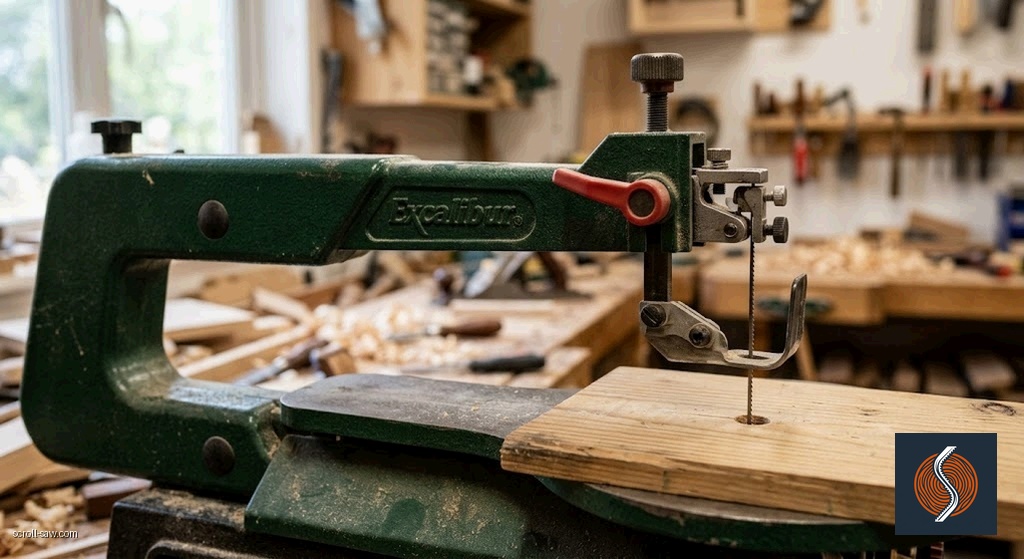
Excalibur 16 Scroll Saw: Specifications, Blade System, an…
You inherit a saw, or you spot one at an estate sale, and the model number on the side plate means nothing to a general search. That is the gap this article closes.
A scroll saw is a benchtop saw that uses a fine, short blade moving up and down at high speed to cut curves and interior shapes in wood, plastic, and thin non-ferrous metal. The Excalibur 16 Scroll Saw sits within that category, and the question this article answers is how the machine actually behaves in a home or small-production shop.
The direct answer is this. The signature Excalibur trait is a tilting head instead of a tilting table. That single feature changes how you cut bevels and how sawdust clears the line. If your work fits the machine’s character, it will serve you well. If it does not, no amount of tuning will make the saw feel right in your hand.
The specification sheet, translated
Specification tables on any Excalibur scroll saw look similar at a glance. The numbers that actually change your experience with the machine are narrower than the marketing page suggests.
-
Throat depth. This is the distance from the blade to the back of the arm. It is the practical limit on how wide a workpiece you can rotate through the saw.
-
Maximum cut thickness. Real-world thickness where the machine cuts confidently is usually 3/4 of the spec sheet number. Take that off the top.
-
Stroke length. Longer strokes clear chips better and reduce blade heat. This is the number most buyers ignore and then wish they had not.
-
Speed range in strokes per minute. Variable is better than fixed. A wide range (400 to 1600 or similar) beats a narrow one.
-
Table size and bevel range. The table is where you support your workpiece. A cramped table is a constant annoyance.
The signature Excalibur trait is a tilting head instead of a tilting table. That single feature changes how you cut bevels and how sawdust clears the line.
The blade system, in plain terms
Excalibur saws accept standard 5-inch pinless blades. Many owners run Pégas or Flying Dutchman blades exclusively.
A good starter blade kit covers the three cuts you will make most often: general profile work, fine detail, and clean-face cross-cutting on figured wood.
-
For general profile work, keep a stack of Olson FR49400 skip-tooth blade assortment on hand. Skip-tooth geometry clears chips fast and does not scorch pine or poplar.
-
For fine detail and interior cuts, reverse-tooth blades produce the cleanest bottom face. The Olson FR49202 reverse-tooth 5-inch blade pack is the standard reference pack, and Flying Dutchman 60-piece pinless variety pack is what most competition scrollers keep by the machine.
-
For puzzle work or spiral cutting inside a tight radius, a set of Olson SP46500 spiral blade set or Flying Dutchman New Spiral #1 pinless pack will do work that a straight blade cannot.
-
If your machine still uses pin-end blades, the Olson FR41001 pin-end 7 TPI blades or the JTEX 48-piece pin-end blade assortment assortment will keep you supplied.
Parts support in real terms
Because the platform passed through several owners, parts sourcing depends on which era your saw was built. Seyco still supports many older Excalibur units through its service arm.
For universal wear parts, aftermarket suppliers such as Olson and Flying Dutchman cover the blade side. For brushes, switches, and blade clamps, the manufacturer parts diagram is the reference document. Order by type number, not model name.
Accessories that actually matter
Most upgrades to a scroll saw are small and cheap. A few change the way the machine feels to use.
-
A focused work light with a magnifying head. The WoodRiver LED shop light with magnifying head is the one most shops end up buying twice, once for the scroll saw and once for the drill press.
-
A foot switch. Once you cut with your hands free of the power switch, you do not go back. The WEN WA0392 15-amp momentary foot pedal switch is the mainstream choice, briidea deadman foot switch is a solid deadman option, and the DCT 115V maintained foot switch handles heavier draw.
-
A stand that isolates vibration. If you are working on a bench that shares space with a router or bandsaw, a dedicated stand such as the WEN MSA1621 adjustable scroll saw stand keeps the saw where you set it.
Verdict
Bottom line, then. The Excalibur 16 Scroll Saw rewards owners who match the machine to their work and put in the small setup time it needs. It is not the newest platform, and for some buyers a current machine such as the DeWalt DW788 20-inch variable-speed scroll saw is the better call. But the platform under discussion has real strengths and a service story that keeps it useful.
Buy with your eyes open, run it in gently, and this platform will earn its bench space.
Key takeaways
-
The Excalibur 16 Scroll Saw fits owners who value precision over portability.
-
Blade choice matters more than most first-time owners expect. Start with a variety pack and settle on two or three geometries for the work you actually do.
-
On any used purchase, spend fifteen minutes on inspection before you spend a dollar on the price.
-
Accessories change the day-to-day experience more than the spec sheet does. A good light and a foot switch pay back within a week.
Frequently asked questions
What blades fit the Excalibur 16 Scroll Saw?
Most platforms in this family run 5-inch pinless blades. A few earlier units used pin-end holders that also accept pinless with a small adapter. When in doubt, remove the current blade and measure. If it is 5 inches with a plain end, run a set of Olson FR49202 reverse-tooth 5-inch blade pack or Flying Dutchman 60-piece pinless variety pack and you will not have to think about it again.
Is the Excalibur 16 Scroll Saw still in production?
Because the platform passed through several owners, parts sourcing depends on which era your saw was built. Seyco still supports many older Excalibur units through its service arm. If your saw is discontinued, plan around universal blades and cross-referenced replacement parts. If you need a current machine on the same footprint, the DeWalt DW788 20-inch variable-speed scroll saw is the closest match in most cases.
How do I identify the exact model and revision?
Look for the metal serial plate on the back of the base casting. It lists the model number, the type or revision number, and the electrical spec. Match all three lines before you order any part.
Do I need a stand?
Not required, but a stand pays back the space it takes. The WEN MSA1621 adjustable scroll saw stand adjusts in height and dampens the bench-top vibration that makes long detail cuts drift.
How much noise does a scroll saw make?
Well-tuned scroll saws run quietly. Most of the noise you hear from an older machine comes from worn arm bearings or a loose motor mount, not the motor itself. If the saw is loud, that is a service item, not a design feature.
Can I use spiral blades on it?
Yes, on any platform that accepts pinless blades. A pack of Olson SP46500 spiral blade set or Flying Dutchman New Spiral #1 pinless pack is what you want for tight radius work and for cutting figured shapes without turning the workpiece.
How do I keep the blade square to the table?
Loosen the blade tension, remove the blade, and check the clamp jaws for even wear. Reinstall a fresh blade, tension it, and check square with a small engineer’s square. If the blade still tilts, the clamp housing is worn and needs replacement or a shim.
Is a foot switch worth it?
For anyone who cuts more than an hour at a time, yes. The WEN WA0392 15-amp momentary foot pedal switch or the DCT 115V maintained foot switch lets you start and stop the saw without lifting your hands off the workpiece, which is a real safety improvement on tight cuts.
References
-
U.S. Consumer Product Safety Commission, safety guidance on stationary power tools and blade guards: cpsc.gov
-
OSHA 29 CFR 1910.213, machine guarding for woodworking machinery: osha.gov/laws-regs/regulations/standardnumber/1910/1910.213
-
National Institute for Occupational Safety and Health, wood-dust exposure guidance: cdc.gov/niosh/topics/wooddust
-
Scroll Saw Woodworking & Crafts, print magazine of record for scroll saw technique: scrollsawer.com
-
Manufacturer service documentation and parts diagrams for the specific model. Search the exact model and type number printed on the serial plate.


