
Scroll Saw Turkey Pattern: Cutting Thanksgiving Decor That Reads Right
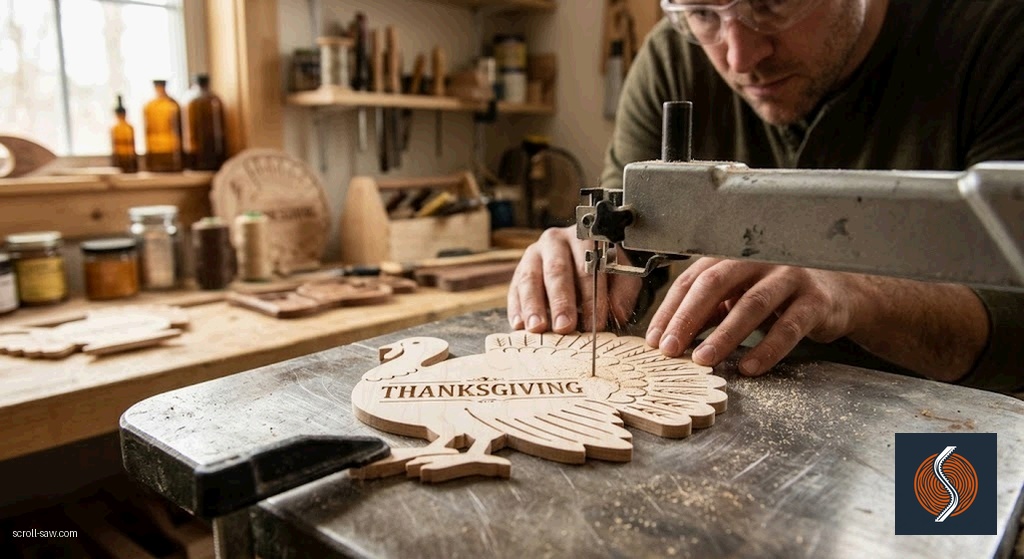
Scroll Saw Turkey Pattern: Cutting Thanksgiving Decor That Reads Right
A scroll saw turkey pattern is a pattern producing a Thanksgiving turkey silhouette or figure. Turkeys are seasonal favorites—Thanksgiving centerpieces, autumn décor, farm-themed pieces.
The subject has visual specifics: the fan of tail feathers, the wattle at the throat, the body proportions. A turkey pattern that lacks these reads as a chicken or generic bird.
Short answer: 1/4-inch to 3/4-inch stock, tail feather detail is the key visual feature, warm autumn colors (browns, oranges, rust) for painted pieces or natural hardwood for clear finish.
Turkey pattern styles
Silhouette (simple). Turkey outline showing fan tail, body, head, feet. Minimal interior detail. Reads clearly at glance. Beginner pattern.
Feathered silhouette. Silhouette with interior detail showing tail feather divisions and body plumage. Mid-level pattern.
Detailed pictorial. Turkey with fine feather detail, facial features, and background elements (leaves, gourds). Advanced pattern.
Compound cut turkey. Two-view pattern producing 3D turkey figure. Traditional folk-art format.
Turkey layered. Multi-layer piece with background, midground, foreground for dimensional Thanksgiving scene.
Turkey with text. Turkey silhouette combined with Thanksgiving text (“Give Thanks,” “Blessed,” “Thankful”).
Stock selection
Silhouette turkeys:
-
1/4-inch Baltic birch plywood: painted pieces.
-
1/2-inch hardwood: substantial silhouettes, clear finish.
-
3/4-inch hardwood: freestanding tabletop pieces.
Detailed pictorial turkeys:
-
1/8-inch Baltic birch plywood: fine fretwork detail.
-
1/4-inch Baltic birch plywood: substantial detail work.
Compound cut turkeys:
-
1.5x1.5x4 inch basswood blocks: small ornaments.
-
2x2x5 inch basswood: substantial figures.
Layered turkeys:
- 1/4-inch Baltic birch across all layers.
Species options:
-
Oak: reads as autumn appropriate.
-
Walnut: rich brown tone.
-
Cherry: warm autumn color.
-
Maple: painted pieces.
-
Basswood: compound cuts.
Blade choice
Silhouette turkeys, 1/4 to 1/2-inch stock: #5 reverse-tooth. Olson FR49202.
Detailed pictorial (fine feathers): #3 reverse-tooth.
Very fine detail: #2/0 blade.
Compound cut basswood blocks: #7 skip-tooth. Olson FR49400.
Production runs of turkeys: Pegas Regular Scroll #7.
Pattern-specific considerations
Tail fan proportions. Tail feathers should fan out wide enough to read as a turkey. Narrow tail reads as chicken or generic bird.
Body proportions. Turkey body is round and full. Long thin body reads wrong.
Head and wattle. Small head, prominent wattle (the red flap at the throat). Distinctive turkey features.
Feet. Simplified feet are fine. Detailed feet look strange at scroll saw scale.
Feather detail. Interior lines dividing tail feathers add readability. Individual feather shapes can be simplified.
Bridges in tail fan. Interior tail feather divisions need bridges to hold shape. Verify bridges are adequate.
Cutting sequence
-
Attach pattern with 3M Super 77.
-
Drill interior entry holes for tail feather divisions and any other interior features.
-
Cut interior detail first. Tail feather divisions, wing detail.
-
Cut turkey outline last.
-
Sand while pattern attached.
-
Peel pattern.
Finishing turkey pieces
Traditional Thanksgiving palette:
-
Rust orange
-
Deep brown
-
Autumn yellow
-
Burgundy red
-
Gold accents
Painting approach for detailed turkeys:
-
Base coat: brown or rust.
-
Highlight coats: lighter browns on tail feather tips.
-
Details: gold or copper accents on feather tips, red wattle, dark eye.
-
Multiple thin coats.
Natural finish:
-
Clear satin polyurethane over hardwood.
-
Walnut or cherry naturally read as autumn colors.
-
Reads as fine woodworking.
Distressed finish:
-
Base color + dark glaze wiped into recesses.
-
Aged farmhouse appearance.
Stain highlighting:
-
Light stain overall + darker stain wiped in for depth.
-
Cost-effective way to add dimensional appearance.
Display and application
Table centerpieces. Large turkey silhouette or dimensional turkey as Thanksgiving table centerpiece.
Wall décor. Framed or wire-mounted turkey silhouettes.
Mantel décor. Freestanding turkeys on mantels or shelves.
Front door hangers. Turkey silhouette with ribbon for front door display.
Turkey-themed wooden signs. Turkey silhouette combined with text (“Gobble Gobble,” “Thankful”).
Ornaments. Small turkey silhouettes as hangable seasonal ornaments.
Multi-piece display. Turkey with additional autumn elements (pumpkins, gourds, leaves) as a seasonal arrangement.
Where to source patterns
Steve Good’s blog has turkey and Thanksgiving patterns, particularly around October-November each year.
Big Book of Scroll Saw Woodworking includes seasonal patterns.
Seasonal scroll saw magazines feature Thanksgiving patterns in autumn issues.
Etsy and pattern sellers offer downloadable turkey patterns.
Common problems and fixes
Turkey looks like a chicken. Tail fan too narrow. Widen fan or add more distinct fan spread.
Tail feathers broke during cutting. Feather details too thin. Enlarge pattern or increase feather width.
Wattle unclear. Detail too small at scale. Enlarge the head/wattle area.
Colors muddy. Too many paint colors blended. Simplify palette or use distinct color blocks.
Piece won’t stand upright. Base too narrow. Widen base or add support.
Turkey looks generic. Missing distinctive features. Ensure fan tail, wattle, and body proportions read clearly.
Interior fretwork holes fall out. Insufficient bridges. Reinforce with bridges before cutting.
Timing for Thanksgiving production
Production start: early September for Thanksgiving.
Craft fair sales: late October through mid-November peak.
Retail sales: late September through late November.
Post-holiday clearance: discount pricing after Thanksgiving.
Turkeys work as autumn décor from September through November even without specific Thanksgiving marketing.
Frequently asked questions
What’s the most important feature of a turkey pattern? The tail fan. It’s what identifies the subject as a turkey rather than a generic bird.
Can I use a chicken pattern for a turkey? Not really. Chickens have narrow tails; turkeys have fanned tails. Different visual reads.
Should turkey pieces be painted or clear-finished? Both markets exist. Painted turkeys read as country/farmhouse décor. Clear-finished hardwood reads as fine woodworking.
Can I sell turkey scroll saw pieces? Yes—strong seasonal market. Craft fairs in October-November move turkey décor consistently.
What size turkey works for a table centerpiece? 12-18 inch turkey silhouette works well as centerpiece. Standalone or with base for stability.
How do I make a compound-cut turkey? Matched front and side view patterns of turkey (typical: side profile view + tail-fan-forward front view). Cut on basswood block as standard compound cut.
Are turkey patterns hard to cut? Simple silhouettes are beginner-level. Detailed pictorial turkeys with feather detail are intermediate to advanced.
References
-
Fox Chapel Publishing, Big Book of Scroll Saw Woodworking.
-
Steve Good, Scrollsaw Workshop (blog).


