
Proxxon 37088 Scroll Saw (DS 115 E): Setup, Limits, Service
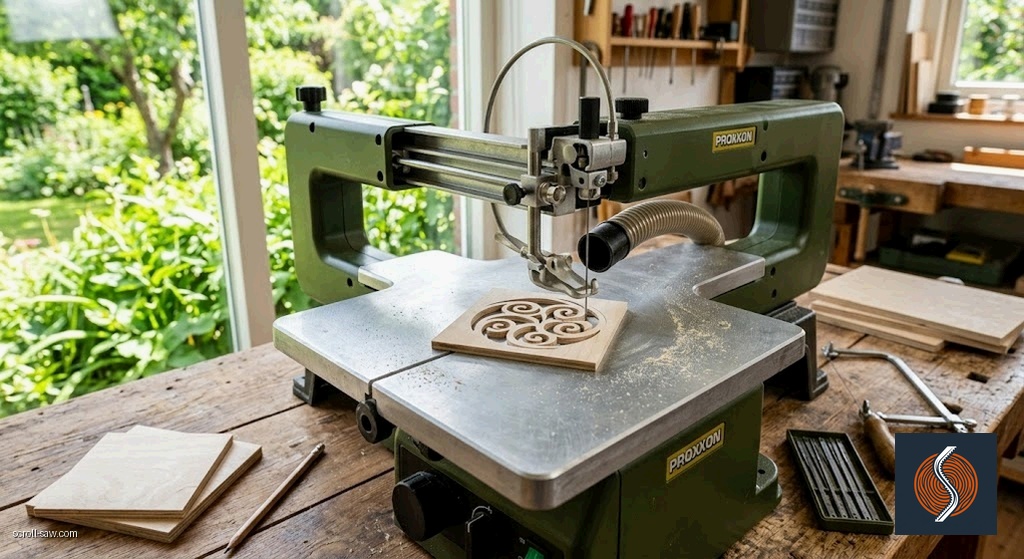
Proxxon 37088 Scroll Saw (DS 115 E): Setup, Limits, Service
Every few weeks someone posts a photo of a Proxxon 37088 next to a full-size Delta or DeWalt scroll saw and asks whether they made a mistake buying the little one. The answer is almost always the same, and it’s almost always the same photo: the Proxxon is on a desk, the Delta is on a stand, and the person is trying to cut a piece of 3/4-inch oak.
They didn’t buy the wrong saw. They bought the right saw for the wrong material.
What the 37088 actually is
The Proxxon 37088, sold as the DS 115/E in Proxxon’s own literature, is a variable-speed benchtop scroll saw built around a small, quiet motor and a short arm. It’s part of Proxxon’s Micromot line, which is aimed at model makers, jewelers, luthiers, and anyone else whose work is measured in millimeters rather than feet. It uses pin-end or plain-end scroll saw blades depending on the holder configuration, and it accepts jeweler’s saw blades that a full-size scroll saw simply can’t tension properly.
The usable capacity, throat, cutting height, table size, comes off your unit’s spec plate, not off a search result. Small differences in production revisions show up in the fine print.
The short answer
The 37088 is worth the bench space if your work is thin, small, and detailed: veneer inlay, model railroad structures, marquetry, jewelry, dollhouse trim, thin brass sheet. It is not worth the bench space if you want to cut cabinet-scale hardwood, thick plywood, or anything that would strain a full-size 16- to 20-inch saw. Its arm is short, its motor is small, and the geometry that makes it accurate for fine work is what limits it on stock over about half an inch of hardwood.
Buy it for what it is. Don’t buy it hoping it will become something else.
Setup that matters
On a saw this small, sloppy setup shows in every cut. A full-size saw forgives a little; the 37088 doesn’t.
-
Bolt it down. The base has mounting holes. Use them. A scroll saw skidding across a benchtop at 1500 SPM is worse on this little machine than on a heavier one because there’s less mass fighting the vibration.
-
Square the table with a small engineer’s square, not by eye and not by the scale. The tilt gauge on any scroll saw is a starting point, not a measurement.
-
Match the blade to the work. A jeweler’s saw blade for brass and thin veneer. A 2/0 or 3/0 for tight-radius fretwork. A 5 or 7 for hardwood up to about 12 mm. The saw will run a coarser blade, but the geometry doesn’t have the throw to feed one aggressively.
-
Tension by feel and sound. Pluck the blade with a fingernail. A well-tensioned scroll blade rings; a slack one thuds. On the Proxxon, over-tensioning tears out lugs on cheaper pin-end blades.
Where the saw stops
These are the real limits, not the marketing sheet’s:
-
Stock over about 15 mm of hardwood overheats the motor if you feed too fast. It can be done, but the cut wanders and the blade dulls quickly.
-
Long straight cuts are not what this arm is designed for. Use a bandsaw or a track saw for those.
-
Tight interior cuts in stock over 10 mm are physically possible but slow, because the short stroke doesn’t clear chips well from a deep kerf.
-
Heavy vibration creeps in when the saw is unbolted or set on a wobbly bench. This is not a defect. It is a small machine that needs its base secured.
Understanding these limits before you buy prevents the disappointment that puts these saws on classifieds three months in.
Service and maintenance
Proxxon builds this line with more European service-mindedness than most benchtop tools in its price range. Parts are available, the exploded diagrams are clear, and the arm assembly comes apart without special tools.
Routine care that keeps a 37088 accurate:
-
Blow out sawdust from the arm hinges after each session. A puff of compressed air is enough.
-
Check the blade holders for pin wear every couple of months of regular use. Pin-end blade holders eventually get sloppy where the pin seats.
-
Inspect the drive cam and its bushing yearly if you use the saw hard. Proxxon publishes the wear specs in the service documentation.
-
Keep the table clean. A scroll saw table with pitch and resin buildup drags the workpiece and makes fine feed impossible.
If the motor develops a buzz that doesn’t go away with the blade removed, that’s brushes wearing or a bearing starting to go. Both are user-serviceable on this class of tool.
Comparison to full-size scroll saws
A short honest comparison saves buying regret:
Against a full-size 16-inch scroll saw (Dewalt DW788, Delta 40-694, Hegner Multimax), the Proxxon 37088 is quieter, smaller, and vastly better at very fine work in thin stock. It’s worse at everything else. You cannot cut a thick puzzle blank on a Proxxon without hating your life. You cannot cut jeweler’s-blade-thick brass on a Hegner without breaking blades.
Against a jeweler’s saw frame (hand-powered), the Proxxon is faster and more consistent but less delicate. A hand frame in trained hands beats the Proxxon on the tightest jewelry work. The Proxxon beats a hand frame on productivity for any small run.
Against the Proxxon DS 230/E (a slightly larger stablemate), the 37088 is smaller, quieter, and cheaper, but the 230 handles slightly thicker stock and a wider workpiece.
Who should skip this saw
If your projects are primarily 3/4-inch pine or plywood, if you want to cut Intarsia-scale hardwood, or if you need a saw for occasional home shop work across mixed materials, look at a 16- or 20-inch scroll saw instead. The 37088 will feel like a toy in that context, and it isn’t a toy, it’s just a specialist. Buying a specialist for general work is the classic tool-buying mistake.
Who should buy it
Model makers, luthiers cutting bindings and purfling, jewelers cutting saw-pierced sheet, marquetry workers, and anyone whose bench sees more veneer than lumber. In that world, the 37088 is one of the quietest, most accurate benchtop machines you can put on a bench. It rewards patience and light hands.
FAQ
Is the Proxxon 37088 the same as the DS 115/E? Yes. 37088 is the SKU used in North American Proxxon distribution. The DS 115/E is the same saw under Proxxon’s European model naming.
Can it cut metal? Yes, thin sheet metal, brass, aluminum, and copper up to about 2 mm, with the right blade and slow feed. Not steel plate.
Will it accept plain-end (jeweler’s) blades? With the appropriate blade holder configuration, yes. Confirm your unit’s holder before ordering pinless blades.
What’s the maximum thickness for hardwood? Realistically, about 12 to 15 mm of hardwood before feed rate drops to a crawl. The saw can technically cut thicker, but it isn’t the tool for it.
Is Proxxon service in North America any good? Proxxon USA has a dedicated service network, and parts availability for the Micromot line is generally good. It is not overnight-shipping fast, but requested parts do arrive.
Does it vibrate on a benchtop? Unbolted, yes. Bolted down, no more than any other benchtop scroll saw of comparable weight.
How loud is it? Quieter than a Dewalt DW788 at the same SPM. Not silent. You can hold a normal conversation next to it, which is not true of every scroll saw on the market.
References
-
Proxxon GmbH product literature (proxxon.com) — official DS 115/E specifications, service diagrams, and parts lists.
-
Proxxon USA support (prox-tech.com) — North American service, replacement parts, and warranty documentation.
-
Fine Woodworking scroll saw reviews (finewoodworking.com) — comparative testing across the benchtop scroll saw category.
-
Scroll Saw Woodworking & Crafts magazine (scrollsawer.com) — pattern work and machine setup guidance for fine-detail scroll cutting.


