
RBI Hawk 214 Scroll Saw: Specs, Blades, and Parts Support
RBI Hawk 214 Scroll Saw: Specs, Blades, and Parts Support
The RBI Hawk 214 shows up in shops belonging to people who bought it new twenty years ago and never had a reason to replace it. That is a genuine compliment to the saw and a warning about the buying market: anyone selling one is either upgrading, downsizing, or handling an estate. The 214 doesn’t get sold because it stopped working.
What the 214 is
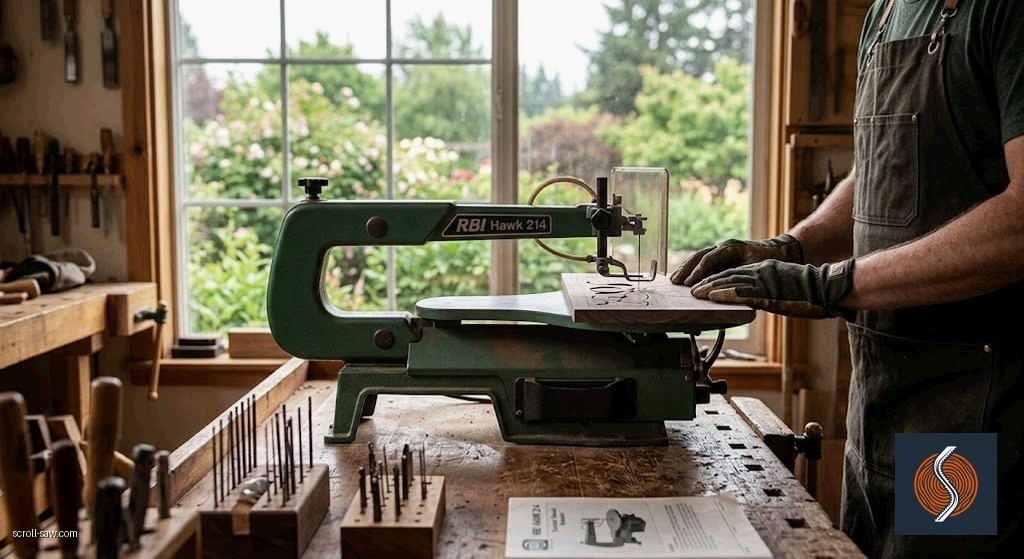
The Hawk 214 is a 14-inch parallel-arm variable-speed scroll saw from RBI Hawk. It sits below the 220VS and 226VS in throat size and slightly below in mass. Same American manufacturing philosophy as its bigger siblings: cast-and-steel construction, quiet motor, plain-end blade holders, upper-arm dust blower. Sold to hobbyists and pattern-makers who wanted the Hawk build quality in a smaller footprint.
The short answer
The 214 is a serious scroll saw in a compact throat class. It cuts cleaner than any modern benchtop scroll saw at the same throat size, holds accuracy longer, and vibrates less. Its two ownership catches are parts support (narrower than it used to be) and the fact that a clean used 214 asks strong money because owners know what they have.
Specifications, at the level that matters
Because the Hawk line saw multiple production runs, don’t rely on old spec sheets or forum quotes for exact numbers. Verify against your unit’s data plate:
-
Throat depth (from blade to arm column)
-
Cutting height at 90 degrees
-
Cutting height at 45 degrees (with table tilt)
-
Table size and material
-
Stroke length
-
Variable-speed range in SPM
-
Motor rating in amps and horsepower
-
Weight
What you’re getting in general terms: a 14-inch throat class scroll saw that outperforms benchtop machines at the same throat size, at the cost of weight and price.
Blade system
The Hawk 214 uses plain-end (pinless) scroll blades held in RBI’s own clamps. That’s a feature, not a limit, for detail work. Plain-end blades come in finer sizes than pin-end and cut tighter radii.
Practical notes:
-
Standard scroll-saw blade sizing applies: 2/0 through 12 depending on stock and detail.
-
Olson, Flying Dutchman, Pegas, and other quality plain-end blades all fit RBI holders.
-
Loading requires small hex keys or thumb-screws depending on your unit’s revision. Confirm before ordering aftermarket quick-clamp accessories.
-
Tension by feel and sound. Pluck the blade; a healthy tension rings.
The 214’s blade holders, like those on the bigger Hawk models, are one of the wear items most commonly ordered on used units.
Parts support today
The practical reality: RBI Hawk parts availability has narrowed as the brand has changed hands, but it hasn’t disappeared. Common wear items (blade holders, bushings, belts, brushes) are still findable through the current brand channel, specialty scroll saw dealers with legacy RBI stock, eReplacementParts, and eBay parts sellers pulling from donor machines.
Where it gets harder:
-
Specific arm castings for older production runs
-
Motor assemblies for the earliest units
-
Speed controller boards for certain revisions
Before buying a used 214, do a rough parts scan for anything you might need. If the saw is otherwise clean, common wear items are not the risk. If it has a specific ailment already, verify the fix is sourceable before committing.
Setup that separates a good cut from a mediocre one
-
Solid stand or heavy bench. The 214 is lighter than the 220 and 226 but still wants a stable base.
-
Table squared to blade with an engineer’s square, not by scale.
-
Blade tensioned by ear. Ringing note, not thud.
-
Blade sized for material. Fine blade for fine work, coarser for hardwood.
-
Feed rate matched to material and blade. The 214 has enough torque to bulldoze, which is a bad habit to develop.
Any complaint about the saw’s cut quality traces back to one of these five points nine times out of ten.
Where the 214 wins
-
Precision in fine work. Cast-and-steel construction gives it an accuracy edge over benchtop machines at similar throat sizes.
-
Longevity. These saws routinely outlast their owners with basic maintenance.
-
Quiet operation. Not silent, but quieter than most modern scroll saws at comparable SPM.
-
Compact footprint for the class. Full-shop build quality without a full-shop machine’s floor space.
Where it loses
-
Throat depth. 14 inches is 14 inches. If your projects need 20-plus, buy a 220 or 226.
-
Modern conveniences. No electronic soft-start on most units, no tool-free blade change on many revisions.
-
Parts support is narrower than for a Dewalt or a current Rikon.
-
Used market prices reflect the reputation; bargains exist but aren’t common.
Comparison notes
Against the RBI 220VS, the 214 gives up throat depth and some mass; the 220 gives up compactness. If your work fits within 14 inches of throat, the 214 is the easier saw to fit in a shop. If not, the 220 is the answer.
Against a Dewalt DW788, the 214 is heavier, quieter under load, and more precise on fine work. The Dewalt is easier to find parts for and faster on blade changes with the tool-free upper clamp.
Against a modern benchtop (Wen, Rikon 10-600, Rockwell), the 214 is a different class. It should be, given the price gap.
FAQ
Is the RBI Hawk 214 still in production? Production has shifted with brand ownership. Check with the current Hawk brand owner for new-machine availability. Most 214 units on the market today are used.
What blades fit? Standard 5-inch plain-end scroll blades. Olson, Flying Dutchman, Pegas, and Proxxon plain-end blades all work.
Can I retrofit pin-end blade holders? Some retrofit kits have existed. Verify current availability before assuming; the plain-end holder is the primary and better option for detail work.
Where’s the model plate? On the machine base, usually rear or underside. Silver adhesive label with model, serial, and electrical data.
How much does a clean used 214 cost? Strong prices, given the reputation. Verify condition to justify the ask; a genuinely clean 214 is worth its price. A neglected one isn’t.
How often does it need service? With regular hobby use, inspect wear parts (bushings, blade holders, belt) yearly. Full service intervals are longer than any benchtop scroll saw.
Is the motor user-serviceable? Brushes and bearings, yes. Full motor replacement depends on parts availability for your specific unit.
References
-
RBI Hawk Tools — current brand owner service and parts channel.
-
eReplacementParts (ereplacementparts.com) — exploded diagrams and cross-reference for RBI Hawk scroll saws.
-
Fine Woodworking (finewoodworking.com) — scroll saw category reviews and used-tool buying guidance.
-
Scroll Saw Woodworking & Crafts (scrollsawer.com) — owner community and pattern work resources for advanced scroll saws.


