
Is the RBI Hawk 220-3 Scroll Saw Right for Your Work?
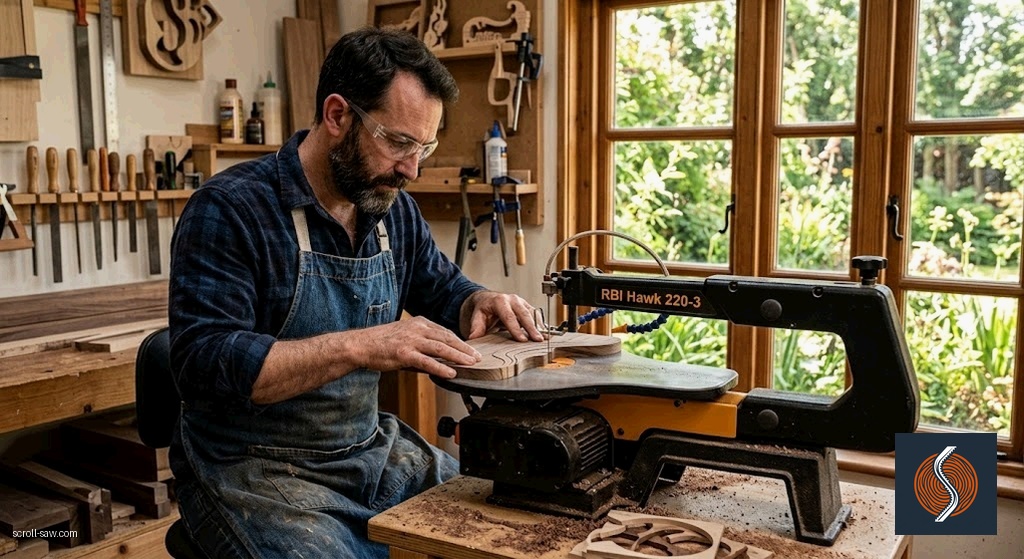
Is the RBI Hawk 220-3 Scroll Saw Right for Your Work?
Every few weeks someone asks a scroll saw group whether the Hawk 220-3 is worth chasing. The answer they get depends on which Hawk owners happen to reply that day. That is a signal, not a problem: the 220-3 is the right saw for a specific kind of scroll sawyer, and the wrong saw for someone else. Here is the test that tells you which one you are before you spend the money.
What the 220-3 is
The RBI Hawk 220-3 is a variable-speed parallel-arm scroll saw in the 20-inch throat class, one of several production revisions in the Hawk 220 family. American manufacturing, cast-and-steel construction, quiet motor, plain-end blade holders, upper-arm dust blower. Between production years and internal revisions, small details shift; the 220-3 designation identifies a specific configuration.
The short answer
Buy a Hawk 220-3 if your work is precision-oriented, if you value a saw that lasts thirty years, and if you have or can build a rock-solid stand for it. Skip it if you want tool-free blade changes, modern electronic soft-start, and easy parts availability at any big-box retailer. This is a serious hobby-to-semi-professional scroll saw with a long service life, not a convenience-first machine.
The test
Answer five questions honestly.
Do you already know what a scroll saw feels like when it is well-tuned? The Hawk rewards a user who can hear when tension is right and see when the table is not square. Beginners can learn on it, but they will learn faster on a more forgiving saw and switch up later.
Do you have a stable stand or heavy bench for it? The 220-3 is not a floating benchtop saw. It needs a base that does not move. If your shop is a folding table in a spare bedroom, the saw will be frustrated by its environment.
Do you cut precise, detailed work? Marquetry, fret work, intarsia, pattern-based cutting. The Hawk’s whole appeal is precision. If your work is straight cuts and roughing, buy a bandsaw or a benchtop scroll saw and save the money.
Are you comfortable ordering parts from a narrower supply channel? Hawk parts are available but not as easy to find as Dewalt parts. If you cannot tolerate a two-week wait for a specific bushing, the Hawk is not the platform for you.
Do you plan to keep the saw for the long haul? The Hawk pays back its price over decades of reliable service. It is a bad value if you are going to sell it in two years.
Four or more yes answers means the 220-3 fits. Two or fewer yes answers means look at a modern benchtop instead.
Where it wins
-
Precision in fine work, especially with quality plain-end blades.
-
Longevity. Basic maintenance keeps these saws accurate for decades.
-
Quiet operation. Not silent, but easier on ears and neighbors than most scroll saws at the same throat size.
-
Mass. The saw is stable under load, which shows up in cut quality on longer detailed runs.
Where it loses
-
Blade change speed. Not slow, but not tool-free-quick-clamp fast.
-
Modern conveniences. No electronic soft-start on most units; the saw reaches speed quickly.
-
Parts availability. Narrower than for a mainstream brand.
-
Price. Both new (when available) and clean used units command strong money.
Honest drawbacks
Owners who love the saw will still admit two specific irritations. First, the blade holder set screws and their retainer designs on some 220-3 revisions strip if over-tightened; light hand pressure is enough. Second, the dust blower routing on this generation is functional but not spectacular; a small auxiliary blower or a shop-vac tap at the throat often gets added.
Neither is a dealbreaker for the intended buyer. Both are dealbreakers for someone hoping the saw is a modern convenience-first machine.
Comparison points
Against a Dewalt DW788, the Hawk is heavier, quieter under load, more precise on fine work, and slower to blade-change. The Dewalt is easier to service today and cheaper to buy used.
Against a Hegner Multimax, the two are closer in character than any other pair on the market. Both are serious long-life scroll saws. Hegner parts support is currently better; Hawk build quality is comparable. Buyer preference and price at the moment usually decide.
Against a modern benchtop scroll saw (Rikon 10-600, Wen 3921), the Hawk is a completely different class. Not a comparison; not the same buyer.
Who should skip it
Beginners who want to learn on a forgiving machine, occasional users who cut a few times a year, anyone who mostly needs straight roughing cuts, and anyone who genuinely wants a modern quick-change blade system as a daily convenience.
Who should buy it
Committed scroll sawyers, pattern workers, marquetry artists, and anyone building a shop for the long haul who wants a serious saw and can accept the tradeoffs.
FAQ
What does the -3 in 220-3 designate? A specific production revision of the Hawk 220. Details of the revision (blade holder style, arm assembly, motor) vary by production year. Verify the exact configuration against your unit’s plate and exploded diagram.
Are 220-3 parts interchangeable with the 220VS? Some are, some are not. Blade holders, belts, and bushings vary between revisions. Verify against the diagram before ordering.
Is the 220-3 still made? Production has shifted with brand ownership over the years. Most 220-3 units on the market today are used.
How does it compare to the 226? Same family, larger throat on the 226. If you need the extra capacity, the 226 is the answer.
Where is the serial plate? On the base, silver adhesive label with model, serial, electrical ratings.
How much should I pay for a clean used one? Strong prices reflect the reputation. A clean 220-3 with the original stand justifies its ask.
Is a beginner going to be happy with this saw? A committed beginner willing to learn, yes. A casual beginner, probably not; the saw rewards patience and punishes shortcuts.
References
-
RBI Hawk Tools — current brand owner service and parts channel.
-
eReplacementParts (ereplacementparts.com) — exploded diagrams and cross-reference for RBI Hawk scroll saws.
-
Fine Woodworking (finewoodworking.com) — scroll saw category reviews and long-form saw comparisons.
-
Scroll Saw Woodworking & Crafts (scrollsawer.com) — owner community and pattern work resources.


