
A Closer Look at the RBI Hawk 220 Scroll Saw
A Closer Look at the RBI Hawk 220 Scroll Saw
Sit down at a well-set-up Hawk 220 and the first thing you notice is what’s missing. No high-pitched whine. No table wobble under hand pressure. No belt slipping on start-up. The saw just runs. On paper, spec sheets don’t capture that. In a shop, it’s the whole story.
That’s why the Hawk 220 still holds its own in a scroll saw world that has moved on to lighter benchtops and quick-change blade systems.
What it is
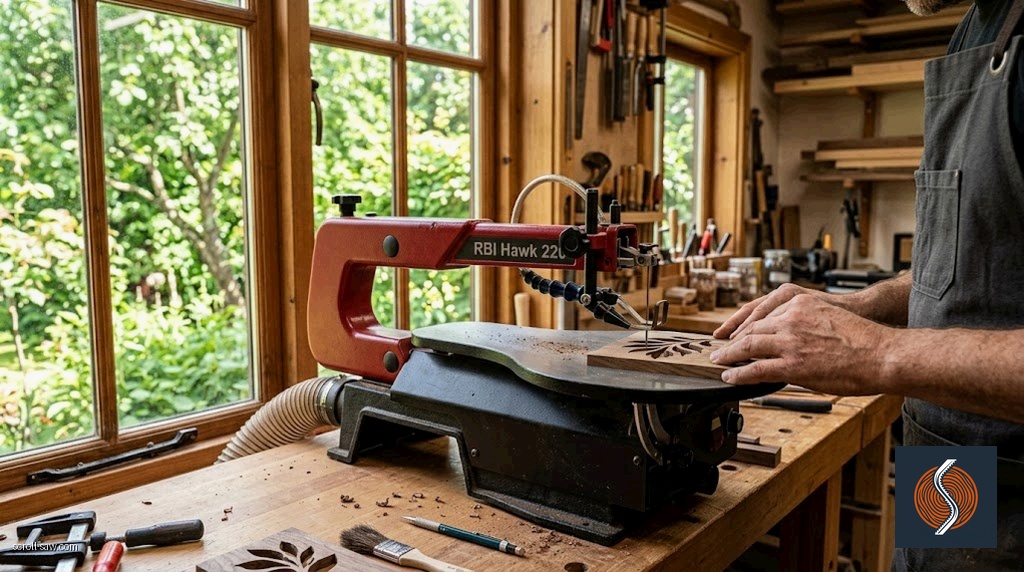
The RBI Hawk 220 is a 20-inch throat parallel-arm variable-speed scroll saw from RBI Industries and later RBI Hawk. American-built, cast-and-steel construction, quiet motor, plain-end blade holders, upper-arm dust blower. Sold new to serious hobbyists and pattern-makers from the 1980s through the 2000s in various revisions.
Specific throat, cutting height, stroke length, table dimensions, and motor rating vary by production year and revision. The data plate on your unit is the authoritative source.
The short answer
The Hawk 220 aged well where it counts (mechanical durability, cut quality, quiet operation) and less well where modern convenience has moved forward (tool-free blade changes, electronic soft-start, easy parts availability). If the character of the saw fits your work, a clean 220 is one of the better used scroll saws you can put in a shop. If you value the modern conveniences, buy a current tool.
Where it holds up
Cut quality. A well-tuned Hawk 220 with a matched blade cuts as cleanly as anything at its throat size, new or old. The parallel arm doesn’t twist the blade at the end of the stroke, which is what leaves burn-free, straight-edge cuts on hardwood.
Vibration. Cast iron and steel weigh what they weigh, and that weight kills vibration under load. Compared to a benchtop scroll saw of any brand, the Hawk 220 is a different world of stability.
Motor character. Quiet and torquey. The saw doesn’t sound like it’s working when it’s cutting hard.
Longevity. These saws routinely have 20 to 40 years on them and still cut clean. Basic maintenance (bushings, blade holders, brushes, belts) is user-serviceable.
Where it shows its age
Blade change. Not slow, exactly, but not tool-free-quick either. Depending on your revision, you’re using a small hex key or thumb-screws for the upper and lower clamps. Fine once you’re used to it; annoying if you’re coming from a Dewalt DW788.
No electronic soft-start. The saw comes up to speed quickly. Some workflows prefer this; some don’t. It is neither a bug nor a feature, depending on the user.
Parts channel. Hawk parts are still findable, but through a narrower supply chain than mainstream brands. A specific bushing can be a two-week wait instead of a next-day Amazon order.
Weight. The reason the saw is stable is the reason it’s hard to move. Not a shop-relocation friendly tool.
Dust blower. Functional, not exceptional. Most experienced owners add a small auxiliary blower or a shop-vac tap for better visibility in the cut.
Setup that unlocks the character
A neglected Hawk 220 cuts poorly. A well-set-up one is a joy. The difference isn’t magic:
-
Solid stand or heavy bench, not a wobbly surface.
-
Table squared with an engineer’s square, not by scale.
-
Blade tensioned by ear, ringing note, not thud.
-
Blade sized for the material.
-
Feed rate matched to material and blade, not to the operator’s impatience.
Any complaint about the 220’s cut quality traces back to one of these five almost every time.
Buying advice for a used 220
Clean, well-maintained examples exist. So do neglected ones. The five-minute walkthrough separates them: arm play, blade tension holding, motor run-up, stand rigidity, cord and switch. Anything that fails is fixable, but stacked repairs on a saw of this age don’t always math out. See our companion piece on inspection checklists before committing.
One quiet variable: whether the original RBI stand is included. It’s not just about looks. A stable stand under a Hawk 220 is part of why the saw cuts the way it does. If the stand is missing, budget for a solid replacement.
Comparison notes
Against a Dewalt DW788, the Hawk is heavier, quieter under load, more precise on fine work, and slower to blade-change. The Dewalt is cheaper used and easier to service today.
Against a Hegner Multimax, closer than most people expect. Both are serious long-life scroll saws. The Hegner has better modern parts support; the Hawk is often cheaper on the used market.
Against a Rikon 10-600, an Excalibur, or a Wen 3921, not a fair comparison. Different classes of machine.
Who should buy one today
Serious scroll sawyers building a shop for the long haul, marquetry artists, pattern-makers, and anyone who values a saw that cuts cleaner than its price suggests. Also, anyone who was raised on Hawks in a mentor’s shop and wants what they remember.
Who should skip it
Beginners looking for their first scroll saw. Anyone who wants tool-free blade changes as a daily convenience. Anyone who can’t tolerate the occasional two-week parts wait.
FAQ
What year did the Hawk 220 first ship? The 220 line ran across multiple revisions from the 1980s through the 2000s. Specific configurations changed within that window.
Are 220 parts still available? Common wear parts (blade holders, bushings, belts, brushes) yes, through the current Hawk brand channel, eReplacementParts, specialty scroll saw dealers, and eBay. Less common assemblies are hit-or-miss.
How does it compare to the 220VS? VS designates variable speed. Non-VS 220 units may be single-speed or two-speed depending on revision. Verify against your unit’s data plate.
Where’s the model plate? Base of the machine, silver adhesive label. Model, serial, electrical ratings.
Can I run pin-end blades? Plain-end holders are the primary configuration. Retrofit is possible on some revisions but not the default option.
How much does a clean used 220 cost? Strong prices, reflecting the reputation. A clean 220 with original stand is worth its ask.
Is it heavy to move? Yes. Plan for two people or a proper lifting strategy.
References
-
RBI Hawk Tools — current brand owner service and parts channel.
-
eReplacementParts (ereplacementparts.com) — exploded diagrams and cross-reference for RBI scroll saws.
-
Fine Woodworking (finewoodworking.com) — scroll saw category reviews and long-form comparisons.
-
Scroll Saw Woodworking & Crafts (scrollsawer.com) — owner community and pattern work resources.


