
RBI Hawk 226VS Scroll Saw: Setup, Limits, and Service
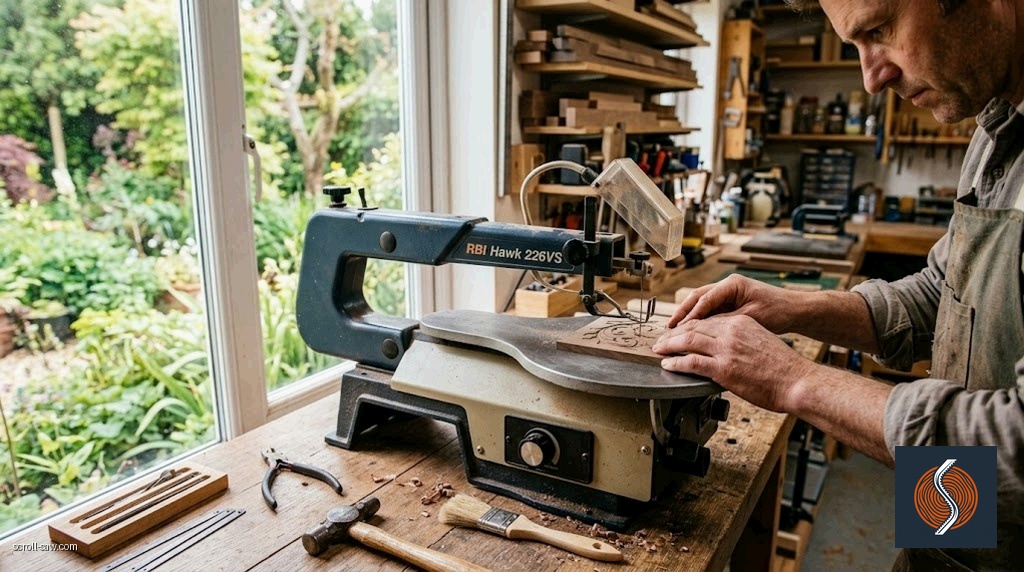
RBI Hawk 226VS Scroll Saw: Setup, Limits, and Service
On a well-set-up 226VS, you can cut a panel with more throat clearance than any comparable scroll saw at the same price point. That single fact is why 226VS owners tend to keep the saw and why the used market doesn’t flood with them. If the 226 fits your work, nothing at the same price beats it.
Getting it to that point takes the same handful of setup and service habits that separate a happy Hawk owner from a frustrated one on any model in the line.
What the 226VS is
The RBI Hawk 226VS is the 26-inch throat variable-speed parallel-arm scroll saw from RBI Hawk. Cast-and-steel construction, quiet motor, upper-arm dust blower, plain-end blade holders. Positioned at serious hobbyists and pattern-makers who need throat clearance beyond what a 20-inch saw provides.
The short answer
The 226VS rewards a rigid stand, a squared table, and correctly tensioned blades matched to material. Its limits are physical, not electronic: you can outrun a scroll saw of any size by feeding too fast in the wrong blade, and the 226 is no exception. Service is user-friendly if you’re comfortable with hand tools; parts availability has narrowed but hasn’t disappeared.
Setup for the 226 specifically
Most of the setup story is the same across the Hawk line. Two things matter more on the 226 than on the smaller Hawks because of the saw’s mass and its longer arm:
Stand rigidity. A 26-inch throat scroll saw is heavier and taller than a 20-inch. Small stand flex that a smaller saw might tolerate becomes visible cut wander on the 226. Original RBI stand is fine. A shop-built base needs to be genuinely rigid, not just heavy.
Arm alignment check. Longer arm means small alignment errors show up more clearly at the blade. On initial setup or after any service, verify the upper arm’s alignment against the lower arm. Any noticeable off-plumb means bushings, pivots, or a bent arm; investigate before cutting anything you care about.
Everything else is standard: square the table with an engineer’s square, tension the blade by ear, match blade to material.
Where the 226 stops
The 226 is a serious hobby-to-semi-professional scroll saw, not a factory production machine. Practical limits:
-
Continuous heavy-duty use over multiple hours will heat the motor eventually. Not a design flaw; the motor is sized for scroll saw work, not for treating the saw like a stationary sander.
-
Straight cuts in thick stock are still not what a scroll saw does. Use a bandsaw.
-
Stack cuts beyond the cutting height at 90 degrees. Verify your unit’s spec plate.
-
Precision work at the extreme fine end (jeweler’s-scale piercing in metal) is possible with the right blade but the saw’s mass and arm length aren’t optimized for that scale. The Proxxon DS 115 E is the better tool there.
Service
As with the rest of the Hawk line, the 226 is a mechanically simple machine.
Routine care:
-
Compressed air on the arm hinges after each session.
-
Yearly inspection of pivot bushings.
-
Blade holder wear checks every few months of regular use.
-
Belt inspection at each blade holder service.
-
Brushes as needed.
Parts sources:
-
Current Hawk brand channel (varies with brand ownership; check current status)
-
eReplacementParts for exploded diagrams and cross-referenced items
-
Specialty scroll saw dealers with legacy RBI stock
-
eBay for parts pulled from donor machines
Cross-reference every part against your unit’s exploded diagram before ordering. The 226 saw multiple production revisions, and blade holders, belts, and pulleys can differ between them.
Common issues on used 226 units
Most 226s on the used market have miles on them. The five common complaints and their causes:
-
Wobbly arm. Pivot bushings worn.
-
Won’t hold tension. Blade holders or tension mechanism worn.
-
Cuts wander. Table not square, blade too small for the stock, or feed rate too aggressive.
-
Vibrates more than a friend’s 220. Stand rigidity or bushings.
-
Motor heats up on long runs. Cooling louvers packed with dust.
All five are fixable at bench level with common hand tools. Combined repairs on a neglected 226 can add up, so inspect before committing on a used purchase.
Comparison
Against the 220VS, the 226 gives you six extra inches of throat at a cost of more mass, more shop footprint, and slightly more setup sensitivity. If your work regularly runs into the throat of a 20-inch saw, the 226 is the answer.
Against a Dewalt DW788, the Hawk is heavier, quieter under load, and more precise; the Dewalt is cheaper used and easier to service today.
Against a Hegner Multimax, close in character; both are serious long-life scroll saws. Hegner has better current parts support. Hawk is often cheaper on the used market.
Who should buy it
Pattern-makers, marquetry artists working at larger scale, and shops where the extra throat is used regularly enough to earn its space.
Who should skip it
Anyone whose work fits within a 14- or 20-inch throat comfortably. The extra six inches is a real feature; unused, it’s just more shop footprint.
FAQ
How is the 226VS different from the 226-3 or similar designations? Production revisions within the 226 family. Details of blade holders, arm assemblies, and control boards can vary. Verify against your unit’s exploded diagram.
Where’s the model plate? On the machine base, silver adhesive label with model, serial, and electrical ratings.
Are 220 parts interchangeable with 226? Some are, some aren’t. Blades and generic hardware yes; arm assemblies, holders, and belts often no. Verify per part.
Is a 26-inch throat overkill for hobby work? Depends on the hobby. For pattern-work portraits, panel-sized fret work, or larger marquetry, no. For typical ornament and small-project scrollwork, yes.
How much shop space does it need? More than a 20-inch. Plan for the full footprint of the saw, the stand, and comfortable clearance for a panel-sized workpiece rotating around the blade.
How long will one last? With basic maintenance, decades. This class of scroll saw routinely outlasts its owner’s interest in the hobby.
Are Hawk 226 stands hard to find used? Harder than the saws themselves, because owners kept the stands even when they sold the machines. Budget accordingly.
References
-
RBI Hawk Tools — current brand owner service and parts channel.
-
eReplacementParts (ereplacementparts.com) — exploded diagrams and cross-reference for RBI scroll saws.
-
Fine Woodworking (finewoodworking.com) — scroll saw comparisons and setup guides.
-
Scroll Saw Woodworking & Crafts (scrollsawer.com) — owner community, patterns, and technique for advanced scroll work.


