
RBI Hawk Scroll Saw Model 220VS: Buy or Repair Checklist
RBI Hawk Scroll Saw Model 220VS: Buy or Repair Checklist
The scroll saw sits on a driveway or a shop floor with a hand-written price on a Post-it. The seller says it belonged to their father, or a friend, or a shop that closed. They ran it once and it worked. You need better information than that. Not because the seller is lying, but because a scroll saw that ran fine in a shop last spring might have three quiet problems today, and the seller has no reason to have caught them.
Here is the walkthrough that catches those problems in ten minutes.
What you’re looking at
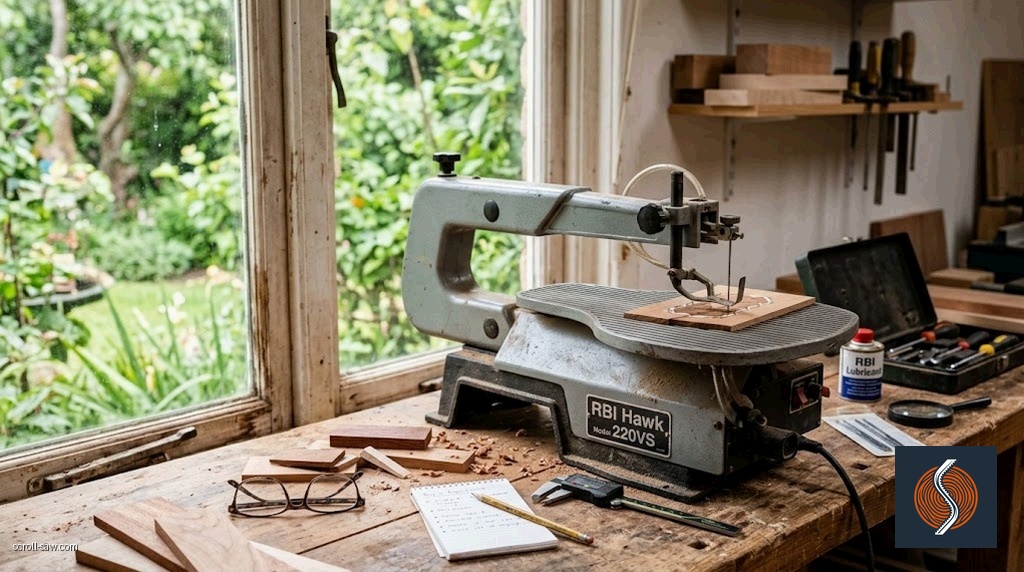
The RBI Hawk 220VS is the variable-speed 20-inch parallel-arm scroll saw from RBI Hawk. Cast-and-steel construction, quiet motor, plain-end blade holders, upper-arm dust blower. Not a benchtop toy; a serious hobby-to-semi-pro saw with a decades-long service life when maintained.
The short answer
Before money changes hands, verify five things in this order: arm play, blade tension holding, motor smoothness, stand rigidity, cord and switch. Any single failure is fixable. Multiple failures on the same machine stack up into a repair project that rarely pencils out at a bargain price.
The walkthrough
Arm play. Machine unplugged. Grab the upper arm near the blade holder. Try to rock it side to side. Any perceptible slop means worn pivot bushings. Bushings are ten to twenty dollars and an hour of bench time; slop cuts wandering lines every day it goes uncorrected.
Tension hold. Install a blade, tension it, walk around the saw for a minute, come back and check tension. If it dropped noticeably, either the tension mechanism is worn or the blade holders are wallowed. Both fixable; both worth counting in the price.
Motor. Plug in, switch on at low speed. Listen for the first three seconds. Smooth rising hum is good. Grinding, ticking, or hesitation is not. Move the speed dial through the full range. Uneven noise at any point means bearings or an eccentric on its way out.
Stand. Push the stand. Any perceptible wobble ruins fine cuts and no amount of adjustment on the machine will fix it. Original RBI stand is best; a solid shop-built base is fine; anything with visible flex is a hidden second purchase.
Cord and switch. Look where the cord enters the housing. Cracked insulation there means the strain relief failed and the cord has been flexing. Look at the switch face for browning around the throw. Both electrical repairs are cheap; both are worth pricing in.
What the walkthrough tells you
All five pass: negotiate on cosmetics only. This is a good scroll saw and you know it.
One fails: fix cost is straightforward; either negotiate that off the price or plan to do it yourself.
Two or three fail: think hard about whether the total repair cost, parts plus your time, keeps the saw in bargain territory. Sometimes yes, often no.
Four or five fail: walk. There are cleaner examples out there. Not every deal is meant to close.
Repair economics on the 220VS
Set the repair ceiling before you start. A clean 220VS on the used market commands strong prices. Your total repair budget, parts and your labor at whatever you value your time, should stay under about half of a clean unit’s asking price. Otherwise the math argues for selling the broken one for parts and buying a working one.
Repairs that consistently pencil out:
-
Bushings and blade holders
-
Belt and pulley wear items
-
Brushes and, with care, motor bearings
-
Cord and switch
Repairs that usually don’t:
-
Arm castings, if available at all
-
Major motor damage where a specific replacement is scarce
-
Anything that requires a rare part on backorder for weeks
Where the parts come from
RBI Hawk parts have moved with brand ownership. Practical today: the current Hawk brand channel, eReplacementParts for exploded diagrams and cross-referenced items, specialty scroll saw dealers with legacy stock, and eBay for donor-machine parts. Verify against your unit’s exploded diagram before ordering; the 220VS saw multiple revisions.
Common problems and fixes
Blade won’t hold tension. Worn blade holders first, tension mechanism second. Order in that order.
Saw wanders on straight cuts. Blade tension and table square. Fix those before blaming the saw.
Vibration is worse than a friend’s Hawk. Stand first, bushings second, motor last.
Motor runs hot on long sessions. Dust in cooling louvers. Blow it out.
Speed dial hunts or feels notchy. Speed controller board or potentiometer. Both user-serviceable.
The invisible best test
Make a cut. If the seller lets you cut a piece of scrap, do it. Set the tension by feel, choose a blade sized to the material, and follow a line drawn in pencil. A well-tuned 220VS follows a curve without wandering off it. A worn one drifts. This test skips a lot of paranoia about small mechanical checks; the saw either cuts clean or it doesn’t.
FAQ
Is the Hawk 220VS the same as the RBI 220VS? Same machine, different brand era. RBI Industries became RBI Hawk with brand changes. Manuals and parts overlap significantly; verify against your unit’s data plate.
How much is a fair used price? Depends on condition and market. Clean examples with original stands hold their value. Neglected ones should reflect the repair work required.
Where is the model plate? On the machine base, silver adhesive label with model, serial, and electrical ratings.
How do I identify the production revision? Model and serial number on the plate, cross-referenced against the exploded diagrams for each revision. Blade holder style and switch type are usually the visible tells.
Are 220VS parts hard to find? Common wear parts, no. Specific arm castings and less-common assemblies, sometimes. Do a rough parts scan for what you might need before committing to a used purchase.
Can I run the saw without the original stand? Only on a heavy, rigid bench or shop-built base. A wobbly base ruins the saw’s biggest advantage, its cut quality.
Is a beginner safe with this saw? Yes, with the caveat that the saw rewards patience. Beginners who take their time learn well on a Hawk; beginners who rush hurt themselves on any scroll saw.
References
-
RBI Hawk Tools — current brand owner service and parts channel.
-
eReplacementParts (ereplacementparts.com) — exploded diagrams and cross-reference for RBI Hawk scroll saws.
-
Fine Woodworking (finewoodworking.com) — scroll saw category reviews and buying guides.
-
Scroll Saw Woodworking & Crafts (scrollsawer.com) — owner community and technique resources.


