
Is the RBI Model 220 Hawk Scroll Saw Right for Your Work?
Is the RBI Model 220 Hawk Scroll Saw Right for Your Work?
Ask five long-time scroll sawyers what saw a serious hobbyist should own and you will hear “a Hawk 220” from at least two of them. That is a lot of consensus in a category that usually generates arguments. It is also a warning: consensus recommendations are not personal recommendations, and the same saw that made someone’s decade of pattern-cutting easy could be the wrong tool for the kind of work you actually do.
Here is the test that separates the two.
What the Hawk 220 is
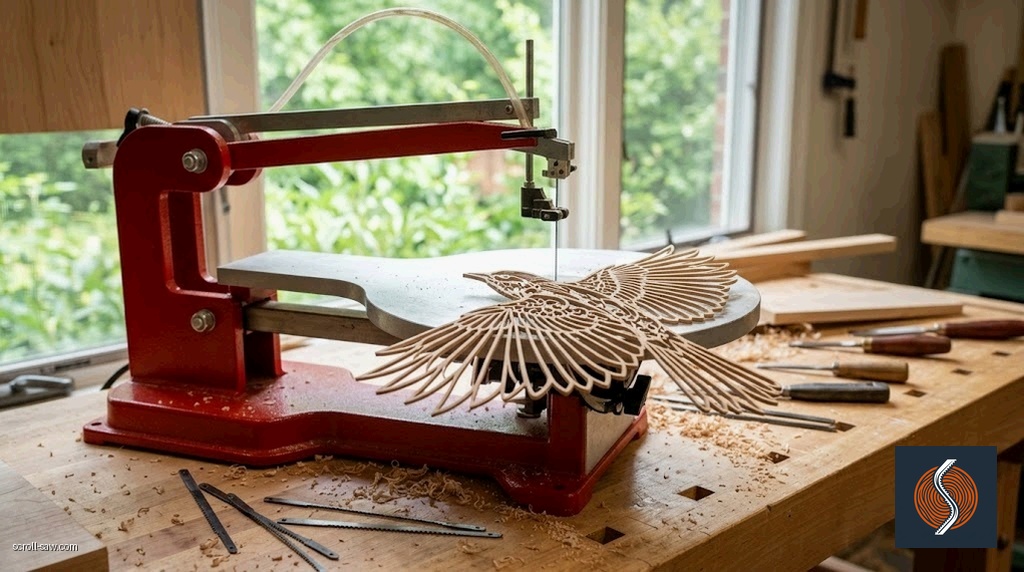
The RBI (later RBI Hawk) Model 220 is a 20-inch throat parallel-arm scroll saw with variable-speed control on the VS variants. American-built, cast-and-steel construction, quiet motor, plain-end blade holders, upper-arm dust blower. Sold to serious hobbyists, pattern-makers, and light-production scroll sawyers across multiple production revisions.
The short answer
Buy a Hawk 220 if your work is precision-oriented, if you value a long-service-life machine, and if you can provide it a solid stand and a shop that respects its weight. Skip it if you want modern convenience features, quick blade-change systems, or a saw that is casually beginner-forgiving. The Hawk is a serious tool; that is a compliment and a warning depending on the buyer.
The test
Answer six questions honestly.
How often will you cut? If the answer is weekly or more, the Hawk earns its price over the years. If the answer is a few times a year, a good benchtop scroll saw is a better fit for the money.
How detailed is your work? Fine fret work, marquetry, intarsia, pattern portraits, these are exactly what the Hawk is for. Rough straight cuts and general project work, less so.
Do you already know how a scroll saw should sound and feel when it is right? Experienced users get the most out of a Hawk. Total beginners can learn on it but often learn faster on a more forgiving benchtop first.
Do you have a rigid stand or a heavy bench? Not a nice-to-have. The Hawk’s cut quality lives on a stable base.
Are you comfortable with a narrower parts supply chain? Hawk parts are findable but not Amazon-Prime instantly available. Occasional waits are part of ownership.
Do you plan to keep the saw for years? The Hawk pays back its price over decades, not months. A short-term purchase is a bad value proposition.
Four or more yes answers on the Hawk-friendly side means the 220 fits your life. Two or fewer, look at benchtop options instead.
Where the Hawk 220 wins
-
Cut quality. Parallel arm, mass, and a stable stand combine to leave clean cuts on hardwood that lighter saws struggle to match.
-
Longevity. Basic maintenance keeps these saws accurate for decades.
-
Quiet operation. Not silent, but easier on ears and neighbors than most saws at comparable throat.
-
Reputation resale. If you buy a clean 220 and take care of it, you can sell it for close to what you paid.
Where the Hawk 220 loses
-
Blade change speed. Slower than tool-free quick-clamp systems.
-
No electronic soft-start on most units.
-
Weight. Not a saw you casually reposition in a shop.
-
Parts channel is narrower than for mainstream brands.
-
Used market prices reflect the reputation; the bargains exist but are not the majority.
Honest drawbacks worth naming
Even Hawk loyalists admit two specific frustrations. Blade holder set screws on some revisions strip if over-tightened, and the factory dust blower is functional but not spectacular. Both are minor and both are commonly worked around by experienced owners.
Comparison notes
Against a Dewalt DW788, the Hawk gives up blade-change speed and easy parts access; it gains cut quality and longevity.
Against a Hegner Multimax, close in character. Both are serious long-life scroll saws. Hegner has better current parts support; Hawk is often cheaper on the used market.
Against a modern benchtop (Wen, Rikon, Rockwell), a different class. Not a fair comparison; not the same buyer.
Who should skip it
Occasional users, first-time scroll saw buyers who want maximum forgiveness, and anyone whose shop can’t accommodate a serious stationary scroll saw with a rigid stand.
Who should buy it
Committed scroll sawyers, pattern workers, marquetry artists, and anyone building a shop for decades of work.
FAQ
Is the Hawk 220 still made? Production has shifted with brand ownership over the years. Most 220 units on the market today are used.
Does the 220 designation mean the same thing across all revisions? Same 20-inch throat class, but internal revisions (blade holders, speed control, motor) vary. Verify against your unit’s data plate.
Where’s the serial plate? On the machine base, silver adhesive label with model, serial, and electrical ratings.
Can I buy a new one today? Availability depends on current brand status. Check with the current Hawk channel.
Is a Hawk 220 harder to learn on than a Dewalt DW788? Slightly, because blade changes are less quick and the saw expects a well-set-up base. Not dramatically so.
Are Hawk 220 parts interchangeable across revisions? Some yes, some no. Verify against exploded diagrams before ordering.
How much shop space does it need? Allow the footprint of the saw plus stand, plus comfortable clearance for a workpiece rotating around the blade.
References
-
RBI Hawk Tools — current brand owner service and parts channel.
-
eReplacementParts (ereplacementparts.com) — exploded diagrams and cross-reference for RBI scroll saws.
-
Fine Woodworking (finewoodworking.com) — scroll saw category reviews and long-form comparisons.
-
Scroll Saw Woodworking & Crafts (scrollsawer.com) — owner community, patterns, and technique.


