
RBI Scroll Saw Model 220: Setup, Limits, and Service
RBI Scroll Saw Model 220: Setup, Limits, and Service
There is a specific kind of shop story that comes up whenever the RBI 220 gets discussed. Somebody’s father-in-law owned one. They inherited it. It sat in a garage for eight years. They plugged it in expecting to find rust and a stuck arm, and the saw ran perfectly on the first pull. That story is not unusual.
The 220 is a machine that wants to keep working. Meeting it halfway is most of ownership.
What the 220 is
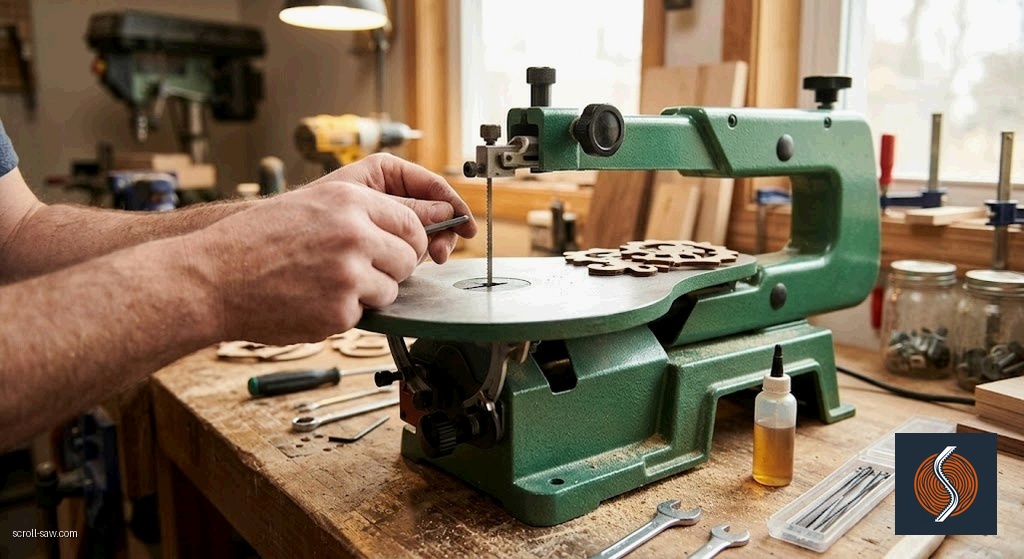
The RBI 220 is a 20-inch throat parallel-arm scroll saw from RBI Industries and later RBI Hawk. Cast-and-steel construction, quiet motor, plain-end blade holders, upper-arm dust blower. Available in fixed-speed, two-speed, and variable-speed configurations across production years.
The short answer
Setup for the 220 comes down to five things: a rigid stand, a squared table, correct blade tension, a blade sized for the material, and a feed rate matched to blade and material. Its limits are the physical limits of any 20-inch parallel-arm scroll saw. Service is straightforward for anyone comfortable with hand tools. Parts channels have narrowed with brand transitions but common wear items are still findable.
Setup that matters
Rigid base. The 220 is heavy enough that its own weight helps, but rigidity, not just weight, is what unlocks the cut quality. Original RBI stand is best. A solid shop-built base works. A folding table does not.
Squared table. Use a small engineer’s square between the table and the blade. Adjust the tilt lock if the reading is off. Never trust the tilt scale for anything more than coarse positioning.
Blade tension by ear. Install the blade, tension the mechanism, and pluck the blade with a fingernail. A well-tensioned scroll blade rings. A slack one thuds. Over-tensioned blades give a strained high pitch and break early. Learn the sound; you will set tension faster than any thumb-feel guess.
Matched blade. Fine blade for fine work in thin stock. Coarser blade for hardwood over 15 mm. The 220 has enough torque to bulldoze the wrong blade through material, which is a bad habit.
Feed rate. The blade cuts the wood. The operator’s job is to keep the workpiece against the blade at a rate the teeth can clear. Force nothing.
Limits
-
Straight cuts in thick stock. A scroll saw is not a bandsaw. Long straight rip cuts belong on a different machine.
-
Continuous heavy-duty use over multiple hours. The 220 is a serious hobby-to-semi-pro saw, not a production machine. It will run all day, but the motor is not sized for factory continuous duty.
-
Jeweler’s-scale precision. Possible with the right blade but not the saw’s home. A Proxxon DS 115 E does that scale better.
-
Throat depth beyond 20 inches. Buy a 226 if you need more.
Service
Routine care is simple:
-
Compressed air on the arm hinges after each session.
-
Yearly inspection of pivot bushings.
-
Blade holder wear checks every few months.
-
Belt inspection annually.
-
Brushes when the motor arcs or loses speed.
Everything on this list is user-serviceable with common hand tools and cheap parts. That is a feature of the 220’s design.
Common wear points
-
Upper arm pivot bushings
-
Blade holders (upper and lower) and their set screws
-
Drive belt (revision-specific)
-
Motor brushes
-
Speed controller board (on VS units, if the speed dial gets erratic)
Order wear parts together when you have the saw apart for one repair. Shipping a single bushing costs the same as shipping four.
Where parts come from
Current Hawk brand channel for common wear items. eReplacementParts for exploded diagrams and cross-referenced components. Specialty scroll saw dealers with legacy RBI inventory. eBay for parts pulled from donor machines.
Verify each part against your unit’s exploded diagram before ordering. The 220 saw multiple revisions and blade holders, belts, and controllers can differ between them.
The character of the saw
What separates the 220 from lighter scroll saws is not any single spec. It is the combination: mass that damps vibration, parallel arms that keep the blade vertical, a quiet motor with useful torque, and a design that a home mechanic can service on a bench. Each of those is a feature; together, they explain why owners keep these saws for decades.
Comparison
Against the 220VS, effectively the same saw with variable-speed control. VS is worth the price bump for varied material work.
Against a Dewalt DW788, the 220 gives up blade-change speed and easy parts; it gains cut quality and longevity.
Against a Hegner Multimax, close in character. Owner preference and current price usually decide.
FAQ
Is the RBI 220 the same as the Hawk 220? Same machine family; different brand era. Parts and manuals overlap. Verify per unit’s data plate.
How much does an RBI 220 weigh? Enough to be a two-person lift. Verify against your unit’s spec plate for the exact figure.
Can I run the 220 without variable speed? Yes, if it’s a fixed- or two-speed variant. Some workflows are fine with a single speed. VS gives you more flexibility across material types.
Where is the model plate? On the machine base, silver adhesive label with model, serial, and electrical ratings.
How long will an RBI 220 last? With basic maintenance, decades. Multi-generation service life is normal for this class.
Do I need to grease the bushings? Check the manual for your specific unit. Some bushings are self-lubricating; some accept a light oil. Do not pack scroll saw bushings with heavy grease; they do not want it.
Is a beginner going to be happy with this saw? A patient beginner, yes. An impatient one will fight it. The 220 rewards care.
References
-
RBI Hawk Tools — current brand owner service and parts channel.
-
eReplacementParts (ereplacementparts.com) — exploded diagrams and cross-reference for RBI scroll saws.
-
Fine Woodworking (finewoodworking.com) — long-form scroll saw comparisons.
-
Scroll Saw Woodworking & Crafts (scrollsawer.com) — owner community and technique resources.


