
Rockwell 40-440 Scroll Saw: Setup, Limits, and Service
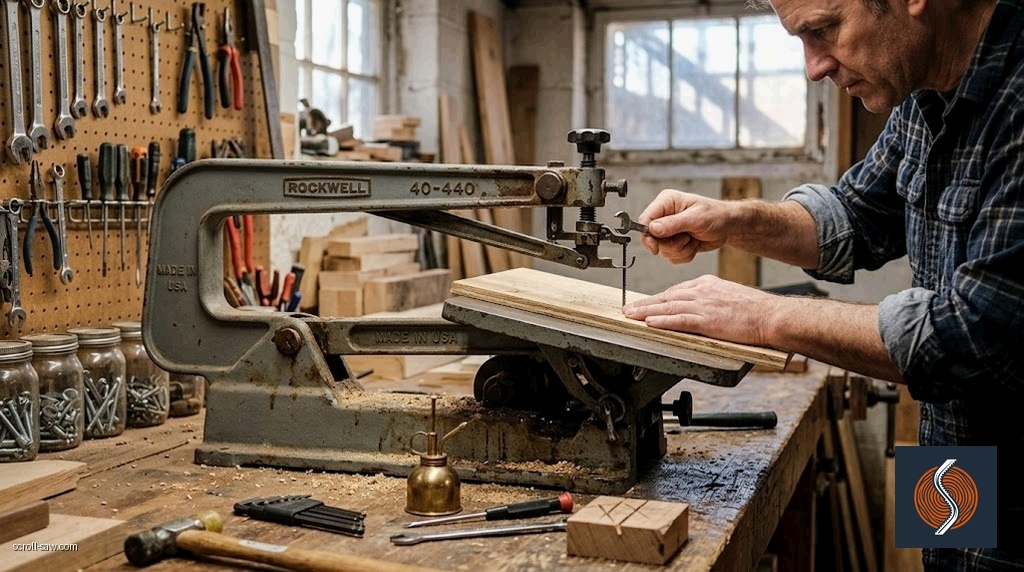
Rockwell 40-440 Scroll Saw: Setup, Limits, and Service
A Rockwell 40-440 in a modern shop is usually not a first purchase. It’s inherited, found at an estate sale, or bought deliberately by someone who already owns a bandsaw and a table saw and wants a serious scroll saw at a used-market price. That is exactly the buyer this saw was built for, several decades ago, and it is still that buyer today.
What the 40-440 is
The Rockwell 40-440 is a stationary scroll saw from the Delta-Rockwell industrial-hobby lineage. Cast iron construction, floor-standing on the original heavy stand, motor and speed configurations that varied by production year, blade holders from an era before the modern quick-change designs.
Exact specifications, throat, cutting height, table dimensions, motor rating, come from your unit’s data plate, not from generalized internet numbers.
The short answer
Setup for the 40-440 is standard scroll saw practice with attention to the age of the machine: rigid base (usually the original stand), squared table, correct blade tension, matched blade, controlled feed. Its limits are the limits of a legacy fixed- or multi-step scroll saw. Service is straightforward for anyone comfortable with older stationary tools; parts channels have narrowed but common wear items are still findable through Delta’s legacy support.
Setup that matters
On a 40-440, three things deserve extra attention beyond generic scroll saw setup:
-
Verify table flatness. Older scroll saws sometimes have tables that were slightly warped by decades of thermal cycles or by stored weight on the table. Straightedge check before trusting it.
-
Confirm arm alignment. A machine that has been dropped, stored on its side, or knocked in transit can show subtle arm misalignment. Blade should be vertical to the table and centered in the throat.
-
Refresh the electrical work if the cord is original. Cord insulation from a 40- or 50-year-old tool is often not what you want carrying current in a modern shop.
Standard setup follows: engineer’s square for the table, correct blade tension by ear, blade sized for the material, controlled feed rate.
Limits
The 40-440 is a stationary scroll saw of its era. Practical limits:
-
No electronic variable speed on original units. Speed changes involve moving a belt on step pulleys.
-
No integrated tool-free blade change.
-
No integrated work light or dust management by modern standards.
-
Continuous heavy-duty production use was not the target then; heavy hobby use is where these saws lived.
Within those constraints, the mass and build quality still deliver cut character that many modern benchtops don’t match.
Service
The 40-440 is mechanically simple. Routine care:
-
Compressed air on the arm hinges and around the motor after use.
-
Yearly bearing and bushing inspection.
-
Blade holder wear checks with each blade change if you’re getting into the habit.
-
Belt condition annually.
-
Motor brushes on brushed-motor variants; bearings and windings on induction-motor variants.
More than a modern saw, a 40-440 rewards a proactive maintenance mindset. Small issues caught early are easy; ignored, they compound into bigger repairs.
Common wear points
-
Pivot bushings on the arm
-
Blade holders and their retention hardware
-
Drive belt (revision-specific)
-
Cord and switch (age-related)
-
Motor bearings or brushes depending on motor type
Order wear parts together when you have the saw apart. Shipping economics reward combined orders on tools from narrower parts channels.
Parts sources
-
Delta Machinery’s legacy parts support for Rockwell-heritage tools
-
eReplacementParts for exploded diagrams and cross-referenced parts
-
Vintage tool specialist dealers with legacy Rockwell inventory
-
eBay for parts from donor machines
-
OWWM (Old Woodworking Machines) community for reference and occasional parts swaps
Common wear items are findable. Specific arm castings or unusual assemblies sometimes require patience.
The character of the saw
What separates a well-maintained 40-440 from modern budget scroll saws is not any single spec. It is the mass, the cast iron table, and the underlying design assumption that this tool would outlive its buyer. That assumption held.
The 40-440 is not the right saw for someone who wants tool-free blade changes and current warranty response. It is the right saw for someone who values cast iron and wants a scroll saw that will still cut cleanly forty years from now with basic care.
Honest drawbacks
The 40-440 is heavy. It takes real shop space. Parts require patience. Manuals require matching to a specific revision. None of these are dealbreakers for the intended owner; all are worth acknowledging.
Comparison
Against a modern Rikon 22 or Delta benchtop, the 40-440 has more mass and a longer track record; the modern saws have current warranty and modern conveniences. Different buyers.
Against an RBI Hawk 220 or 226, closer in class. Both are serious cast-iron scroll saws with long service lives. The Hawk has a stronger specialized-scroll-work reputation; the Rockwell has broader vintage-tool community support.
Who should own one
Someone with the shop space, the patience for legacy parts sourcing, and the appreciation for cast-iron stationary tools. Also, anyone who already inherited one and wants to keep it in service.
Who should skip it
Anyone who wants tool-free blade changes, current warranty, and easy parts availability. Also, anyone whose shop can’t accommodate a floor-standing scroll saw.
FAQ
Where’s the data plate on a 40-440? On the machine base or column, cast or stamped plate. Look for model, serial, motor ratings.
Are 40-440 parts interchangeable with Delta scroll saw parts? Sometimes. Rockwell-to-Delta transitions included overlapping components. Verify per part.
Can I add variable speed to a 40-440? Aftermarket variable-frequency drives can be added to some motor configurations. Verify feasibility per your unit’s motor type.
How long will one last? Decades more, if it isn’t already at that age. Cast iron scroll saws routinely outlast owners.
Is a manual available? Delta’s legacy support and OWWM community are the primary sources. Verify the manual matches your revision.
Is the 40-440 worth restoring? Depends on condition and your relationship to the tool. Fundamentally sound examples are worth the work.
Where is a good stand for one? Original Rockwell stands are heavy and stable when found. A well-built shop-built base of similar mass and rigidity works.
References
-
Delta Machinery / Delta Power Equipment (deltamachinery.com) — legacy parts and service.
-
eReplacementParts (ereplacementparts.com) — exploded diagrams for Rockwell scroll saws.
-
OWWM (Old Woodworking Machines) community (owwm.org) — vintage machine reference and community.
-
Fine Woodworking (finewoodworking.com) — restoration and setup guides.


