
Is the Ryobi 18 Inch Scroll Saw the Right Scroll Saw for You?
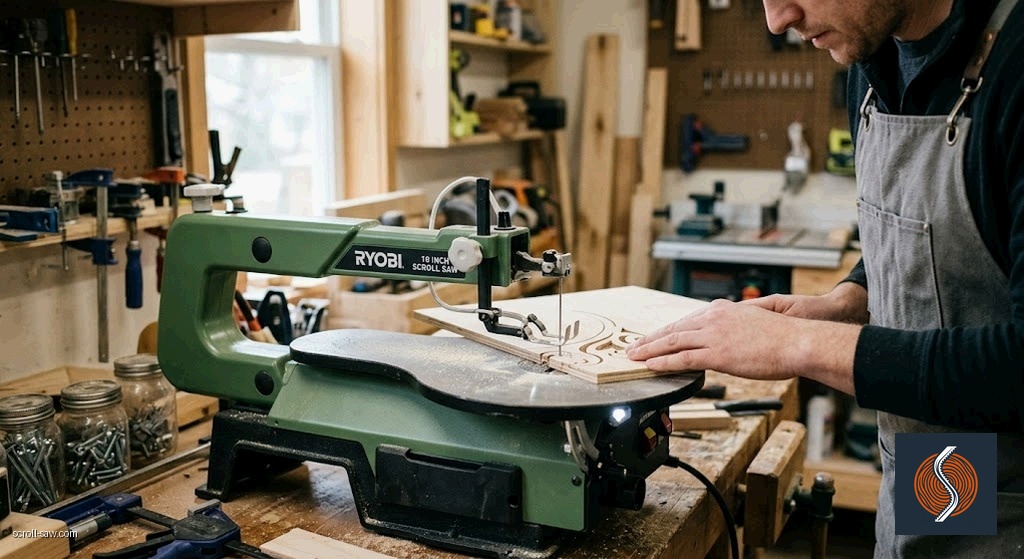
Is the Ryobi 18 Inch Scroll Saw the Right Scroll Saw for You?
The Ryobi 18-inch scroll saw catches buyers who ran out of throat on a 16-inch and started looking for the next thing. Two extra inches of throat sounds small on paper and often matters more in the shop than the number suggests. The question is whether the Ryobi is where you should land or whether you should keep climbing to something in a different class.
What the Ryobi 18 inch is
The Ryobi 18-inch scroll saw refers to Ryobi’s 18-inch throat class scroll saw offerings. Variable-speed benchtop design, standard blade compatibility, integrated dust blower and work light on current builds, benchtop footprint sized for a heavy bench or the matching stand accessory.
Exact model designations vary across production years; verify against your unit’s data plate.
The short answer
Buy the Ryobi 18 inch if the extra two inches of throat past a 16 solves your project reach problem and you want to stay in the Ryobi price bracket. Skip it if what you actually needed was a class-up in build quality (Rikon, Dewalt DW788, or used cast-iron shop machine) rather than just more throat.
When two extra inches matters
Throat depth affects one thing: how much workpiece rotation you can avoid. On projects where the workpiece regularly bumps the arm column on a 16-inch saw, adding two inches of clearance genuinely helps. On projects that fit comfortably within 16 inches, the extra throat is unused capacity.
Before committing, measure your typical workpiece from the cut line to the far edge. If that distance is often close to 16 inches, upgrading to 18 gives you meaningful margin. If it’s usually 10 or 12, the extra throat isn’t the upgrade you needed.
Where the Ryobi 18 wins
-
More throat depth than 16-inch benchtops at similar price positioning
-
Ryobi parts channel is familiar to owners of other Ryobi tools
-
Modern variable-speed control on current builds
-
Warranty support on new units
Where it loses
-
Still a benchtop scroll saw, not a cast-iron shop machine
-
Larger footprint than a 16-inch benchtop
-
Blade change routine on most Ryobi builds is not tool-free
-
Motor sized for hobby use, not production
The alternative question
If you’re upgrading from a 16-inch benchtop because your work outgrew it, ask whether what you really need is:
-
Two more inches of throat (Ryobi 18 or similar)
-
A class-up in build quality (Rikon 10-600VS or Rikon 22)
-
Both, which usually means a Rikon 22 or a used cast-iron shop machine
Owners who upgrade laterally within a brand sometimes find that six months later they still want the class-up. Owners who class up on the first move usually don’t upgrade again for years.
Honest drawbacks worth naming
Common Ryobi 18 inch owner observations: the dust blower is functional but not remarkable, the work light is standard rather than exceptional, and heavy hardwood work over 20 mm strains the motor. Class expectations, not defects.
Setup that unlocks the saw
-
Bolt or clamp to a heavy bench, or use the matching stand accessory.
-
Square the table with an engineer’s square.
-
Tension the blade by ear.
-
Match the blade to the material.
-
Feed slowly on thicker hardwood.
Standard scroll saw setup, non-negotiable on any benchtop machine.
Comparison
Against a Ryobi 16 inch, the 18 gives you two extra inches of throat depth at a modest price premium and larger footprint.
Against a Rikon 10-600VS (16-inch class), the Rikon is a class up in build, cut quality, and warranty response. Similar price bracket to the Ryobi 18.
Against a Rikon 22 or a used Dewalt DW788, both are meaningful step-ups. Higher prices; different tools.
Who should buy the Ryobi 18
Hobbyists whose work legitimately needs 18-inch throat depth and who value Ryobi’s price positioning. Also, buyers who already own other Ryobi tools and appreciate the familiar parts channel.
Who should skip it
Serious pattern makers, marquetry artists, and anyone whose upgrade goal is cut quality rather than just throat depth. Look at Rikon 10-600VS, Rikon 22, or a used Dewalt DW788 instead.
FAQ
How is the Ryobi 18 different from the Ryobi 16? Two extra inches of throat depth. Same benchtop class of build, larger footprint, slightly higher price.
Does it accept pin-end blades? Most Ryobi builds accept both pinned and plain-end with the included holder configuration. Verify per unit.
Is the blade change tool-free? Usually not on Ryobi benchtop builds. Small hex hardware is typical.
How does it handle hardwood? Cleanly up to about 15 mm with a matched blade. Over 20 mm the motor works harder than it should.
Where’s the data plate? On the base, usually rear or underside.
What’s the warranty? Standard Ryobi tool warranty on current units; verify terms at purchase.
Should I skip Ryobi and go to Rikon? If your budget stretches and cut quality matters as much as throat depth, yes. If Ryobi’s price is what you can commit and 18 inches of throat is what you need, the Ryobi 18 is legitimate.
References
-
Ryobi Tools (ryobitools.com) — official product literature and support.
-
eReplacementParts (ereplacementparts.com) — exploded diagrams and parts.
-
Fine Woodworking (finewoodworking.com) — scroll saw category reviews.
-
Scroll Saw Woodworking & Crafts (scrollsawer.com) — owner community.


