
Ryobi 405mm Scroll Saw: Speed, Arm, Ownership Notes
Ryobi 405mm Scroll Saw: Speed, Arm, Ownership Notes
A Ryobi listed as 405mm on the box is the same class of saw a US shopper would see labeled as 16-inch. Metric-market versions may carry different model designations, different labeling on the machine, and different-language manuals. The mechanical machine is the same as its inch-labeled counterpart in the great majority of cases.
Owning one is about knowing which US-equivalent model matches your unit and which parts channel serves your market.
What the 405mm designation means
405 millimeters equals 15.94 inches. Ryobi and other manufacturers round to “16 inch” in inch-market catalogs and to “405 mm” in metric-market catalogs for the same throat class of scroll saw. Occasionally a manufacturer will use 406mm as the equivalent; both refer to the 16-inch throat class.
The short answer
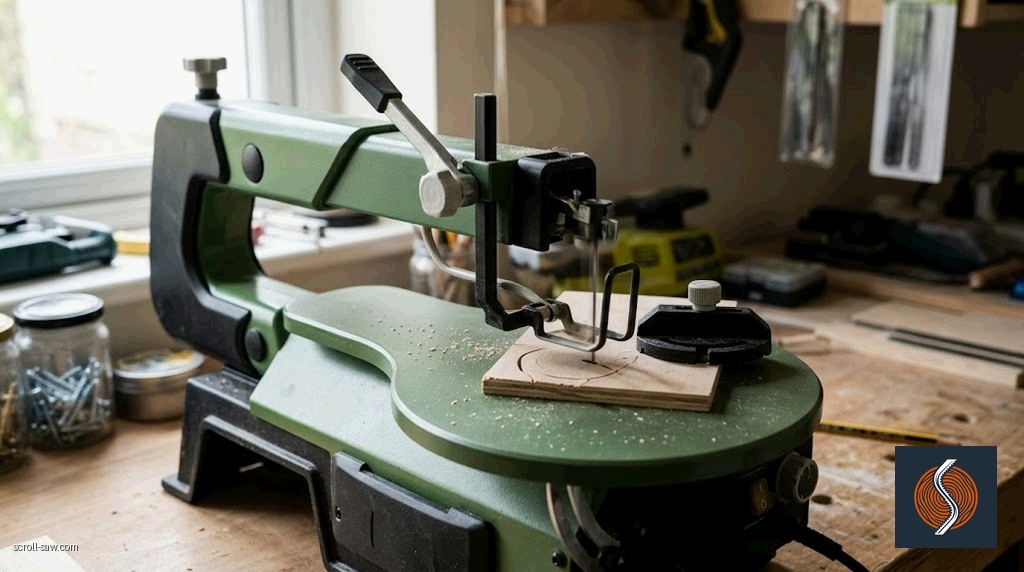
A Ryobi 405mm scroll saw is a benchtop 16-inch class scroll saw. Speed range on VS variants is useful across its span. Arm design is the standard Ryobi benchtop parallel arm with an upper-arm blade holder. Ownership matches the US 16-inch class Ryobi experience: reasonable performance for hobby use, standard wear points, common parts availability through the local Ryobi service channel.
Speed range in practice
Ryobi VS-variant 405mm scroll saws use continuous variable-speed control across their range. Low speeds handle delicate work in thin material; high speeds handle typical scroll saw work in softwood and moderate hardwood. Transitions are smooth on healthy units.
If your speed dial hunts or feels notchy, the cause is usually a worn potentiometer or a speed controller board on the way out. Both are user-serviceable.
Arm design in practice
The standard Ryobi benchtop arm layout keeps the blade largely vertical through the stroke. Cut character:
-
Cut faces stay reasonably square at typical feed rates
-
Blade life on precision work is normal for the class
-
Blade tracks tight radii cleanly with a fine blade sized to the material
The arm is not the mass of a cast-iron shop scroll saw. Vibration control depends on how well the saw is mounted.
Ownership over years
Common owner observations after a few years:
-
Blade holders wear with heavy use
-
Set screws can strip if over-tightened
-
Dust blower is functional but often supplemented
-
Motor holds up under moderate use
-
Speed control on VS units may develop a slight play with age
None of these are dealbreakers. All are worth expecting.
Parts channel in metric markets
Ryobi’s parts network in metric-market countries is generally strong. Local Ryobi service centers, authorized dealers, and third-party parts retailers cover most wear items. When a specific part is not stocked locally, cross-referencing against the US 16-inch equivalent model (SC 160, SC 162VS, or current designation) sometimes turns up compatible parts.
Before ordering across the metric-inch divide, verify:
-
Part number equivalence
-
Voltage compatibility (motors and electrical parts, not mechanical items)
-
Threaded hardware standards (some use metric fasteners, some imperial)
Mechanical parts (blade holders, bushings, belts) usually cross. Electrical parts sometimes don’t.
Setup that matters
-
Bolt to a heavy bench or use the matching stand accessory.
-
Square the table with an engineer’s square (a metric or imperial square both work).
-
Blade tension by ear.
-
Match blade to material.
-
Feed slowly on thicker hardwood.
What the 405mm designation doesn’t change
-
The fundamental cut character of the machine
-
The wear points
-
The setup habits that unlock the saw
-
The class of work it fits
What it does change is the model designation on the paperwork, the manual language, and the specific parts channel serving your market.
Comparison
Against other 405mm benchtop scroll saws (metric-market equivalents of Wen, Rikon, Rockwell), the Ryobi is comparable in class. Specific differences in warranty response, blade holder detail, and parts availability depend on the market.
Against a serious 500mm class scroll saw (metric equivalent of 20-inch shop machines), a different tool entirely. Different price, different build.
Who should own one
Occasional-to-regular hobbyists in metric-market countries whose work fits a 405mm throat and who prefer Ryobi’s brand and service network. Also, buyers who prioritize local Ryobi warranty response over shopping across brands.
Who should skip it
Serious scroll sawyers whose work would justify a cast-iron shop machine, users specifically looking for tool-free blade change, and buyers whose local Ryobi service network is weaker than a competitor’s.
FAQ
Is 405mm the same as 406mm? Both refer to the 16-inch scroll saw throat class. 15.94 inches (405mm) and 16 inches (406.4mm) round to the same class.
Is the 405mm Ryobi the same machine as the US 16-inch Ryobi? Same class of saw, usually similar or identical mechanical build. Model designations, electrical ratings, and paperwork differ by market.
Where’s the data plate? On the base, usually rear or underside, with model, serial, and electrical ratings for your market.
Can I use US parts on a 405mm Ryobi? Mechanical parts usually yes. Electrical parts may differ due to voltage. Verify before ordering.
Where do I find the manual? Ryobi’s regional service and support site for your market. If your specific model isn’t listed, the US equivalent model’s manual covers most of the same content.
Is the warranty different in metric markets? Standard Ryobi tool warranty applies, with specifics that vary by market. Verify at purchase.
How’s the parts channel outside the US? Strong in most Ryobi markets. Local service centers stock common wear items.
References
-
Ryobi Tools regional sites (ryobitools.com and regional equivalents) — market-specific product literature and support.
-
eReplacementParts (ereplacementparts.com) — US-market Ryobi parts diagrams useful for cross-reference.
-
Fine Woodworking (finewoodworking.com) — scroll saw reviews and setup guides.
-
Scroll Saw Woodworking & Crafts (scrollsawer.com) — owner community.


