
Sears Craftsman 16 Direct Drive Scroll Saw: Ownership Notes
Sears Craftsman 16 Direct Drive Scroll Saw: Ownership Notes
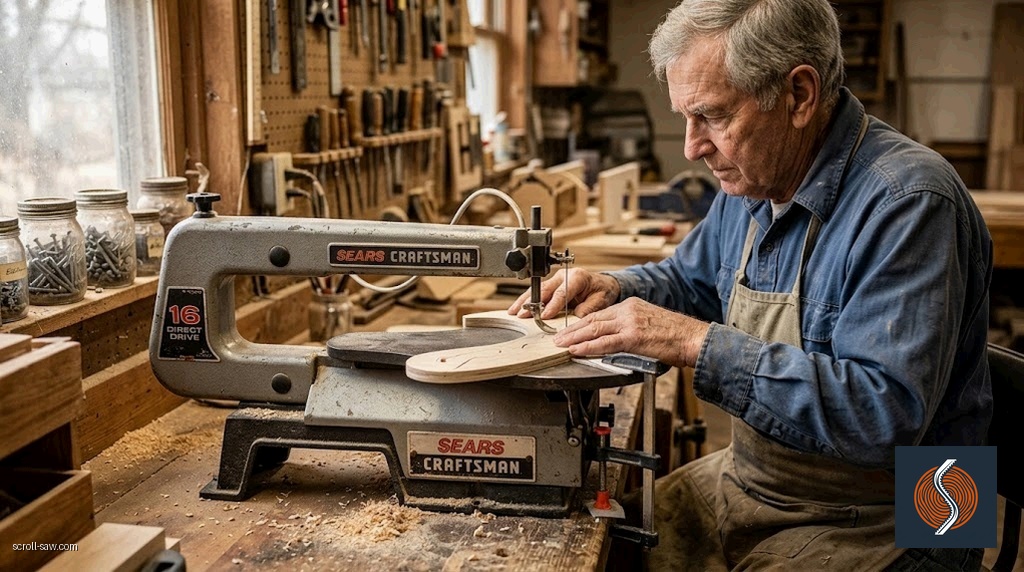
Direct drive on a scroll saw is a specific design decision. No belt between the motor and the arm mechanism, which trades one set of characteristics for another. On the Craftsman 16-inch direct-drive scroll saw, those tradeoffs show up in the cut character, the noise profile, and the long-term maintenance story.
What direct drive means here
Direct drive on a scroll saw means the motor drives the arm mechanism without an intermediate belt. Advantages: fewer wear parts, less noise from belt slap, no belt tension adjustment. Disadvantages: motor vibration transfers more directly, motor RPM options are less flexible, and motor bearing wear directly affects arm behavior.
On the Craftsman 16-inch direct-drive scroll saw, the design choice is fine for typical hobby work and shows its limits under aggressive load.
What the Craftsman 16 direct drive is
The Craftsman 16-inch direct-drive scroll saw refers to Sears Craftsman-badged 16-inch scroll saws with direct-drive motor configurations, produced across several years. As with other Craftsman scroll saws, multiple manufacturers built for Sears over the production span. Model number prefixes identify the specific maker.
The short answer
A Craftsman 16-inch direct-drive scroll saw is a reasonable hobby saw when in good condition. Its speed range is often fixed or limited (direct drive doesn’t easily accommodate wide variable speed). Its arm design is the standard Craftsman benchtop upper-arm. Ownership rewards basic maintenance and a stable base. Parts vary by production year and maker.
Speed range in practice
Direct-drive scroll saws typically ship with fixed speed or narrow-range electronic speed control. On the Craftsman 16 direct drive:
-
Fixed-speed variants run at one motor-defined SPM
-
Variable-speed variants (where the motor is a variable-speed type) offer a limited range compared to belt-driven scroll saws with two-step or three-step pulleys
Blade selection matters more than on a wide-range variable-speed scroll saw, because you can’t dial down for delicate materials.
Arm design in practice
Standard upper-arm parallel-arm layout on most Craftsman 16 direct-drive builds. Cut character:
-
Blade stays largely vertical through the stroke
-
Cut faces stay reasonably square at typical feed rates
-
Blade life is normal for the class
The direct-drive configuration transfers motor vibration to the arm assembly more than a belt-driven design does. Stable mounting matters more here as a result.
Ownership over years
Common owner observations:
-
Motor bearings become the critical wear item; when they go, the whole cut character degrades
-
Blade holders wear at normal scroll saw rates
-
Direct drive means no belt to replace or adjust
-
Vibration control depends heavily on mounting
-
Dust blower is basic on most Craftsman direct-drive scroll saws
Setup that matters
-
Rigid heavy mount. Direct drive is unforgiving of a flexible base.
-
Squared table with an engineer’s square.
-
Correct blade tension by plucked note.
-
Matched blade for material.
-
Controlled feed.
Where the direct-drive Craftsman 16 wins
-
Simpler mechanical design (no belt)
-
Fewer wear parts on the drive train
-
Quieter than belt-driven scroll saws in specific noise components
-
Compact design at benchtop scale
Where it loses
-
Motor vibration transfers to the arm
-
Speed range is more limited
-
Motor bearing wear is the critical long-term failure point
-
Aftermarket variable-speed retrofits are difficult on direct-drive designs
Honest drawbacks
Direct-drive scroll saws depend on motor quality. A worn motor on a direct-drive scroll saw is a bigger deal than on a belt-driven one because the motor’s behavior is the arm’s behavior. When buying used, motor condition matters more here than on most other scroll saw designs.
Comparison
Against a belt-driven Craftsman 16 of similar era, the direct-drive gives up speed range and gains simpler maintenance. Different tradeoffs.
Against a modern Ryobi 16 with electronic variable speed, the direct-drive is simpler mechanically and less flexible in speed.
Against a Rikon 10-600VS or a used Dewalt DW788, both are class-up options with modern conveniences.
Who should own one
Occasional hobbyists finding one clean at a low price, users comfortable with fixed or limited-range speed control, and owners of an already-working direct-drive Craftsman.
Who should skip it
Buyers who need wide variable speed, users pursuing serious pattern work, and anyone whose intended workflow assumes low-SPM delicate cutting.
FAQ
Is direct drive better or worse than belt drive on a scroll saw? Different tradeoffs. Direct drive simplifies mechanical maintenance and transfers vibration; belt drive adds a wear part but decouples motor from arm.
Are Craftsman direct-drive scroll saw parts still available? Varies by maker and era. Motor-specific parts can be harder to source than generic wear items.
Where’s the data plate? On the base or column, with model number identifying the maker via prefix.
Can I retrofit variable speed? Difficult on most direct-drive designs. Sometimes possible with a variable-frequency drive on specific motor types.
How does it handle 3/4-inch hardwood? With a matched blade and controlled feed, cleanly. Direct-drive vibration shows up more here than on a belt-driven saw.
Is a beginner going to be happy with it? At a low used price and with basic setup, yes.
How long will the motor last? Depends on the specific motor’s build and use. Motor bearing life is the practical long-term limit.
References
-
Sears PartsDirect (searspartsdirect.com) — Craftsman parts and manuals.
-
eReplacementParts (ereplacementparts.com) — Craftsman scroll saw parts diagrams.
-
Fine Woodworking (finewoodworking.com) — scroll saw category reviews.
-
Scroll Saw Woodworking & Crafts (scrollsawer.com) — owner community and technique.


