
Sears Craftsman 16 Scroll Saw: Setup, Limits, Service
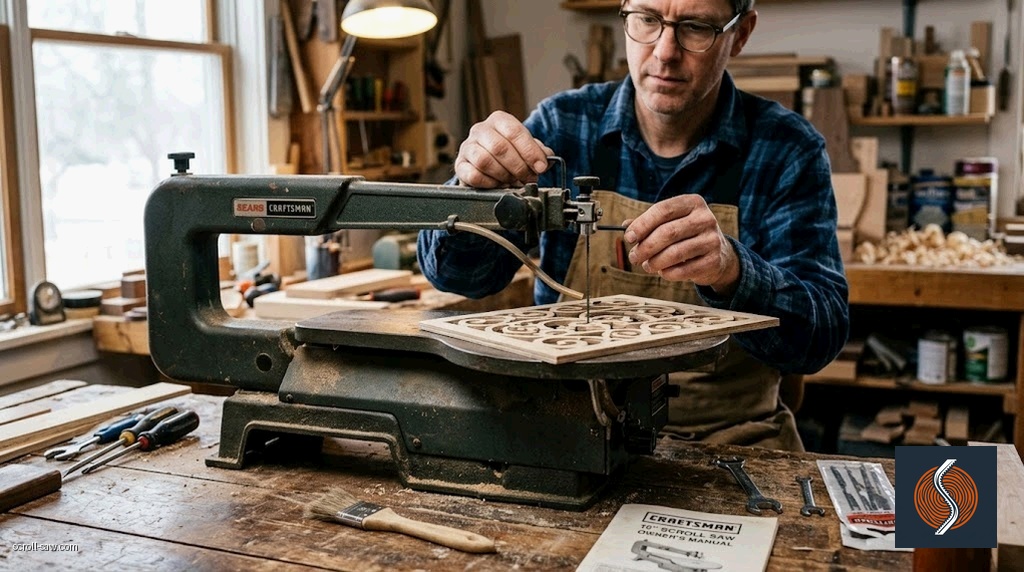
Sears Craftsman 16 Scroll Saw: Setup, Limits, Service
The Craftsman 16-inch scroll saw is one of the most common used-market scroll saws in North America. Sears sold many under the Craftsman badge across decades, and while the specific machines varied by maker, the setup and service story converges on the same basic principles that make any scroll saw cut well.
What the Craftsman 16 is
“Craftsman 16 inch scroll saw” is a Sears retail category, not a single machine. Multiple manufacturers (Emerson, Rexon, and others) built 16-inch scroll saws under the Craftsman brand across the years. Model number prefixes on the data plate identify the maker.
The common thread: 16-inch throat class, benchtop or benchtop-with-stand format, and the basic scroll saw architecture that hasn’t changed fundamentally in a century.
The short answer
Setup for any Craftsman 16 comes down to the same five things: rigid mount, squared table, correct blade tension, matched blade, controlled feed. Limits are the physical limits of a benchtop scroll saw plus the age-related considerations of older hardware. Service is user-serviceable for anyone comfortable with basic hand tools.
Setup that matters
Rigid mount. Bolt to a heavy bench or the original stand if intact. A Craftsman 16 on a folding table produces most of the internet’s complaints about the brand.
Squared table. Engineer’s square between the blade and the table. Adjust the tilt lock hardware to bring the table to true 90 degrees.
Blade tension. Install the blade, tension the mechanism, pluck the blade with a fingernail. Ringing note is right. Older Craftsman scroll saws sometimes use tension mechanisms that feel different from modern designs; the plucked-note test transcends the mechanism.
Matched blade. Standard 5-inch scroll blades in appropriate sizing for the material. Fine for fine, coarser for thicker.
Feed rate. Let the blade cut. Force nothing.
Age-related setup additions
For a used Craftsman:
-
Inspect the cord for age-related insulation damage before first use
-
Verify switch operation is smooth
-
Check fastener tightness across the machine
-
Confirm the base is intact without cracks
-
Look at bushings for slop
Five minutes of pre-use inspection prevents surprises.
Limits
Craftsman 16 scroll saws are hobby-tier tools. Practical limits:
-
Hardwood over 15 mm at aggressive feed rates strains most Craftsman 16 motors
-
Continuous production use is not the target
-
Blade change is not tool-free on most builds
-
Precision at the jeweler’s-scale end is limited by the mass and build class
Within these constraints, a well-set-up Craftsman 16 delivers real scroll saw work.
Service
Routine care:
-
Compressed air after each session
-
Blade holder inspection with each blade change
-
Yearly bearing and bushing inspection
-
Belt condition annually on belt-driven variants
-
Motor brush check on brushed-motor variants
Older Craftsman scroll saws sometimes benefit from bearing regreasing per the manufacturer’s specification. Do not repack scroll saw bushings with heavy grease unless the manual specifies it; many bushings are self-lubricating.
Common wear points
-
Blade holders and set screws
-
Pivot bushings on the arm
-
Motor brushes on brushed-motor variants
-
Drive belt on belt-driven variants
-
Speed control (on variable-speed variants where used)
-
Cord and switch (age-related)
Parts sources
-
Sears PartsDirect (searspartsdirect.com) as the primary Craftsman channel
-
eReplacementParts and other third-party parts retailers
-
Manufacturer’s own channel if you can identify the maker via model prefix
-
eBay for donor machines and estate-sale lots
Craftsman parts availability has declined with Sears’ retail contraction. Verify parts exist before committing to a repair.
The character of a well-preserved Craftsman 16
Older Craftsman scroll saws sometimes carry build details (cast iron tables, heavier motor housings) that modern budget benchtops don’t match. Not every era produced this quality, but the good ones are legitimately capable hobby saws.
Setup is what unlocks that character. A neglected Craftsman 16 cuts poorly; a properly set-up one cuts as well as most modern benchtops in the same throat class.
Honest drawbacks
Quality varies by era and maker. Parts availability declines with age. Modern conveniences (tool-free blade change, current warranty) are not part of the package. All of these are known and manageable.
Comparison
Against a Ryobi entry-level scroll saw, similar hobby class with Ryobi’s better current parts channel.
Against a Rikon 10-600VS or a used Dewalt DW788, both are class-up options.
Against a serious cast-iron scroll saw (RBI Hawk, Hegner), different tool entirely.
Who should own one
Occasional hobbyists finding a clean unit at a fair used price, users comfortable maintaining older tools, and owners of an already-working Craftsman that fits their scroll work.
Who should skip it
Serious pattern makers, buyers demanding modern conveniences, and users whose specific Craftsman needs parts no longer available.
FAQ
Are Craftsman scroll saw parts still available? Varies by maker and era. Verify before committing.
How do I identify who made my Craftsman? Model number prefix on the data plate. Woodworking forums decode prefixes.
Where’s the data plate? On the base or column, silver or stamped label.
Where’s the manual? Sears PartsDirect and Craftsman archive sites, matched by model number.
How much should I pay used? Condition and era dependent. Well-preserved older Craftsman 16s justify a fair ask; worn units should be cheap.
Is it good for beginners? At the right price and with proper setup, yes.
Can I upgrade the blade holders? Some aftermarket options fit some Craftsman 16 builds. Verify per unit.
References
-
Sears PartsDirect (searspartsdirect.com) — Craftsman parts and manuals.
-
eReplacementParts (ereplacementparts.com) — Craftsman scroll saw parts diagrams.
-
OWWM (Old Woodworking Machines) community (owwm.org) — vintage tool identification.
-
Fine Woodworking (finewoodworking.com) — setup and maintenance guides.


