
A Closer Look at the Sears Craftsman 20 Scroll Saw
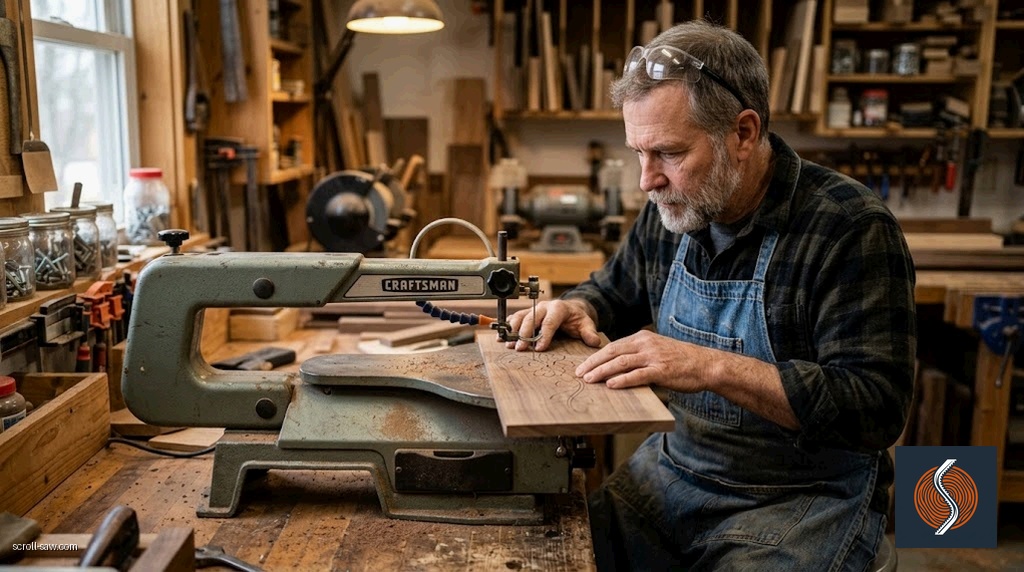
A Closer Look at the Sears Craftsman 20 Scroll Saw
The Craftsman 20-inch scroll saw sat at the top of Sears’ scroll saw lineup. A 20-inch throat pushes into territory that specialist brands like RBI Hawk, Hegner, and Excalibur have long dominated, and a well-preserved Craftsman 20 attempts to occupy that space at a hobby-class price. Whether it succeeds depends on which specific unit you’re looking at.
What the Craftsman 20 is
A Sears Craftsman-branded 20-inch throat scroll saw, produced across several production years by different manufacturers. As with the rest of the Craftsman lineup, model number prefixes identify the actual maker. The 20-inch throat class typically included heavier construction than the 16- and 18-inch Craftsman scroll saws.
The short answer
A Craftsman 20-inch scroll saw at its best is a heavier-duty hobby scroll saw with genuine cast-iron mass. At its worst it’s an ambitious import build that never quite delivers the shop-machine feel the throat size promises. Identification and inspection separate the two.
What makes a good Craftsman 20
Cast iron construction. The best Craftsman 20s have cast iron tables, heavy cast bases, and enough mass to control vibration under load.
Solid arm design. Parallel-arm layout that keeps the blade largely vertical. Some Craftsman 20s used arm designs that are legitimately capable; others used cost-optimized layouts that don’t match their throat size.
Serviceable motor. Motor accessible for brush replacement, bearings, and general service. Not sealed to prevent user maintenance.
Documented parts channel. Manual with parts list, accessible through Sears PartsDirect or a third-party channel.
A Craftsman 20 that has all four is a legitimate hobby-to-semi-serious scroll saw at a hobby price.
What makes a bad one
-
Sheet-metal-heavy construction that flexes under load
-
C-arm design where the throat size promised parallel-arm performance
-
Sealed motor that can’t be serviced at home
-
Discontinued specific parts with no aftermarket cross-reference
Units with these characteristics look like a Craftsman 20 on the outside and behave like a 16-inch benchtop with a bigger table on the inside.
Physical inspection
Standard used-scroll-saw walkthrough:
-
Arm play (bushings)
-
Motor smoothness (bearings, brushes)
-
Blade holder condition
-
Cord and switch
-
Table flatness
Add for a 20-inch class saw:
-
Stand rigidity (a 20-inch scroll saw needs a heavy base)
-
Arm assembly rigidity (rock the arm; flex or play argue against buying)
Where a good Craftsman 20 wins
-
20-inch throat at hobby-class pricing (when found clean)
-
Cast iron construction on well-built units
-
Simple mechanical design serviceable at home
-
Larger table than typical benchtops
Where even a good one loses
-
Not the parts channel of a specialist scroll saw brand
-
No modern conveniences (tool-free blade change, current warranty)
-
Weight makes it a two-person move
-
Quality varies dramatically by era and maker
Honest drawbacks
Craftsman 20-inch scroll saws are heterogeneous. Some are legitimately worth restoring and putting into serious hobby use. Some are ambitious builds that don’t deliver on the throat-size promise. Buying one used means either identifying the specific unit against the vintage-tool community’s knowledge or accepting the inspection-risk of an unknown machine.
Comparison
Against a Craftsman 18, meaningful additional throat and (on good units) meaningful additional mass.
Against an RBI Hawk 220 or a Hegner Multimax, class-up options in mass, parts support, and specialist reputation.
Against a Rikon 22, closer in modern-benchtop-plus category. Rikon has current warranty and modern conveniences.
Who should buy or keep one
Hobbyists finding a well-preserved Craftsman 20 at a fair price after inspection, users comfortable maintaining older stationary tools, and buyers who value the throat size at hobby-class pricing.
Who should skip it
Serious pattern makers whose work justifies a specialist scroll saw, buyers who want current warranty, and anyone unwilling to inspect and identify before committing.
Setup habits
-
Rigid base or the original stand if intact
-
Squared table with an engineer’s square
-
Correct blade tension by plucked note
-
Matched blade to material
-
Controlled feed rate
A Craftsman 20 rewards proper setup more than the smaller benchtops do because its cut quality potential is higher when the machine is correctly configured.
FAQ
Are Craftsman 20 scroll saws still made? Not as a current Sears offering. Used market is the source.
Who made my Craftsman 20? Model number prefix. Woodworking forums decode prefixes.
Where’s the data plate? On the base or column.
Are Craftsman 20 parts still available? Varies by production year and maker. Verify before committing.
How does it compare to a Hawk 220? On a good Craftsman 20, closer in class than the price gap would suggest, though the Hawk retains a stronger specialist reputation and parts support.
Should I invest in restoring an old Craftsman 20? Depends on the specific unit’s build quality and parts availability.
Where’s the manual? Sears PartsDirect and vintage tool community archives.
References
-
Sears PartsDirect (searspartsdirect.com) — Craftsman parts and manuals.
-
eReplacementParts (ereplacementparts.com) — Craftsman scroll saw parts diagrams.
-
OWWM (Old Woodworking Machines) community (owwm.org) — vintage tool identification.
-
Fine Woodworking (finewoodworking.com) — restoration and setup guides.


