
Sears Craftsman 20 Scroll Saw: Speed, Arm, Ownership
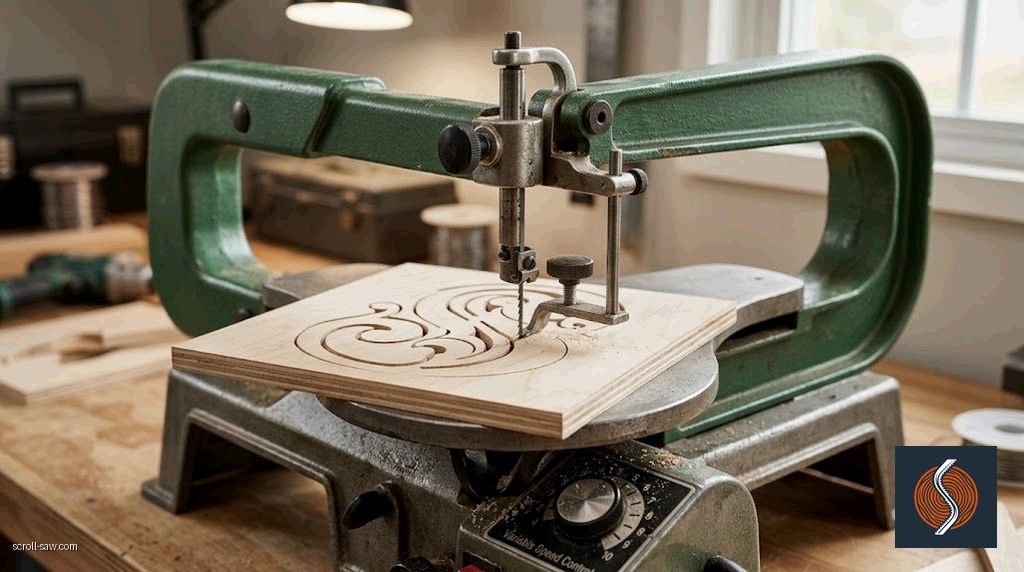
Sears Craftsman 20 Scroll Saw: Speed, Arm, Ownership
The Craftsman 20-inch scroll saw category covers several distinct machines from different manufacturers across different production eras. Speed range, arm design, and ownership experience all vary meaningfully by which specific unit you have. Identification comes first; general commentary comes second.
What we’re covering
“Craftsman 20 inch scroll saw” is a Sears retail category that included:
-
Older Emerson-era Craftsman 20s with step-pulley speed control and cast iron construction
-
Mid-era Craftsman 20s with electronic variable speed on some builds
-
Later Rexon-built or import-built Craftsman 20s with modern benchtop features scaled up to 20 inches
Each has different speed, arm, and ownership characteristics. Model number prefix on the data plate identifies which you have.
The short answer
Speed range on Craftsman 20 scroll saws varies from fixed single-speed (older units) through step-pulley multi-speed (many mid-era units) to continuous electronic variable speed (later units). Arm design is typically upper-arm parallel-arm layout with build-quality that varies by era. Ownership rewards identification, inspection, and standard scroll saw setup habits.
Speed range across eras
Older Emerson-era Craftsman 20s. Often fixed-speed or step-pulley multi-speed. Speed changes involve moving a belt on pulleys. Reliable, mechanically simple, less convenient than continuous variable speed.
Mid-era Craftsman 20s. Some builds added electronic variable-speed control. Speed range depends on the specific controller; older electronic controllers sometimes have narrower usable range than modern designs.
Later Craftsman 20s. Continuous variable speed on many builds. Range and smoothness comparable to modern benchtop scroll saws.
Check your unit’s data plate and control layout to determine which category you’re in.
Arm design across eras
Upper-arm parallel-arm layout is standard across most Craftsman 20 builds. What varies:
-
Arm rigidity (older cast units are stiffer)
-
Blade holder design (older thumb-screw; newer set-screw or clamp)
-
Table tilt hardware (varies by era)
-
Dust blower routing (mostly basic across eras)
Parallel-arm geometry keeps the blade largely vertical through the stroke, which shows in cut quality when the arm and mounts are solid.
Ownership over years
What Craftsman 20 owners consistently report:
-
Well-built older units age gracefully; poorer builds accumulate problems
-
Motor character is usually the long-term determinant
-
Blade holders wear at normal scroll saw rates
-
Stand condition matters as much as machine condition
-
Parts availability declines with time; some units are easier to keep alive than others
Setup habits
-
Rigid base or the original stand if intact
-
Squared table with an engineer’s square
-
Correct blade tension by plucked note
-
Matched blade to material
-
Controlled feed rate
Standard scroll saw setup, non-negotiable on a 20-inch machine.
Where a well-preserved Craftsman 20 wins
-
20-inch throat at hobby-class pricing (when found clean)
-
Cast iron construction on the best older units
-
Simple mechanical design that a home mechanic can service
-
Larger table than smaller Craftsman scroll saws
Where even a good one loses
-
Parts availability declines over decades
-
No modern conveniences on older builds
-
Weight makes it a two-person move
-
Documentation quality varies
Honest drawbacks
Craftsman 20s are wildly variable by era and maker. Some are worth restoring seriously; some are worth much less than their asking prices. Do not skip the identification-and-inspection step.
Comparison
Against a Craftsman 18, more throat and often more mass, especially on older units.
Against an RBI Hawk 220 or Hegner Multimax, class-up options in mass, parts, and reputation.
Against a Rikon 22, modern-benchtop-plus alternative with current warranty and modern conveniences.
Who should own one
Hobbyists finding a well-preserved unit at a fair price after inspection, users comfortable maintaining older stationary tools, and owners of an already-working Craftsman 20 that fits their scroll work.
Who should skip it
Serious pattern makers, users seeking modern conveniences, and buyers who won’t identify and inspect before committing.
FAQ
Are Craftsman 20 scroll saws still made? Not as a current Sears offering.
How do I identify the era and maker? Model number prefix on the data plate.
Where’s the data plate? On the base or column.
Are Craftsman 20 parts still available? Varies by year and maker.
What speed range should I expect? Depends on the specific unit. Fixed, step-pulley, or continuous electronic depending on era.
Is a beginner going to be happy with it? At the right price and with proper setup, yes.
Should I restore an old Craftsman 20? Depends on the specific unit’s build quality and parts availability.
References
-
Sears PartsDirect (searspartsdirect.com) — Craftsman parts and manuals.
-
eReplacementParts (ereplacementparts.com) — Craftsman scroll saw parts diagrams.
-
OWWM (Old Woodworking Machines) community (owwm.org) — vintage tool identification.
-
Fine Woodworking (finewoodworking.com) — setup and restoration guides.


