
Vintage Delta Scroll Saw: A Practical Reference
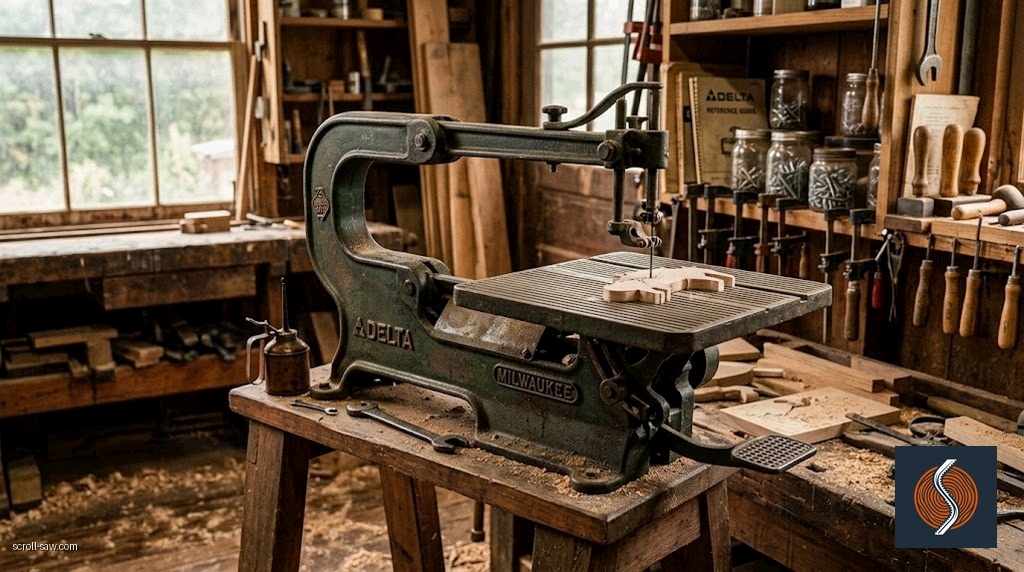
Vintage Delta Scroll Saw: A Practical Reference
Vintage Delta scroll saws carry a name that meant something specific to a generation of American woodworkers. Delta (later Delta-Rockwell, later Rockwell Delta, and various corporate configurations over decades) produced scroll saws in different throat depths and mechanical configurations from the 1930s through the tail end of the 20th century. A vintage Delta in a shop today can be a legitimately capable machine, a project waiting to happen, or somewhere in between.
What “vintage Delta scroll saw” covers
The term spans:
-
1930s-1940s Delta scroll saws (pre-Rockwell acquisition)
-
Delta-Rockwell era scroll saws (roughly 1940s through 1980s)
-
Rockwell Delta scroll saws (roughly 1970s through 1980s)
-
Later Delta scroll saws (into the 2000s under various corporate configurations)
Different eras used different mechanical designs, different motor configurations, and different quality standards. Model number and era identification comes first.
The short answer
A vintage Delta scroll saw ranges from legitimately excellent shop machines (some 1940s-1960s cast-iron designs) through solid mid-tier hobby saws (1970s-1980s standard production) to marginal later-era units. Identification, inspection, and parts availability check should happen before any purchase or major repair investment.
Identifying your Delta
Data plate. Delta and Delta-Rockwell scroll saws have data plates with model number, serial number, and manufacturing date on many units. Read carefully.
Model number lookup. Delta model numbers have specific meanings by era. OWWM (owwm.org) and Delta-specific owner communities maintain lookup lists.
Physical inspection. Compare visible details to known Delta model references from vintage tool communities.
Serial number. Sometimes correlates to production year through Delta’s records.
What makes a good vintage Delta
Cast iron construction. The best older Delta scroll saws use cast iron extensively. Base, table, arm castings.
Serviceable motor. Older Delta motors are typically robust induction or repulsion-start motors that reward maintenance.
Documented parts channel. Common Delta scroll saw models still have documented parts through various channels.
Restorable condition. Age is not the same as wear; a well-cared-for vintage Delta from 1958 may be in better shape than a hard-used one from 1998.
What makes a bad one
-
Broken castings (Delta castings are generally durable but not indestructible)
-
Motor damage where the specific motor is unavailable
-
Bushings or bearings so worn that cut quality can’t be recovered without a full mechanical rebuild
-
Missing critical parts that aren’t cross-referenced elsewhere
Parts sources
Sears PartsDirect (searspartsdirect.com). Some Delta parts, especially for later Craftsman-Delta crossover units.
eReplacementParts (ereplacementparts.com). Delta scroll saw parts diagrams for many models.
Delta Machinery (deltamachinery.com). Current Delta parts channel for supported models.
OWWM (owwm.org) community. The definitive vintage Delta community with parts leads, documentation, and restoration guidance.
eBay and estate sales. Donor machines and rare parts.
Setup that unlocks a vintage Delta
-
Rigid base (many vintage Delta scroll saws came with dedicated cast-iron stands)
-
Squared table with an engineer’s square
-
Correct blade tension by plucked note
-
Matched blade to material
-
Controlled feed rate
Older Delta scroll saws sometimes require rebuilding the tension mechanism, replacing bushings, and refurbishing the blade holders before setup can be considered complete. Community restoration guides document the specifics for common models.
Common service tasks
-
Bushing replacement at the arm pivot
-
Motor service (brushes on brushed motors, general cleaning and lubrication on induction motors)
-
Blade holder refurbishment or replacement
-
Tension mechanism rebuild on older thumb-tension designs
-
Cord and switch replacement (period-appropriate or modern equivalents)
Where a well-restored vintage Delta wins
-
Cast iron construction that modern budget scroll saws don’t match
-
Simple mechanical designs serviceable at home
-
Legitimately capable cut quality on well-restored units
-
Character and shop presence that modern scroll saws don’t offer
Where even a good one loses
-
No modern conveniences (tool-free blade change, current warranty, integrated modern work light)
-
Parts availability declines with age
-
Setup and maintenance skills are non-optional
-
Weight makes many units a two-person move
Honest drawbacks
Vintage Delta ownership rewards owners who enjoy the mechanical side of the hobby. Owners who want a scroll saw to plug in and use with minimal fuss should look at modern mainstream tools. The two ownership experiences are meaningfully different.
Comparison
Against modern mainstream scroll saws (WEN, Ryobi, Rikon), the vintage Delta trades modern conveniences for cast-iron construction and character.
Against specialist modern scroll saws (RBI Hawk, Hegner), the vintage Delta is generally not in the same specialist class regardless of specific model.
Against other vintage scroll saws (Rockwell, Craftsman older units), Delta and Delta-Rockwell scroll saws often have stronger community support and parts availability.
Who should own a vintage Delta
Woodworkers who enjoy restoration and maintenance, users whose work fits the specific vintage Delta’s throat class, and owners of a well-preserved unit that already runs well.
Who should skip it
Buyers who want current warranty, users who need modern conveniences, and anyone unwilling to learn vintage-tool restoration and maintenance skills.
FAQ
Is a vintage Delta scroll saw worth restoring? Depends on the specific model, its condition, and parts availability. Well-built older Delta scroll saws are often worth restoration.
Where do vintage Delta scroll saw parts come from? Delta Machinery’s current channel for supported models, eReplacementParts, OWWM community, and donor machines.
Where’s the data plate? On the base, column, or arm depending on the specific Delta model and era.
How do I identify my Delta’s era? Model number, serial number, and physical inspection cross-referenced against OWWM’s Delta model reference.
Is a beginner going to be happy with a vintage Delta? Only if the beginner is also interested in restoration and maintenance. Modern mainstream scroll saws are easier for pure-user beginners.
How much should I pay for a used vintage Delta? Condition, model, and era dependent.
Can I use modern scroll saw blades in a vintage Delta? Usually yes, in standard 5-inch sizes. Verify against your specific blade holder configuration.
References
-
Delta Machinery (deltamachinery.com) — current Delta parts for supported models.
-
eReplacementParts (ereplacementparts.com) — vintage Delta scroll saw parts diagrams.
-
OWWM (Old Woodworking Machines) community (owwm.org) — the definitive vintage Delta community.
-
Fine Woodworking (finewoodworking.com) — vintage tool restoration guides.


