
Central Machinery Scroll Saw Blade Change: Clean Cuts
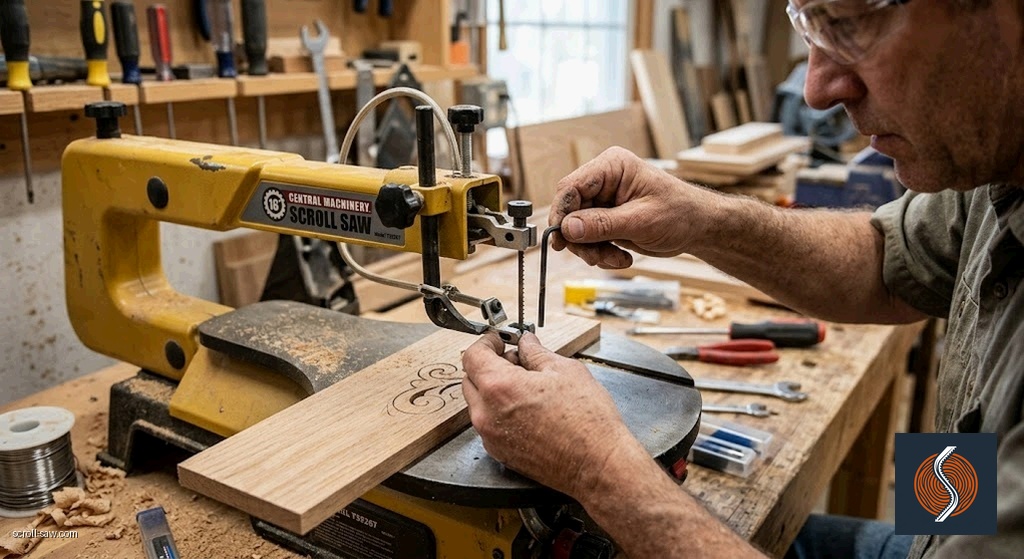
Central Machinery Scroll Saw Blade Change: Clean Cuts
Central Machinery (the Harbor Freight house brand) sells scroll saws at prices that make them a common first scroll saw for hobbyists testing the craft. Blade change on Central Machinery scroll saws follows the same general logic as any scroll saw but has specific quirks worth knowing. Getting the blade change right is where clean cuts start.
What Central Machinery scroll saws are
Central Machinery is Harbor Freight’s private-label tool brand. Their scroll saws span several models across throat sizes and features. Typical builds include benchtop scroll saws with variable-speed control, standard 5-inch blade compatibility, and pin-end and plain-end holder configurations depending on the specific model.
Exact specifications and blade holder configurations vary by model. Verify against your specific Central Machinery scroll saw’s manual.
The short answer
Blade change on Central Machinery scroll saws typically uses set-screw or clamp-style blade holders. The process: release tension, remove old blade, install new blade with correct orientation, close holders, re-tension. Correct tension is verified by plucking the blade with a fingernail; it should ring, not thud.
Before the blade change
Unplug the saw. Standard scroll saw safety.
Have the new blade ready. Standard 5-inch scroll blade in the right size for your work.
Verify blade type. Pinned or plain-end depending on your holder configuration.
Note blade direction. Scroll saw blades cut on the down stroke; teeth face down toward the table. Marking on the blade packaging usually indicates orientation.
The blade change sequence
Release tension. Loosen the tension mechanism until the blade goes slack. Most Central Machinery scroll saws have a lever or knob for this.
Remove the old blade. Loosen the holder set screws (usually small hex hardware). Slide the blade out.
Install the new blade. Feed the blade through the table opening if starting from below (interior cuts) or from above (edge cuts). Position both ends in the holders.
Orient the blade. Teeth face down toward the table.
Tighten the holders. Firm hex-hardware pressure. Don’t over-tighten (set screws strip if forced).
Re-tension. Apply tension until the blade rings when plucked with a fingernail.
Test. Plug in, run at low speed briefly, verify the blade tracks straight.
Common Central Machinery blade change quirks
Set screws strip if over-tightened. Central Machinery’s blade holder hardware is standard but sized for hobby use. Firm pressure is enough.
Blade holders wear over time. Wallowed jaws or stripped threads mean the holder needs replacement, not more tightening.
Pin-end vs plain-end configuration. Some Central Machinery scroll saws accept both; some accept only one type. Verify against your manual.
Tension mechanism variability. Different Central Machinery scroll saws use different tension mechanisms. The plucked-note test is the universal check.
Blade tension: the pluck test
Install the blade. Tension the mechanism. Pluck the blade with a fingernail:
-
Ringing note: correct tension
-
Thud: under-tensioned; the blade will wander and produce rough cuts
-
Very high pitch or immediate break: over-tensioned; the blade will fail quickly
The pluck test transcends brand and mechanism. Every scroll saw’s blade tension is checkable this way.
Common issues after blade change
Blade breaks quickly. Over-tensioned, feed rate too high, or wrong blade size for material.
Cut wanders. Under-tensioned, table not square, or feed rate too high.
Blade slips in holder. Set screw insufficiently tight, wallowed holder jaws, or wrong blade type.
Cut face rough. Blade dull, wrong TPI for material, or blade dull from previous use.
Setup after blade change
Blade change is the moment to check other setup:
-
Squared table (engineer’s square)
-
Correct blade tension (pluck test)
-
Blade matched to material
-
Feed rate controlled
Where Central Machinery scroll saws win
-
Very low entry price
-
Wide retail availability at Harbor Freight
-
Enough capability to learn on
-
Standard 5-inch blade compatibility means blades from Olson, Flying Dutchman, and other quality brands all fit
Where they stop
-
Cast quality is entry-level
-
Blade holders wear faster than on mid-tier scroll saws
-
Long-term parts availability is limited
-
Not the saw for serious pattern work
Honest drawbacks
Central Machinery scroll saws are entry-level tools. Blade change hardware can strip if over-tightened. Blade holders wear on hard-used units. Dust management is basic. All manageable at the price point.
Setup habits that make Central Machinery scroll saws better
-
Bolt to a heavy bench
-
Change blades before dull
-
Match blade sizing to material
-
Feed slowly
-
Keep the machine clean between sessions
Comparison
Against a WEN 3920, similar class of tool with WEN’s slightly better documentation and warranty channel.
Against a Ryobi entry-level 16, similar class with Ryobi’s better retail parts channel.
Against a Rikon 10-600VS, the Rikon is a genuine class up in build quality at a higher price.
Who should use a Central Machinery scroll saw
Beginners testing the craft, occasional hobbyists at the lowest price point, and users whose work is modest in scale.
Who should skip it
Buyers who cut regularly and want a step-up saw. Users whose specific work needs mid-tier build quality. Anyone who values current warranty support and readily-available parts.
FAQ
Does Central Machinery accept standard scroll saw blades? Yes. Standard 5-inch scroll blades fit. Pinned or plain-end depending on your specific model.
How often should I change blades? Before they’re actually dull. A dull blade produces rough cuts, wanders, and stresses the motor.
Where do Central Machinery blade holders come from? Harbor Freight (harborfreight.com) is the primary channel. Some cross-reference to generic scroll saw holders.
Where’s the manual for my Central Machinery scroll saw? Harbor Freight’s product page or the packaged manual.
Can I upgrade the blade holders? Some aftermarket options fit some Central Machinery models. Verify per unit.
Where’s the data plate? On the base of the machine.
Is it good for a beginner? At the price and with proper setup, yes.
References
-
Harbor Freight (harborfreight.com) — Central Machinery product literature and parts.
-
Olson Saw Company (olsonsaw.com) — quality replacement blades.
-
Scroll Saw Woodworking & Crafts (scrollsawer.com) — owner community.
-
Fine Woodworking (finewoodworking.com) — scroll saw setup guides.


