
Bald Eagle Scroll Saw Patterns: Detail Work on America
Bald Eagle Scroll Saw Patterns: Detail Work on America
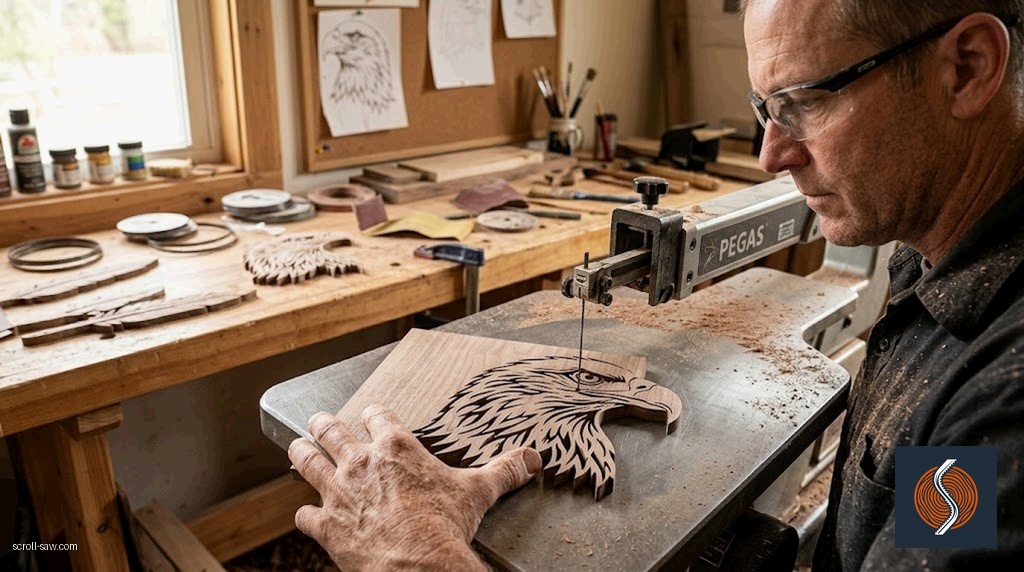
A bald eagle scroll saw pattern captures one of the most visually striking birds in North American wildlife. The bald eagle’s combination of a white head, dark body, and spread wings creates a silhouette that reads immediately and powerfully. For scroll saw work, the eagle is a subject that can be executed at beginner level (simple silhouette) or advanced level (full feather detail).
Eagle patterns are perennial sellers at craft fairs, especially in markets with patriotic themes, fishing communities, or wildlife décor interest.
Short answer: dark walnut or cherry for clear-finish eagles (natural contrast between head and body), 1/4-inch to 1/2-inch stock, #3 or #5 reverse-tooth for detailed feather work, grain parallel to the wingspan for structural strength.
Bald eagle pattern styles
Simple silhouette. Eagle profile or frontal silhouette. No interior detail. Reads as eagle from shape alone. Beginner pattern.
Wing-spread silhouette. Eagle with wings fully spread. Dramatic shape. May require plywood for structural integrity at the wing tips.
Detailed feather work. Interior lines showing feather structure. Intermediate to advanced.
Full pictorial. Realistic eagle with fine feather texture throughout. Advanced pattern.
Eagle on perch. Eagle standing on branch or rock. Shows talons and body detail.
Eagle in flight. Eagle with slight wing angle. Dynamic pose.
Diving eagle. Eagle in diving pose with wings partially folded. Dramatic. Complex pattern.
Eagle with fish. Eagle carrying fish in talons. Multi-element pattern.
Eagle portrait. Head and upper body close-up. Face detail prominent.
Eagle with flag or text. Patriotic combination pattern. Eagle silhouette with American flag, shield, or text.
Design considerations for eagles
White head accuracy. The bald eagle’s white head and tail are the identifying visual features. In clear-finished wood, the head-to-body transition needs visual indication (burned line, painted detail, or two-wood contrast).
Wing spread proportions. Bald eagle wingspan is about 2.3x its body length. Patterns that don’t maintain this proportion look wrong.
Feather direction. Wing feathers fan radially from shoulder. Body feathers lie flat and scale downward. Tail feathers fan from base. Patterns with correct feather direction read as realistic.
Grain direction. Wings spread horizontally; grain should run horizontally for wing strength. Vertical grain cracks at wing tips.
Stock selection
Dark hardwood for contrast:
-
Walnut: dark, natural grain. The body’s dark brown color is close to walnut’s natural color.
-
Cherry: warm medium tone. Different from eagle’s natural color but elegant.
-
Wenge: very dark (difficult to cut).
Baltic birch plywood for:
-
Large patterns with horizontal wing grain.
-
Painted eagles (paint handles color contrast).
-
Very detailed patterns where structural integrity matters.
Multi-wood approach (advanced):
-
Dark walnut for body; light maple for head and tail.
-
Produces natural color contrast matching the actual bird.
-
More complex to execute.
Stock thickness:
-
1/4 inch: silhouette art.
-
3/8 inch: standard wall art.
-
1/2 inch: substantial pieces.
Blade choice
Simple silhouettes: #5 reverse-tooth. Olson FR49202.
Detailed feather work: #3 reverse-tooth for fine feather lines.
Very fine feather detail: #2/0 blade.
Thick stock: #7 skip-tooth. Olson FR49400.
Production runs: Pegas Regular Scroll #7.
Pattern attachment and cutting
-
Attach pattern with 3M Super 77. Optional ScotchBlue Painter’s Tape 2090 underneath for clear-finish hardwood.
-
Drill all interior entry holes before cutting.
-
Cut finest interior details first. Fine feather texture in the wing tips and tail.
-
Cut medium detail. Primary feather divisions.
-
Cut perimeter last. Wing outline, body outline, head.
-
Sand while pattern attached. Light 220-grit.
-
Peel pattern.
Finishing for bald eagles
Clear finish over dark walnut: shows natural wood color close to eagle’s body color. White-head detail achieved through painted accent on head area (white acrylic over clear finish, or light-colored wood for head in multi-piece construction).
Painted eagle:
-
White for head and tail.
-
Dark brown/black for body and wings.
-
Yellow for beak and talons.
-
Multi-thin coats.
Two-wood contrast: dark wood for body, light wood for head and tail—contrasting woods assembled into one piece. Advanced technique.
Woodburned detail: burn feather texture onto the surface before finishing. Adds visual depth without multiple wood pieces.
Stained: dark stain on body area; mask and leave head lighter. Achieves contrast with one wood species.
Where to source patterns
Steve Good’s blog has bald eagle patterns.
Big Book of Scroll Saw Woodworking includes eagle patterns.
Wayne Fowler specializes in wildlife pictorial scroll saw work including eagle patterns.
Patriotic scroll saw pattern books feature eagle patterns prominently.
Etsy and pattern sites have eagle patterns at various skill levels.
Common problems and fixes
Wing tips broke during cutting. Grain direction wrong (vertical in horizontal wing). Reorient to horizontal grain. Use plywood.
Eagle not recognizable. Proportions wrong or features indistinct. Study reference eagle photographs; verify white head, wing proportions, tail fan.
Feather detail muddy. Detail too fine for scale. Enlarge pattern.
White head area not visible. No visual contrast. Paint head area white, burn a dividing line, or use contrasting wood for head.
Feathers on body look like random lines. Incorrect feather direction. Feathers should follow the bird’s anatomy (scale from head to tail; radiate from wing shoulder).
Perimeter cut confused by feather detail. Complex pattern hard to follow. Mark perimeter clearly before cutting.
Pattern adhesive difficult to remove. Adhesive on detailed feather areas. Allow more solvent time; use orange oil.
Sizing for display
8-12 inches wingspan: shelf or accent piece.
12-18 inches wingspan: standard wall art.
18-24 inches wingspan: large wall art, statement piece.
24+ inches wingspan: oversized installation. Requires plywood for structural integrity.
Frequently asked questions
Is the bald eagle a hard scroll saw subject? Simple silhouette: beginner. Detailed feather work: intermediate. Full pictorial: advanced. The subject scales with skill.
What’s the best wood for eagle patterns? Walnut for natural color resonance with the species. Cherry for warm elegance. Baltic birch plywood for large or detailed patterns.
How do I show the white head on a one-wood piece? Paint white on the head area after cutting and clear-coating the body. Or burn a dividing line. Or stain selectively.
Can I make an eagle set (multiple eagles for display)? Yes. Three eagles at different poses reads as a grouping display. Common in patriotic-themed décor.
Do eagle pieces sell well? Strong market, particularly in communities with patriotic themes, outdoor/hunting enthusiasts, Pacific Northwest. Prices $25-200 depending on size and detail.
Can I combine an eagle pattern with text? Yes. Eagle silhouette above or beside words (“America,” “Freedom,” “Land of the Free”). Combination pieces are popular patriotic décor.
Do I need references for eagle patterns? For simple silhouettes, no. For detailed pictorial work, yes—study eagle photography. The feather structure must follow the bird’s actual anatomy to read as realistic.
References
-
Wayne Fowler, wildlife scroll saw books.
-
Fox Chapel Publishing, Big Book of Scroll Saw Woodworking.
-
Steve Good, Scrollsaw Workshop (blog).


