
Delta Scroll Saw Quick Set Blade Changer: Match by Material
Delta Scroll Saw Quick Set Blade Changer: Match by Material
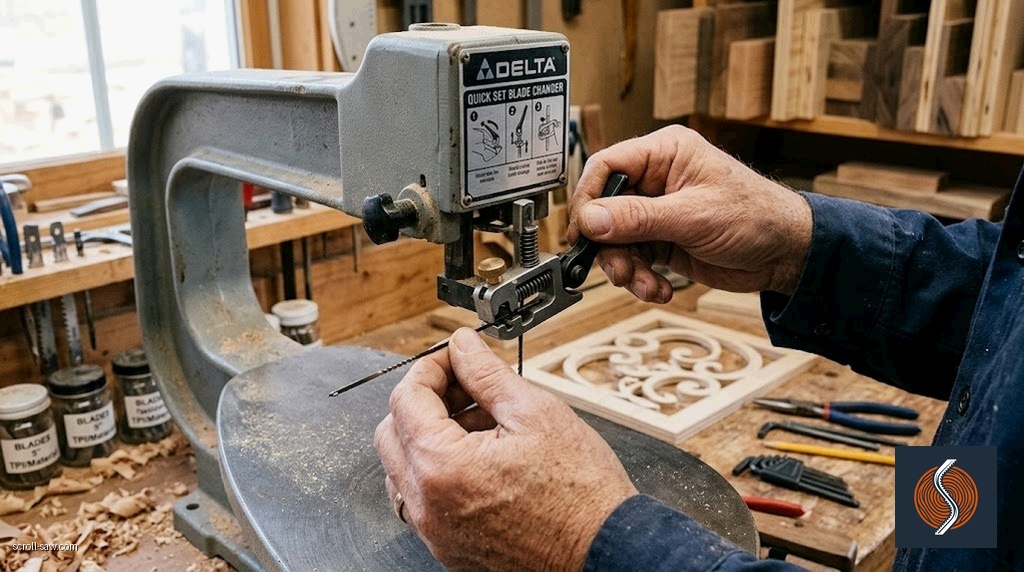
Quick-set blade changers on Delta scroll saws replace the traditional set-screw blade holders with tool-free mechanisms that speed up blade change dramatically. On Delta scroll saws that include the quick-set system, blade change goes from a wrench-and-hex-key process to a few seconds of lever motion. Getting cleaner cuts still comes down to matching the blade to the material.
What the Delta quick-set blade changer is
The Delta quick-set blade changer is a tool-free blade holder mechanism on specific Delta scroll saws. Some Delta scroll saws include it as standard equipment; some accept it as an aftermarket upgrade for compatible models.
Exact quick-set mechanism design varies by Delta model. Verify against your specific Delta scroll saw’s documentation.
The short answer
Use the quick-set blade changer for fast blade change. Match the blade number to the material. Tension correctly using the pluck test. Feed slowly. The mechanism speeds up blade change; the blade selection and technique still determine cut quality.
Blade selection by material and thickness
Standard scroll saw blade principles apply:
Softwood up to 20 mm. Blade number 5 to 9. Medium TPI. Feed slowly.
Hardwood up to 15 mm. Blade number 5 to 7 for standard cuts; number 3 for fine detail.
Thin hardwood (up to 6 mm). Blade number 2 to 3 for standard; 2/0 for very fine detail.
Plywood up to 12 mm. Blade number 5 to 7. Feed slowly to reduce splintering.
Plastics. Blade number 3 to 5. Slow feed to prevent melting.
Very fine detail in thin stock. Blade number 2/0.
Using the quick-set blade changer
Step 1: Unplug the saw.
Step 2: Have the new blade ready. Verify blade type compatibility with your Delta quick-set (typically standard 5-inch scroll blades).
Step 3: Release tension. Delta scroll saws with quick-set typically use a lever-based tension release.
Step 4: Release the quick-set blade holders. Activate the quick-set mechanism (varies by model; usually a lever, twist, or press motion).
Step 5: Remove old blade.
Step 6: Position new blade. For edge cuts, insert from above. For interior cuts, thread through the workpiece pilot hole from below.
Step 7: Orient the blade. Teeth face down toward the table.
Step 8: Engage the quick-set holders. Return the quick-set mechanism to the locked position.
Step 9: Re-tension. Ringing pluck when tapped with a fingernail.
Step 10: Test. Low-speed run.
Interior cut technique with quick-set
-
Drill a pilot hole in the workpiece
-
Release blade tension
-
Release the upper quick-set holder only (leave the lower engaged)
-
Thread the free end of the blade up through the pilot hole
-
Engage the upper quick-set holder
-
Re-tension
-
Cut
Quick-set makes this sequence dramatically faster than traditional set-screw holders.
The pluck test
Even with quick-set, verify tension by plucking the blade with a fingernail. Ringing note is correct. The pluck test transcends the holder mechanism.
Common issues
Quick-set won’t hold blade. Blade too thick or too thin for the mechanism’s designed range. Verify blade compatibility.
Blade slips during cutting. Quick-set mechanism worn, or blade misaligned in the holder.
Quick-set mechanism binds. Dust and pitch buildup. Compressed air clean and light lubrication if needed.
Blade breaks quickly. Over-tensioned, feed rate too high, or wrong blade for material. Not typically the quick-set mechanism’s fault.
Cut wanders. Under-tensioned, table not square, or feed rate too high.
Where the quick-set wins
-
Fast blade change speeds up interior-cut work dramatically
-
Consistent clamp pressure once the mechanism is calibrated
-
No wrenches to lose
-
Convenient for cuts requiring multiple blade changes
Where quick-set stops
-
Mechanism can wear over time
-
Not universally compatible with every scroll saw blade width
-
Repair or replacement of a worn quick-set mechanism is often more involved than replacing traditional set-screw holders
Aftermarket quick-set options
Some Delta scroll saws that shipped with traditional set-screw holders have aftermarket quick-set upgrade options. Compatibility depends on the specific Delta model. Community forums document specific upgrades.
Maintenance
-
Compressed air the quick-set mechanism after each session
-
Inspect for wear at every blade change
-
Light lubrication if the mechanism binds (verify per manufacturer’s guidance)
-
Replace the quick-set mechanism if consistent grip degrades
Setup after blade change
-
Squared table (engineer’s square)
-
Correct blade tension (pluck test)
-
Matched blade to material
-
Feed rate controlled
Where a Delta scroll saw + quick-set works well
-
Scroll sawyers doing frequent interior-cut work benefit most
-
Complex patterns with many blade removals and reinstalls become practical
-
Beginners find blade change less intimidating with quick-set
Where quick-set doesn’t fix underlying issues
-
Vibration from arm bushings
-
Motor bearing issues
-
Table flatness or square problems
-
Wrong blade for material
Comparison to traditional set-screw holders
Quick-set trades some mechanical simplicity for speed. Traditional set-screw holders are simpler to repair when they wear; quick-set is faster to use. Both hold blades securely when in good condition.
FAQ
Does my Delta scroll saw have quick-set? Check the manual or the blade holders. Quick-set has a lever, twist, or press mechanism; traditional set-screw holders have hex hardware.
Can I add quick-set to my Delta scroll saw? Some Delta models have aftermarket quick-set options. Verify per model.
Are quick-set holders more or less reliable than set-screw holders? Similarly reliable when maintained. Different repair profiles.
How do I know the tension is right with quick-set? Pluck the blade. Ringing note.
Does quick-set fit all blade widths? Most designs accept a defined width range. Verify per your Delta.
Where’s the manual for my Delta’s quick-set? Delta Machinery’s support pages or your original manual.
Is quick-set worth the price bump? For frequent interior-cut work, yes. For occasional hobby use, less critical.
References
-
Delta Machinery (deltamachinery.com) — current Delta scroll saw parts and manuals.
-
eReplacementParts (ereplacementparts.com) — Delta parts diagrams.
-
Fine Woodworking (finewoodworking.com) — scroll saw blade change guides.
-
Scroll Saw Woodworking & Crafts (scrollsawer.com) — owner community.


