
Delta Scroll Saw Stand: Getting the Specification Right
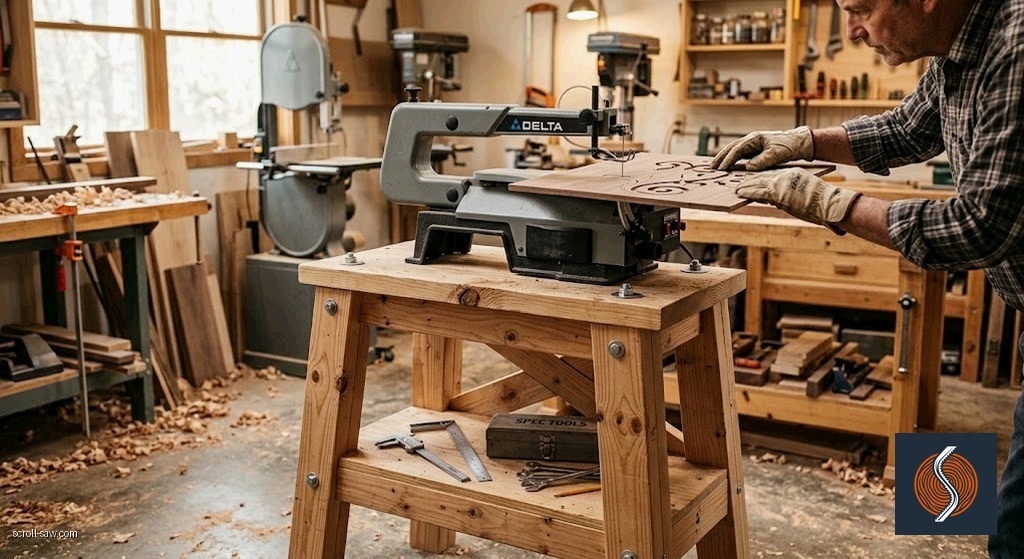
Delta Scroll Saw Stand: Getting the Specification Right
A Delta scroll saw needs a stable base. On a benchtop Delta scroll saw, that base can be a heavy workbench or a dedicated stand. On a floor-standing Delta scroll saw, the stand is usually integral to the machine. Getting the stand specification right for a benchtop Delta comes down to fit, stability, and workflow.
What a scroll saw stand does
Rigid mounting. Vibration control, which shows up directly in cut quality.
Working height. Correct height for the operator, which affects comfort and control.
Storage. Some stands include storage for blades, patterns, and accessories.
Portability. Wheels or a compact design for shops with limited space.
The short answer
Pick a stand that matches your Delta’s mount pattern, sets the table at a comfortable working height, and is heavy or well-braced enough to control vibration. Period-original Delta stands (if available) or modern equivalent stands are typical choices. Shop-built stands can equal or exceed commercial options.
Stand types
Period-original Delta stand. Made for the specific Delta scroll saw. Fits the mount pattern directly. Available on the used market with the saw or separately for some models.
Modern equivalent stand. Made by Delta Machinery (current models) or third-party manufacturers. May require mount adaptation for older Delta scroll saws.
Universal scroll saw stand. Designed to fit multiple scroll saw brands. Often needs shims or adapter plates for specific Delta mount patterns.
Shop-built stand. Custom-built to fit your specific Delta and shop layout.
Specification checks
Mount pattern. The stand top must accept your Delta’s mount hole pattern.
Weight capacity. Stand must support the Delta scroll saw’s weight plus operational forces.
Rigidity. Stand should not flex under the arm’s movement forces.
Working height. Table at elbow height for standing operators (usually 36 to 44 inches for the table).
Footprint. Fits shop space and operator movement.
Storage. Blade drawers, pattern storage, accessory shelves.
Portability. Wheels or folding design if needed.
Weight and rigidity
Heavier stands control vibration better. A Delta scroll saw on a light stand walks on aggressive feed rates. A Delta scroll saw on a heavy stand cuts consistently.
Target weight: at least 40 to 50 pounds for a benchtop Delta scroll saw stand. Heavier is better within practical shop limits.
Working height
Standard scroll saw working height positions the table at elbow height for a standing operator. Sitting operators use a lower stand or seated setup at seated elbow level.
-
Standing average operator: table at 36 to 40 inches
-
Standing tall operator: table at 40 to 44 inches
-
Seated operator: table at 28 to 32 inches with a standard chair
Where a period-original Delta stand wins
-
Direct fit for the specific Delta scroll saw
-
Period-appropriate for restored older Delta scroll saws
-
Documented in original Delta manuals
-
Sometimes includes Delta-specific storage features
Where it loses
-
May not be available for all Delta scroll saw models
-
Weight and rigidity vary by era
-
Used-market availability declines with age
Where a modern equivalent stand wins
-
Current retail availability
-
Modern features (adjustable feet, wheels with locks, storage integration)
-
May be heavier or more rigid than period-original stands
-
Warranty on new units
Where it loses
-
May require mount adaptation for older Delta scroll saws
-
Modern stands don’t match period-original aesthetics for restored older Deltas
Where a shop-built stand wins
-
Custom fit to your specific Delta and shop
-
Full control over weight, height, and storage features
-
Often more rigid than commercial stands at similar cost
-
Storage designed for your specific workflow
Where it loses
-
Requires design and build skills
-
No warranty
-
Time investment
Mounting your Delta to the stand
Step 1: Verify mount hole pattern. Compare the scroll saw’s mount holes to the stand’s top plate.
Step 2: Add rubber or foam pads. Reduce vibration transmission.
Step 3: Bolt firmly. Use bolts sized to the mount holes. Snug but not over-tight.
Step 4: Level the stand. Adjustable feet or shims.
Step 5: Verify stability. Push on the scroll saw’s arm. Movement in the stand indicates insufficient anchoring or a stand that’s too light.
Storage integration
-
Drawer for scroll saw blades organized by TPI
-
Shelf for patterns and jigs
-
Hook for shop vacuum hose if using dust collection
-
Small parts organizer for blade holders, set screws, and accessories
-
Below-table storage for larger workpieces
Portability considerations
Fixed stand. Most stable, best for permanent shop placement.
Casters (wheels). Convenient for shops that rearrange. Require locking mechanisms for stable operation.
Folding stand. Compact for storage, less stable than fixed or heavy caster stands.
Where a Delta scroll saw + good stand wins
-
Stable base transforms benchtop Delta scroll saw performance
-
Working height reduces operator fatigue
-
Storage integration keeps the shop organized
Where a stand doesn’t fix underlying issues
-
Cast quality of the scroll saw itself
-
Motor issues
-
Setup errors (unsquared table, wrong blade, incorrect tension)
Sourcing Delta scroll saw stands
Delta Machinery (deltamachinery.com). Current stands for supported Delta scroll saws.
eReplacementParts (ereplacementparts.com). Delta stand parts and diagrams.
Amazon and Home Depot. Modern universal scroll saw stands.
Woodworking retailers (Rockler, Woodcraft). Higher-quality universal stands.
eBay and estate sales. Used Delta stands and vintage tool stands.
Local Facebook marketplace and Craigslist. Used stands, often paired with the scroll saw.
Delta-specific vintage sources. OWWM community for older Delta stands.
Setup habits
-
Stand at a comfortable working height
-
Rubber or foam between scroll saw and stand
-
Firm bolts through the mount pattern
-
Level the stand
-
Keep the stand storage organized
FAQ
Do I need a stand for my Delta scroll saw? A rigid base is non-negotiable. A stand is one way; a heavy workbench is another.
Where do I find a period-original Delta stand? Delta Machinery for supported models, eBay for older models, OWWM community, estate sales.
How heavy should the stand be? At least 40 to 50 pounds. Heavier is better within practical shop limits.
What’s the right working height? About elbow height when standing (36 to 44 inches for the table depending on operator).
Can I build a shop-built stand? Yes. Weight, rigidity, and fit are the key criteria.
Should I add casters? Only with locking mechanisms. A rolling scroll saw is a stable scroll saw only when locked.
How do I mount the scroll saw to the stand? Bolt through the scroll saw’s mount holes with rubber or foam pads between.
References
-
Delta Machinery (deltamachinery.com) — current Delta scroll saw stands and parts.
-
Rockler (rockler.com) — aftermarket scroll saw stands.
-
Woodcraft (woodcraft.com) — stand options.
-
OWWM (Old Woodworking Machines) community (owwm.org) — vintage Delta stand documentation.
-
Fine Woodworking (finewoodworking.com) — shop-built stand plans.


