
DeWalt Scroll Saw Blade Tension: Size, Tooth Geometry, and Material Guide
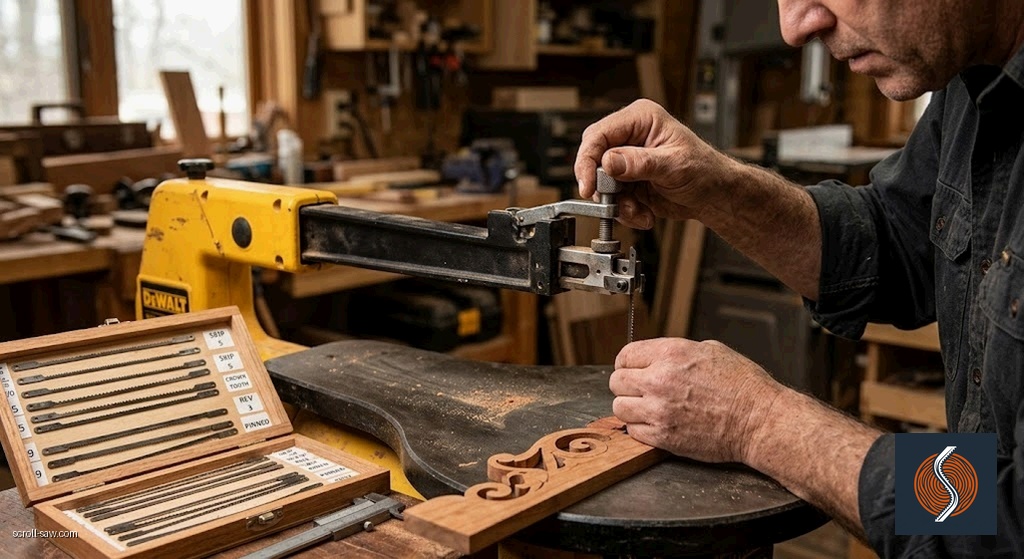
DeWalt Scroll Saw Blade Tension: Size, Tooth Geometry, and Material Guide
You are halfway through a delicate fretwork pattern when the blade starts wandering. The cut that was clean three minutes ago now drifts left every time you round a curve. You stop, lift the upper arm, and check the blade. It is still sharp. The teeth are not loaded with pitch. The problem is tension. Your dewalt scroll saw blade tension has backed off just enough to turn a precise cut into a guessing game.
Blade tension is the single most overlooked variable on a scroll saw. Get it right and the saw tracks straight, cuts clean, and the blade lasts. Get it wrong and you get drift, broken blades, and tearout that ruins good wood. On the DeWalt DW788, the tensioning system is better than most, but it still requires your attention every time you change a blade.
The dewalt scroll saw blade tension question comes down to three things: getting the right blade size for your material, understanding tooth geometry, and setting tension correctly using the built-in lever. Let’s walk through each one so you can stop fighting the saw and start cutting.
How the DeWalt DW788 Blade Tension System Works
The DeWalt DW788 uses a tool-free blade clamp system that lets you swap blades in seconds without reaching for a wrench. The blade-tensioning lever sits up front, among the front-mounted controls, so you can adjust tension without moving your hands far from the workpiece. This is a real advantage over saws that bury the tension knob behind the upper arm where you have to grope for it mid-cut.
The double parallel-link arm design keeps the blade moving straight up and down with minimal deflection. That means tension holds more consistently through the stroke than on cheaper single-arm saws where the blade flexes at the bottom of the cut. The 1.3-amp motor drives the blade at a fixed speed, so tension is doing the work of keeping the blade tracking true.
Here is the thing though: the tensioning lever on the DW788 is convenient, but it is not a calibrated instrument. There is no gauge that tells you the blade is at exactly the right tension. You learn by feel and by watching how the blade behaves in the cut. Most experienced scroll sawyers tension a blade until it produces a clear ping when plucked, like a guitar string, and then test with a few practice cuts.
Scroll Saw Blade Sizes and What Fits the DeWalt
The DeWalt DW788 accepts pin-end and pinless blades. This is one of the reasons it has been a favorite among serious hobbyists for years. The tool-free blade clamp holds pinless blades securely, which matters because most fine fretwork uses pinless blades in sizes from #2/0 up to #12.
Pin-end blades are thicker and stiffer. They are what you want for cutting thick stock, doing rough work, or making long straight cuts where you need durability over finesse. Pinless blades give you finer control and let you thread the blade through a small pilot hole for inside-cut work, which is essential for fretwork and intarsia.
The 20-inch throat gives you room to maneuver, but blade size should match your material thickness, not your throat capacity. A #5 or #7 blade handles most 3/4-inch hardwood comfortably. Drop to a #2/0 or #3 for thin veneers or delicate pattern work in 1/4-inch stock. Going too big on thin material wastes wood and leaves rough edges. Going too small on thick stock snaps blades and tests your patience.
Tooth Geometry: Why It Matters More Than Tension
You can have perfect dewalt scroll saw blade tension and still get lousy cuts if the tooth geometry is wrong for your material. Scroll saw blades come in several tooth patterns, and each one has a job.
Skip-tooth blades have a gap between teeth that clears sawdust efficiently. They cut fast and stay cool, which makes them a good default for general work in wood up to about 1 inch thick. The tradeoff is a slightly rougher cut surface.
Reverse-tooth blades have teeth pointing up at the bottom of the blade and down at the top. This design eliminates tearout on the underside of your workpiece, which is the bane of scroll saw work. If you have ever flipped a piece over and found splinters lifted along every cut line, reverse-tooth blades solve that. They cut slower and can vibrate more, so they need slightly higher tension.
Spiral blades cut in all directions, which sounds great until you try to control one. They are useful for cutting shapes where you cannot turn the workpiece, but they leave a wider kerf and are harder to steer. Most people who buy a spiral blade use it once and go back to flat blades.
Crown-tooth blades are a compromise: they cut on both the upstroke and downstroke, leaving a cleaner finish than skip-tooth but clearing chips better than reverse-tooth. They are a good middle ground if you do mixed work.
The point is this: tooth geometry affects how much tension you need. Fine-tooth blades in thick material need more tension to track straight because the small teeth load up and create drag. Coarse-tooth blades in thin material can run at slightly lower tension because they cut freely and put less sideways pressure on the blade.
Material Guide: Matching Blade to Wood
The wood you cut changes the equation. Hardwoods like maple, oak, and cherry put more load on every tooth. They need a stiffer blade with more tension to prevent drift. Softwoods like pine and cedar cut easily but can tear out aggressively if your blade is too aggressive.
Plywood is its own animal. The alternating grain layers mean a blade is always cutting some end grain, which dulls teeth faster. A skip-tooth blade with moderate tension works well here. If you are cutting Baltic birch plywood for fine boxes or ornaments, a reverse-tooth blade in a #3 or #5 size with good tension will give you clean edges on both faces.
Exotic hardwoods and dense materials like corian or bone require patience. Run a fine blade at higher tension and feed slowly. The DeWalt’s 1.3-amp motor has enough power for these materials, but pushing too fast will stall the blade and bow your cut line.
For metal (thin sheet brass or copper, which some scroll sawyers cut), you need a very fine blade, high tension, and a lubricated blade. The DW788 can handle light metal work, but it is not a jeweler’s saw. If metal cutting is your primary use, you may want a different tool entirely.
Setting Tension on the DeWalt DW788: Step by Step
Here is how I set dewalt scroll saw blade tension on the DW788, and how I teach others to do it:
-
Install the blade in the tool-free blade clamp. Make sure the blade seats fully in both the upper and lower clamps. A blade that is not fully seated will slip no matter how much tension you apply.
-
Lift the blade-tensioning lever. On the DW788, this lever is front-mounted, so you can reach it without moving the workpiece.
-
Push the lever forward to increase tension. You will feel resistance increase as the blade tightens.
-
Pluck the blade like a guitar string. You want a clear, high ping. A dull thud means too little tension. A ping so high it sounds brittle means you are over-tensioning, which shortens blade life and can stress the clamp mechanism.
-
Make a test cut in scrap of the same material and thickness as your project. If the blade tracks straight and the cut is clean, you are set. If it drifts, add a small amount of tension and test again.
-
Recheck after about 10 minutes of cutting. Blades stretch slightly as they warm up, and tension can drop. This is normal, not a flaw of the saw.
The cast-iron table on the DW788 provides a stable platform that does not flex under tension, which is more than I can say for some aluminum-table competitors. The 45-degree left bevel and 45-degree right bevel capabilities let you tilt the table for angled cuts, but remember that bevel cutting changes how the blade loads and may require slightly different tension.
Common Tension Problems and Fixes
If your blades break frequently, you are probably over-tensioning. Back off slightly and see if blade life improves. If the blade drifts to one side, tension is too low or the blade is damaged. Check for a bent blade before cranking up the tension.
If the blade pops out of the clamp during a cut, the blade is not seated properly or the clamp is worn. The dewalt scroll saw blade holder system is durable, but the clamps can develop wear after years of use. If you are constantly fighting blade retention, inspect the clamp jaws for wear and replace if needed.
Vibration that gets worse as tension increases usually means the blade is too fine for the material thickness. Move up one blade size and the vibration will often disappear.
Changing Blades on the DeWalt Scroll Saw
Changing blade on dewalt scroll saw is straightforward because of the tool-free blade clamp system. Here is the process:
Lift the upper arm using the upper-arm lift mechanism. This opens the space between the clamps so you can thread the blade for inside cuts or simply swap blades. Loosen the blade clamps, remove the old blade, insert the new blade, and close the clamps. Apply tension with the lever and you are ready to cut.
For inside-cut threading, lift the upper arm, remove the blade from the upper clamp, thread it through your pilot hole in the workpiece, reseat it in the upper clamp, and tension. The tool-free clamp makes this fast enough that you do not dread inside cuts, which is not true of every scroll saw.
The DeWalt DW7880 and DeWalt DW7881 are blade options that DeWalt offers for this saw. The DW7880 is a pack of pinless blades and the DW7881 is a pack of pin-end blades. Having both types on hand gives you flexibility for different projects.
Who Should Skip This Saw for Blade Work
If you only cut straight lines in thick stock, a scroll saw is the wrong tool regardless of brand. A band saw will do that work faster and with less blade breakage. The DW788 earns its place when you need curves, inside cuts, and fine detail work. If your projects are all straight ripping, save your money.
If you cut metal exclusively, the DW788 will do light work but is not optimized for it. The blade speed is fixed and the clamp system is designed for wood blades. A dedicated metal-cutting scroll saw or a jeweler’s saw will serve you better.
My Verdict
The DeWalt DW788 has one of the best blade tension systems in its class. The front-mounted tensioning lever, tool-free blade clamps, and double parallel-link arm design work together to make blade changes and tension adjustments fast and repeatable. The 20-inch throat and cast-iron table give you the capacity and stability for serious work.
The flaws are real: no tension gauge means you learn by feel, the fixed motor speed limits you on very slow cutting tasks, and the blade clamps can wear over years of heavy use. But for a woodworker who wants to do fretwork, intarsia, or detailed pattern cutting, the DW788’s blade system is a genuine advantage over cheaper saws that fight you at every blade change.
Get the tension right, match your blade to your material, and this saw will reward you with clean cuts and fewer broken blades.
FAQ
How do I know if my dewalt scroll saw blade tension is correct? Pluck the blade like a guitar string. A properly tensioned blade produces a clear, high ping. If the sound is dull or flat, add tension. If the blade feels brittle or breaks quickly, back off slightly. Always test with a practice cut in scrap material before starting your project.
What size blades fit the DeWalt DW788 scroll saw? The DW788 accepts both pin-end and pinless blades. Pinless blades in sizes from #2/0 to #12 are commonly used for fine fretwork. Pin-end blades are better for thicker stock and rough cutting. The tool-free blade clamp handles both types.
How often should I check blade tension? Check tension every time you install a new blade and recheck after about 10 minutes of cutting. Blades stretch slightly as they warm up, which reduces tension. If you notice drift or wandering cuts mid-project, stop and recheck.
What causes blades to break on the DeWalt scroll saw? Over-tensioning is the most common cause. Other factors include using a blade that is too fine for the material thickness, feeding too fast, or a damaged blade clamp that creates uneven stress. If blades break consistently, reduce tension slightly and inspect the clamp jaws.
Can I use spiral blades on the DeWalt DW788? Yes, the DW788 accepts spiral blades. However, spiral blades cut in all directions, leave a wider kerf, and are harder to control than flat blades. They are useful for shapes where you cannot rotate the workpiece but most woodworkers prefer flat blades for precision work.
What is the difference between skip-tooth and reverse-tooth blades? Skip-tooth blades have gaps between teeth that clear sawdust efficiently and cut fast. Reverse-tooth blades have teeth pointing in both directions, which eliminates tearout on the underside of the workpiece. Reverse-tooth blades cut slower but produce cleaner cuts on both faces.
How do I thread a blade for inside cuts on the DeWalt DW788? Lift the upper arm using the upper-arm lift, remove the blade from the upper clamp, thread it through the pilot hole in your workpiece, reseat it in the upper clamp, and apply tension with the lever. The tool-free blade clamp makes this process quick.
Does the DeWalt DW788 have a blade tension gauge? No, the DW788 does not have a calibrated tension gauge. Tension is set by feel using the front-mounted tensioning lever. Experienced users learn to judge correct tension by the sound of the blade when plucked and by the quality of test cuts.
References
- DeWalt DW788 product specification page, DeWalt.com
- Scroll Saw Woodworking Basics, Rick Hutcheson (blade selection and tension)
- U.S. Consumer Product Safety Commission, power tool safety guidelines, CPSC.gov
- Woodworking safety standards, OSHA.gov
Title Tag: DeWalt Scroll Saw Blade Tension Guide Meta Description: Learn how to set DeWalt scroll saw blade tension correctly, choose the right blade size and tooth geometry, and match blades to materials for clean, drift-free cuts. URL Slug: dewalt-scroll-saw-blade-tension-size-tooth-geometry-and-material-guide Excerpt: Blade tension is the most overlooked variable on a scroll saw. This guide covers how the DeWalt DW788 tension system works, which blade sizes and tooth geometries fit different materials, and how to set tension correctly for drift-free cuts.


