
Choosing a DeWalt Scroll Saw Dust Blower That Fits the Machine and Workflow
Choosing a DeWalt Scroll Saw Dust Blower That Fits the Machine and Workflow
The sawdust from a scroll saw is not like the dust from a table saw or a router. It is fine, almost powdery, and it lands directly on your cut line where you need to see what you are doing. You blow it away with your breath, it comes back. You brush it with your hand, you risk moving the workpiece. A good dewalt scroll saw dust blower setup solves this, but getting it right takes more thought than you might expect.
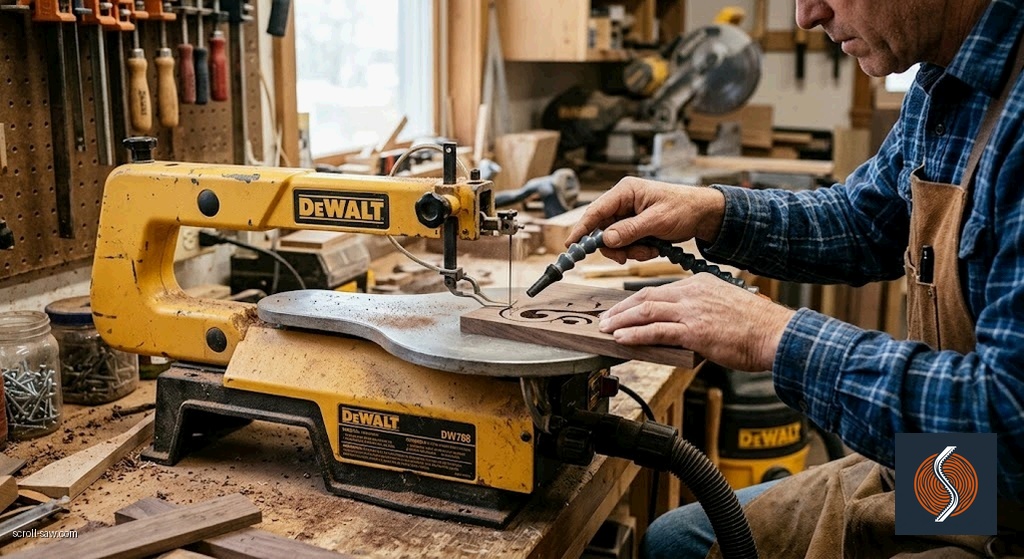
The DeWalt DW788 comes with a flexible dust blower built in. It is a small, adjustable tube that directs a stream of air from the saw’s air pump to the cut line. In principle, it works. In practice, it has limits that every DW788 owner runs into eventually. The question is whether the built-in blower is enough for your workflow or whether you need to add dust collection to keep your workspace clean and your cut line visible.
The Built-In Flexible Dust Blower on the DeWalt DW788
The flexible dust blower on the DW788 is one of those features that sounds better on paper than it performs in heavy use. The tube is adjustable, so you can aim it at the cut line. The air flow is steady, not pulsing. For light work in dry wood, it does the job: it keeps the immediate cut area clear enough to follow a pattern line.
The problem is volume. The built-in blower moves a modest amount of air. When you are cutting green wood, resinous softwoods, or materials that produce sticky dust, the blower cannot keep up. The dust clings to the workpiece and the table, and you end up stopping to brush it away anyway. The cast-iron table is flat and smooth, which helps dust slide off, but the blower alone will not clear a heavily loaded cut area.
Another issue is adjustment range. The flexible tube stays where you put it for a while, but vibration during long cutting sessions can shift it. You may find that the air stream has drifted off your cut line after 20 minutes of cutting. This is not a dealbreaker, but it is an annoyance that adds up over a long session.
Adding a Dust Collector to the DeWalt Scroll Saw
If the built-in blower is not enough, the next step is adding dust collection. The dewalt scroll saw dust collector conversation starts with a simple fact: the DW788 has a dust port, but it is small. Most shop vacuums and dust collectors use 2.5-inch or 4-inch hoses. The DW788’s port is smaller than that, which means you need an adapter to connect standard dust collection hoses.
Here is what to think about when choosing a dust collector for the DeWalt 788 scroll saw:
Airflow matters more than hose size. A shop vac with high static pressure will pull more dust through a small port and an adapter than a large-diameter low-pressure dust collector will. Scroll saw dust is fine and light, so you need suction, not volume. A standard shop vac is usually sufficient for a single scroll saw.
Port location affects efficiency. The dust port on the DW788 is positioned to catch dust that falls through the blade slot in the table. Dust that lands on top of the table or clings to the workpiece will not be captured by the port alone. This is why the best setup combines the built-in blower (to push dust off the cut line) with the dust port (to pull dust away from the table).
Adapter quality matters. A loose adapter leaks air and reduces suction at the port. Look for a tapered adapter that fits snugly between the DW788’s port and your vacuum hose. Tape the joints with duct tape if needed. Every leak in the system reduces the suction that reaches the saw.
The DW788 Stand and Dust Collection Integration
If you mount your DW788 on a stand, you have more options for dust collection. The stand gives you room to run a hose from the dust port to a shop vac mounted on a shelf below the saw. This keeps the vacuum close to the source, which minimizes hose length and maximizes suction.
Stand mounting also lets you position a secondary dust collection point. Some woodworkers add a small auxiliary dust port near the front of the table, connected to the same shop vac with a Y-adapter. This captures dust that the built-in port misses. It is not elegant, but it works.
The exploded diagram for the DW788 (available in the owner’s manual) shows the dust port assembly and how it connects to the saw’s internal air path. If you are modifying your dust collection setup, studying this diagram helps you understand where dust travels inside the saw and where your collection efforts will be most effective.
Comparing Dust Collection Approaches
There are three common approaches to dewalt dw788 scroll saw dust collection, and each has tradeoffs:
Built-in blower only. Simplest, no extra equipment. Works for light, dry work. Fails with heavy dust production or sticky materials. Cost: nothing extra.
Shop vac connected to dust port. Captures most dust that falls through the table. Requires an adapter and a shop vac. Does not capture dust on top of the table. Good for most hobbyist work. This is what most DW788 owners end up with.
Shop vac plus auxiliary port plus blower. Maximum dust capture. The blower pushes dust off the cut line, the main port pulls dust from below, and an auxiliary port catches what the main port misses. More complex to set up and maintain, but the cleanest option for heavy users.
My recommendation for most people is the middle option: a shop vac connected to the dust port, with the built-in blower aimed at the cut line. This combination handles 80 percent of scroll saw work without the complexity of a multi-port system. If you cut for hours at a time or work with particularly dusty materials, upgrade to the third option.
What the DeWalt DW7880 and DW7881 Blades Mean for Dust
The blades you use affect dust production more than you might think. The DeWalt DW7880 (pinless blades) and DeWalt DW7881 (pin-end blades) are the factory blade options, but most woodworkers buy third-party blades too.
Fine-tooth blades produce finer dust that is harder to capture. Coarse-tooth blades produce larger chips that fall through the table slot more readily and are easier for the dust port to grab. If you are having trouble with dust despite having a shop vac connected, try a blade with slightly larger teeth. The dust will be coarser and easier to collect.
Workflow Considerations
Think about how you work. If you do short sessions of 15 to 30 minutes, the built-in blower may be all you need. You can brush off the table between cuts. If you do marathon sessions of two or three hours, dust builds up fast and you need active collection running the whole time.
If you cut inside shapes (where you thread the blade through a pilot hole), dust accumulates inside the workpiece as you cut. The blower helps clear the cut line, but dust inside the cutout will not be captured by any dust collection system. Plan to empty cutouts and brush the table when you finish each piece.
The 20-inch throat means you can swing large workpieces on the DW788, but large workpieces generate more dust in a wider area. A dust port centered under the blade slot will not capture dust from the edges of a wide piece. If you regularly cut large panels, consider adding a downdraft table or a secondary collection point.
My Verdict
The built-in flexible dust blower on the DeWalt DW788 is adequate for light work but insufficient for serious sessions. Adding a shop vac to the dust port is the single biggest improvement you can make to your dust situation, and it costs less than you might think. The adapter is the only specialty part you need.
The real flaw in the DW788’s dust system is the small port size. A larger port would accept standard hoses directly and capture more dust without the leakage that adapters introduce. But this is a limitation of the saw’s design, not something you can fix without modifying the machine.
For most woodworkers, the answer is simple: connect a shop vac, aim the blower at the cut line, and accept that you will still need to brush the table occasionally. That is the reality of scroll saw dust, and no single tool or attachment will change it completely.
FAQ
Does the DeWalt DW788 come with a dust blower? Yes, the DW788 includes a flexible dust blower that directs air from the saw’s internal pump to the cut line. It is adjustable and works for light to moderate cutting. For heavy dust production, adding a shop vac to the dust port improves collection significantly.
What size dust port does the DeWalt DW788 have? The dust port on the DW788 is smaller than standard 2.5-inch shop vac hoses. You will need an adapter to connect a standard shop vac hose to the saw’s dust port. A snug-fitting tapered adapter with taped joints will give the best suction.
Can I use a shop vac for dust collection on my DeWalt scroll saw? Yes, a standard shop vac works well for scroll saw dust collection. Scroll saw dust is fine and light, so you need high static pressure (which shop vacs provide) rather than high volume. Connect the vac to the dust port with an adapter.
How do I improve dust collection on my DeWalt 788 scroll saw? Start by connecting a shop vac to the dust port with a well-sealed adapter. Keep the built-in blower aimed at the cut line. For heavy use, consider adding an auxiliary dust port near the front of the table with a Y-adapter to capture dust the main port misses.
Does the DeWalt DW788 dust blower work for all materials? The built-in blower works well for dry wood that produces light, powdery dust. It struggles with green wood, resinous softwoods, and materials that produce sticky dust. In those cases, a shop vac connected to the dust port is necessary to keep the cut line visible.
Where is the dust port located on the DeWalt DW788? The dust port is positioned below the cast-iron table, designed to catch dust that falls through the blade slot. Dust that lands on top of the table or clings to the workpiece will not be captured by the port alone, which is why combining the port with the built-in blower is effective.
Can I mount a shop vac under the DeWalt DW788 stand? Yes, if you use a stand, you can mount a shop vac on a shelf below the saw. This keeps the hose short, which maximizes suction. The stand also gives you room to run hoses and position the vacuum out of the way.
References
- DeWalt DW788 owner’s manual and exploded diagram, DeWalt.com
- Wood dust exposure standards, National Institute for Occupational Safety and Health, CDC.gov
- Shop ventilation and dust collection guidelines, OSHA.gov
Title Tag: DeWalt Scroll Saw Dust Blower Guide Meta Description: Learn how to choose and set up a dust blower and dust collection system for your DeWalt scroll saw, including built-in blower limits, shop vac setup, and workflow tips. URL Slug: choosing-a-dewalt-scroll-saw-dust-blower-that-fits-the-machine-and-workflow Excerpt: The DeWalt DW788’s built-in dust blower works for light cutting but struggles with heavy dust. This guide covers how to add shop vac dust collection, choose the right adapter, and build a system that keeps your cut line clear.


