
Best Magnifying Lamp for Scroll Saw: Lighting and Magnification That Actually Help
Best Magnifying Lamp for Scroll Saw: Lighting and Magnification That Actually Help
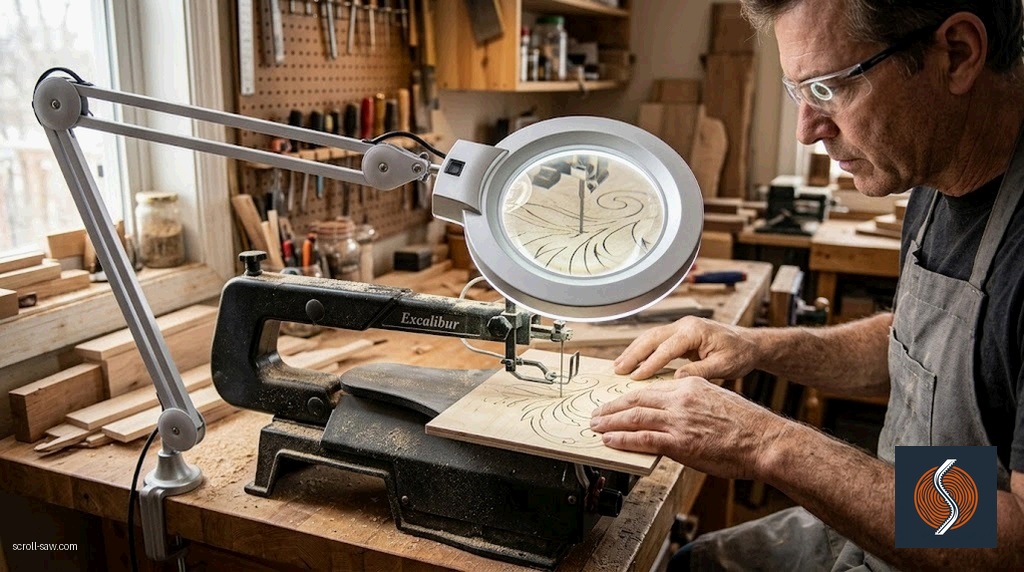
A magnifying lamp positioned at the scroll saw lets you see fine detail patterns, pattern lines, and blade position clearly—particularly important for detailed fretwork, portrait work, and very fine fonts. Without adequate lighting and magnification, fine detail work depends on approximation rather than precision.
The lamp has two functions: task lighting (illuminating the work surface without shadow) and magnification (making small details visible). Both matter for scroll saw use.
Short answer: a 5-diopter (2.25x magnification) daylight LED ring lamp on a flexible arm positioned directly over the blade and pattern is the standard setup. The arm must be adjustable to avoid interfering with blade changes.
Why magnification and lighting matter
Fine pattern lines. Printed scroll saw patterns have line widths of 0.5-1mm. At standard working distance (18-24 inches from eyes to work), fine lines are hard to distinguish from the wood grain.
Blade position relative to pattern. Knowing exactly where the blade is relative to the pattern line matters for precise cutting. Magnification makes the relationship clear.
Detail patterns. Portrait fretwork, wildlife feather detail, and fine script fonts require seeing small-scale pattern elements clearly.
Shadows from overhead lighting. Workshop lighting often creates shadows under the saw table or around the blade entry point. Task lighting eliminates work-surface shadows.
Eye fatigue. Fine detail work with inadequate lighting causes eye strain over long sessions. Proper lighting reduces fatigue.
Diopter and magnification explained
Magnifying lamps are rated in diopters. The relationship to magnification:
-
3.5 diopter: ~1.75x magnification. Light magnification, wide field of view.
-
5 diopter: ~2.25x magnification. Standard for detail work. Good balance of magnification and working distance.
-
7 diopter: ~2.75x magnification. More magnification, smaller field of view.
-
10 diopter: ~3.5x magnification. Jewelry-scale magnification. Narrow field, close working distance.
For scroll saw work: 5 diopter is the standard. Enough to see fine pattern detail; wide enough field of view to see the work context.
7 diopter works for very fine detail (portrait fretwork under 2 inches, very fine script).
Light type
Daylight LED (5000-6500K color temperature). Neutral white light that renders pattern lines and wood grain accurately. Fine pattern detail is clear. Eye-friendly for extended sessions. Energy-efficient.
Fluorescent daylight. Similar color rendering to daylight LED. Larger lamp heads, wider illumination.
Incandescent. Warm yellow light. Acceptable for general work, not ideal for fine detail (color rendering reduces contrast on pattern lines).
Warm LED. Similar issues to incandescent. Softer but less contrasty.
Recommendation: daylight LED. Best contrast for pattern lines; runs cool; lasts long.
Arm and positioning
Flexible gooseneck arm. Positions anywhere; holds its position well. Good for scroll saw where exact positioning matters.
Articulating arm (spring-balanced). Large range of motion; holds position reliably. Common in professional settings.
Fixed arm with swivel head. Less flexible; repositioning is limited. Less ideal for scroll saw.
Clamp mount vs. base mount. Clamp mount attaches to the saw table or workbench. Base mount sits on a surface. Clamp mount is generally more versatile.
Positioning for scroll saw:
-
Arm positioned to the side of the saw (not directly above, which blocks vision and blade access).
-
Lamp head angled to illuminate the blade entry point without shadow.
-
Close enough to illuminate detail without blocking hand movement.
-
Height allows easy blade changes without moving the lamp.
What to look for when buying
Diopter: 5 for most work; 7 for very fine detail.
Color temperature: 5000K-6500K daylight.
Light type: LED for longevity and cool running.
Arm type: flexible gooseneck or articulating arm with adequate range of motion.
Mount type: clamp mount for scroll saw bench positioning.
Lamp head size: larger lens gives wider field of view at same magnification.
Brightness: adjustable brightness preferred. Some scroll saw environments need brighter light; some less.
Build quality: lamp used in a workshop needs to handle the environment.
Alternatives to dedicated magnifying lamps
Optivisor or head-mounted magnifier. Worn on the head, provides hands-free magnification. Many scroll saw cutters prefer optivisors for very fine detail work. No lamp shadow concerns. Requires separate task lighting. Various diopter options (typically 2.5x or 3.5x for general scroll saw).
Task lighting without magnification. For work that doesn’t need magnification, a simple adjustable LED desk lamp provides task lighting. Suitable for most intermediate scroll saw work.
Floor lamp positioned beside saw. Adjustable floor lamp brings light from the side rather than above. Some scroll saw workers prefer this to mounting lamps on the saw.
Saw-mounted light. Some scroll saws include integrated lights. These provide task lighting but not magnification. Add-on lights that clip to the arm cover are available for some saws.
Setup for scroll saw use
-
Position lamp on scroll saw side. Right side if right-handed (so you’re not reaching across the lamp).
-
Clamp to bench edge or saw arm. Below eye level. Lamp head below saw arm.
-
Angle head toward blade. Illuminate the blade entry point and pattern area.
-
Test positioning. Sit at saw; verify illumination covers the pattern area without shadow. Verify arm doesn’t interfere with saw arm movement.
-
Verify magnification is useful. At working distance, 5-diopter should visibly clarify pattern lines.
Common problems and fixes
Lamp blocks vision. Lamp positioned too high or centered over work. Reposition to side angle.
Shadow from lamp itself. Lamp arm creating shadow in work area. Reposition arm.
Eye strain during extended use. Incorrect magnification or color temperature. Verify 5000K+ color temperature; try 5 diopter if using 7.
Lamp head can’t reach working position. Arm too short or mounting position wrong. Reposition clamp; longer gooseneck arm.
Pattern lines still hard to see. Magnification insufficient or pattern printed too fine. Try 7 diopter; print patterns with bolder lines.
Lamp heat too close to stock. Incandescent lamp. Switch to LED; runs cool.
Frequently asked questions
Do I need a magnifying lamp for scroll saw work? Not for all work. Simple silhouette patterns with adequate line width cut fine without magnification. For fine fretwork, portrait detail, and small fonts, magnification significantly improves results.
What diopter is best for scroll saw? 5 diopter for most scroll saw work. 7 diopter for very fine detail. 3.5 diopter if you find 5 diopter disorienting.
Can I use a jeweler’s loupe instead? Jeweler’s loupes are too magnified and too small a field. Magnifying lamps provide practical magnification at working distance for scroll saw scale work.
Should I use an optivisor or a lamp? Optivisors move with your head (no shadow issues) but require separate task lighting. Magnifying lamps provide both. Experienced scroll saw cutters use both for very fine work.
Does the lamp need to be scroll-saw-specific? No. Any quality 5-diopter LED daylight magnifying lamp with flexible arm works. “Scroll saw specific” products are general magnifying lamps rebranded.
How close should the lamp be to the work? At 5 diopter, optimal focus distance is approximately 10-12 inches. Position lamp so focus distance corresponds to the work surface height.
Can I use a magnifying glass instead? Handheld magnifying glass requires one hand and can’t be positioned for extended cutting sessions. A mounted lamp is hands-free.
References
-
Steve Good, Scrollsaw Workshop (blog).
-
Fox Chapel Publishing, Big Book of Scroll Saw Woodworking.


