
Box Making Projects for the Scroll Saw: From Simple Keepsake Boxes to Complex Constructions
Box Making Projects for the Scroll Saw: From Simple Keepsake Boxes to Complex Constructions
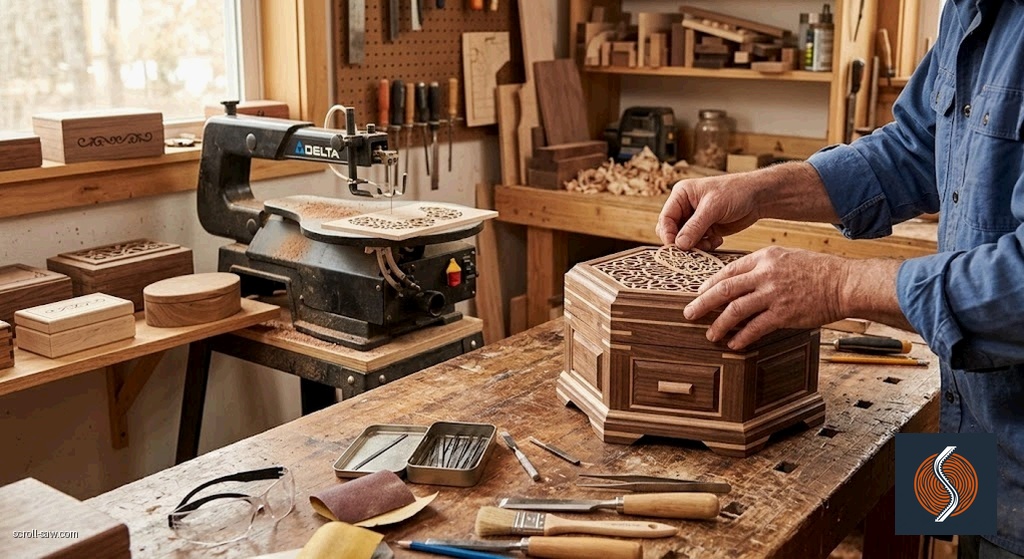
Scroll saw box making uses the scroll saw’s curve-cutting capability to produce boxes with unusual shapes, decorative panels, and ornamental lids that standard woodworking tools can’t easily produce. A scroll saw box might have a curved-wall silhouette, a fretwork-panel lid, a compound-cut decorative element, or interlocking parts.
Boxes are practical gifts and functional craft fair items. A wooden box has lasting value that flat wall art sometimes lacks.
Short answer: Creating Wooden Boxes on the Scroll Saw by Scroll Saw Workshop is the canonical reference for scroll saw box projects. Most box projects require 1/4 to 3/4-inch stock, woodworking adhesive, and basic joinery knowledge.
Types of scroll saw boxes
Simple keepsake box. Four sides, bottom, and hinged or removable lid. Scroll saw provides curved exterior silhouette or decorative lid fretwork.
Decorative box with fretwork lid. Standard box construction with fretwork-cut lid. The fretwork is the feature.
Interlocking scroll saw box. Box assembled from interlocking scroll-cut pieces without traditional joinery. Complex design.
Stacked ring box. Multiple rings of varying size stacked to form a shaped box (like an oval or teardrop form). Unique shape impossible with standard woodworking.
Scroll-cut keepsake. Box with scroll-cut openings on sides, showing interior contents (jewelry, mementos).
Curved-side box. Box with curved walls cut on scroll saw. Distinctive silhouette compared to standard right-angle box.
Clock box. Box with clock mechanism mounted in fretwork front panel.
Jewelry box. Multi-compartment box with fretwork lid, velvet lining, and scroll-cut organizational elements.
Puzzle box. Box that opens through a non-obvious mechanism. Advanced project.
Box construction methods
Traditional joinery (butt, miter, rabbet). Standard woodworking joints, assembled with standard adhesive. Scroll saw provides decorative elements.
Dado joints. Slots cut by router or table saw (not scroll saw) receiving panel edges. Clean construction.
Stacked ring construction. Each ring is a scroll-cut oval or shape. Rings stacked and glued. Interior formed by varying ring sizes.
Interlocking scroll-cut. Scroll-cut tabs and slots lock without traditional adhesive joinery.
Bent wood. Thin stock kerfed on scroll saw; bent around form; glued.
Scroll saw’s role in box making
The scroll saw contributes:
Curved sides. Scroll saw cuts curved exterior silhouettes for box sides.
Fretwork lids and panels. Decorative cutouts in box top or sides.
Ring-stacked shapes. Stacked rings forming organic box shapes.
Decorative details. Appliqué or inlay elements attached to box surfaces.
Interior fittings. Scroll-cut compartment dividers.
The box is not entirely a scroll saw project. Standard box assembly still uses standard woodworking methods. Scroll saw adds the distinctive decorative elements.
Stock selection for boxes
Structural sides and bottom:
-
1/4 to 1/2-inch solid hardwood or plywood.
-
Cherry, walnut, maple for premium boxes.
-
Baltic birch plywood for stability and painted boxes.
Fretwork lid:
-
1/8 to 1/4-inch plywood or thin hardwood.
-
Enough thickness to handle without breaking.
Stacked ring construction:
-
1/4 to 3/4-inch solid wood (softer hardwoods like cherry or butternut are more forgiving).
-
Consistent thickness for matching rings.
Interior lining:
-
Felt or velvet—not scroll-cut, but necessary for jewelry boxes.
-
Cedar sheets for aromatic boxes.
Hardware:
-
Hinges: piano hinge (continuous) or butt hinges.
-
Clasps or closures.
-
Knobs or pulls.
-
All available at woodworking suppliers.
Blade choice for boxes
Curved side cuts in 1/4-1/2-inch hardwood: #5 or #7 reverse-tooth. Olson FR49400.
Fretwork lid detail in 1/8-1/4-inch stock: #3 reverse-tooth. Olson FR49202.
Stacked ring construction in 1/4-inch stock: #5 reverse-tooth.
Production box runs: Pegas Regular Scroll #7.
Simple keepsake box project sequence
-
Determine dimensions. Interior size needed for contents (jewelry, keepsakes, photos).
-
Mill or purchase stock. Cut sides, bottom, and lid stock to rough dimensions.
-
Cut side shapes on scroll saw (if curved) or crosscut to standard dimensions.
-
Cut fretwork lid on scroll saw.
-
Assemble box body. Glue and clamp corners. Verify square.
-
Sand assembled box. Exterior surfaces.
-
Mount hardware. Hinges, clasp, feet.
-
Install lid. Hinge to box back.
-
Finish. Sand to 220-grit; clear or painted finish.
-
Line interior. Felt or velvet if jewelry box.
Stacked ring box sequence
-
Design shape. Side profile of finished box. Convert profile to ring thicknesses.
-
Cut rings. Each ring is a closed oval or shape cut on scroll saw. Interior cutout varies per ring.
-
Sand each ring. Verify flat mating surfaces.
-
Stack and glue rings. Dry-fit first. Align grain across rings or stagger for uniform appearance.
-
Shape exterior. Drum sander, spokeshave, or careful scroll-cut refining.
-
Separate lid from body. Band saw or scroll saw at the intended lid line. Or design rings so specific layers form the lid naturally.
-
Finish. Oil finish or clear coat.
Finishing boxes
For jewelry or keepsake boxes:
-
Exterior: clear satin polyurethane on hardwood.
-
Interior: felt or velvet lining (hides interior finish).
For display pieces:
-
Full finish inside and out.
-
French polish for premium appearance.
Painted boxes:
-
Multiple coats of latex or acrylic.
-
Clear coat sealer.
Oil-finished boxes:
-
Penetrating tung oil or danish oil.
-
No film buildup in fretwork gaps.
Where to source patterns
Creating Wooden Boxes on the Scroll Saw is the specific reference for scroll saw box projects.
Complete Guide to Making Wooden Clocks, 3rd Ed includes box elements for clock housing.
Big Book of Scroll Saw Woodworking has box patterns.
Steve Good’s blog has box projects.
Common problems and fixes
Corners don’t align. Sides cut to different lengths. Verify lengths against cut list before assembly.
Lid doesn’t fit after assembly. Box warped or lid cut for pre-glue dimensions. Test-fit lid before final glue-up.
Fretwork lid is too fragile. Stock too thin or design too fine for stock. Thicken stock; reinforce fretwork design.
Stacked rings don’t align. Ring interiors vary. Verify ring size consistency.
Finish filled fretwork gaps. Too-thick finish coat. Multiple thin coats; brush carefully.
Hardware mounting cracked the wood. Mounting holes too close to edge. Re-position hardware; pre-drill correctly.
Box smells of finish. Finish not fully cured before closing. Allow full cure time before using box for sensitive items.
Frequently asked questions
Do I need a table saw for scroll saw boxes? For some box constructions, yes. For simple boxes (butt joints) and stacked ring constructions, the scroll saw can do most of the cutting. A drill press and basic hand tools round out the shop.
What’s the easiest scroll saw box project? Simple keepsake box: rectangular form with a fretwork-cut lid. One scroll saw contribution (the lid), rest is standard woodworking.
Can I make boxes for sale? Yes—strong market. Jewelry boxes $30-150. Small keepsake boxes $20-75. Elaborate stacked-ring boxes $75-300.
How do I add a hinge to a scroll saw box? Standard butt hinges for most boxes. Piano hinge for long lids. Route or chisel a shallow recess (mortise) for hinges to lie flush.
What wood is best for jewelry boxes? Cherry (traditional), walnut (premium dark), or maple (light tone). Interior lining with felt or velvet regardless of wood species.
Can I use MDF for box construction? MDF takes screws poorly at edges. Better for painted boxes where interior dimensions matter more than strength. Not for heirloom pieces.
What’s the most impressive scroll saw box technique? Stacked ring construction. Produces organic curved forms that read as sculpted rather than built. Takes time but the results are distinctive.
References
-
Scroll Saw Workshop, Creating Wooden Boxes on the Scroll Saw, Fox Chapel Publishing.
-
Fox Chapel Publishing, Big Book of Scroll Saw Woodworking.
-
Steve Good, Scrollsaw Workshop (blog).


