
Celtic Cross Scroll Saw Patterns: Knotwork, Circles, and Sacred Geometry
Celtic Cross Scroll Saw Patterns: Knotwork, Circles, and Sacred Geometry
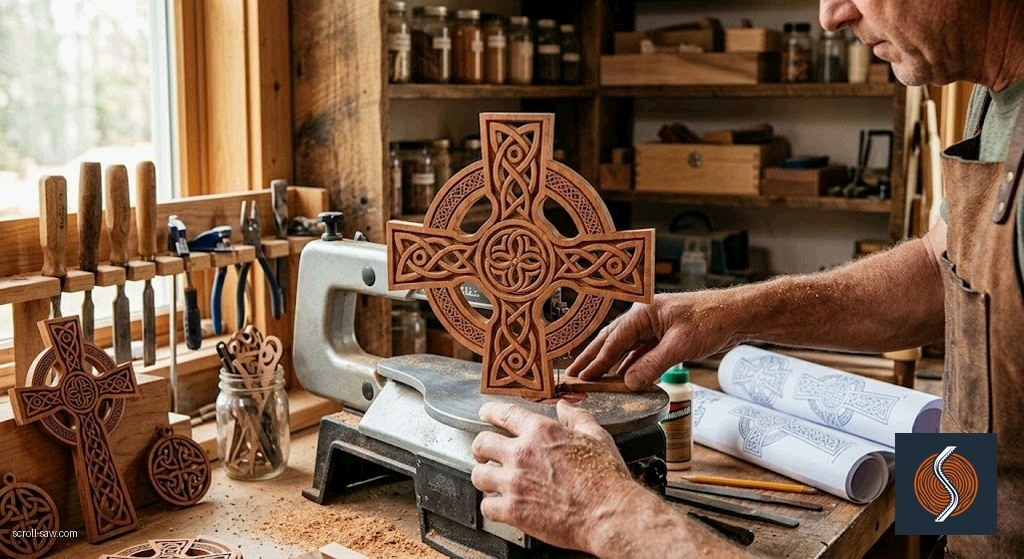
A Celtic cross scroll saw pattern combines the Latin cross form with a circle connecting the four arms—the defining element that distinguishes it from other cross forms—and often includes interlaced knotwork filling the cross arms and body. The design is both religious and cultural, with roots in early medieval Irish and Scottish Christianity.
Celtic cross patterns range from simple (cross with circle, minimal decoration) to complex (full knotwork infill across all surfaces). Skill requirements scale accordingly.
Short answer: 1/4-inch to 1/2-inch stock (Baltic birch plywood for complex knotwork, hardwood for clear-finish crosses), #3 or #5 reverse-tooth blade for knotwork, plan cutting sequence to preserve bridge integrity throughout.
Celtic cross design elements
The cross form. Standard cross with four arms. The arm proportions (arm length vs. arm width vs. total height) vary by tradition. Common proportions: arm width 1/4 to 1/3 of arm length.
The ring. Circle connecting the four arm ends is the defining Celtic cross feature. The ring can be solid (no cutout), hollow (the ring is just a circular band), or decorated.
Interlaced knotwork. Continuous interlaced strands with no beginning or end. Traditional in Celtic art. Fills cross arms, ring area, and body.
Spiral motifs. Alternative or complementary decoration. Spirals at cross intersections.
Zoomorphic elements. Animal interlace. Interlaced animal forms instead of or alongside geometric knotwork.
Inscriptions. Irish or Latin text on cross arms. Historically common on high crosses.
Figure carving. Some Celtic crosses depict Biblical figures. Simplified in scroll saw context.
Pattern skill levels
Simple Celtic cross. Cross outline with ring. No knotwork. Beginner pattern.
Cross with simple knotwork. Basic interlace in one or two arms. Intermediate.
Full knotwork cross. Complex continuous interlace across entire cross. Advanced.
High cross pictorial. Cross with figure panels and decorative fields. Very advanced.
Stock selection
Baltic birch plywood for:
-
Complex knotwork designs with many small bridges.
-
Cross-grain construction handles cutting in all directions.
-
Standard for intermediate to advanced Celtic crosses.
Solid hardwood for:
-
Simple crosses without complex knotwork.
-
Heirloom clear-finish pieces.
-
Species: cherry (warm, traditional), walnut (dark, dramatic), oak (traditional, slightly open grain—use for larger crosses where grain isn’t a problem), maple (light, neutral).
Thickness:
-
1/4 inch: standard for most crosses.
-
3/8 inch: more substantial.
-
1/2 inch: heirloom thickness.
Blade choice
Simple cross outline: #5 reverse-tooth. Olson FR49202.
Knotwork detail: #3 reverse-tooth. Knotwork requires tight turns in crossing interlace.
Very fine knotwork: #2/0 or #1 blade.
Production: Pegas Regular Scroll #7 for smoother cuts on production runs.
Extended sessions: Pegas Modified Geometry #12. Cool-running.
Knotwork cutting principles
Celtic knotwork is a pattern of interlaced strands. On the scroll saw, this means cutting channels between strands and at strand crossings.
Bridges in knotwork. At each crossing, strands must be connected (the crossing can’t be a complete cutout). Bridges at crossings are structural to the knotwork.
Consistent strand width. All strands in a knotwork pattern should be the same width. Consistency is what makes knotwork read as knotwork.
Continuous cutting path. Plan a cutting sequence that follows one strand’s channel completely before starting the next. Minimizes blade re-entry.
Interior to exterior. Cut central crossings first; work outward to cross arms.
Ring cutting last. The ring is structural; cut it last after interior knotwork is complete.
Perimeter last. Cross outer boundary cut after all interior work.
Cutting sequence for knotwork cross
-
Drill all interior entry holes before cutting begins. Mark on pattern.
-
Cut central body knotwork. Finest detail.
-
Cut arm knotwork. Left arm, right arm, top arm, bottom arm.
-
Cut ring interior. If the ring itself has cutouts.
-
Cut the cross perimeter. The outer boundary.
Finishing Celtic crosses
Clear finish (natural wood):
-
Satin polyurethane over hardwood.
-
Cherry or walnut most natural for Celtic cross.
-
Multiple thin coats; avoid pooling in knotwork channels.
Painted:
-
Traditional Irish stone cross coloring: gray or stone-colored paint.
-
Green (Irish cultural association).
-
Gold metallic for ceremonial appearance.
Stained dark:
-
Dark walnut stain over light wood.
-
Reads as aged stone in the right application.
Woodburned detail:
-
Burn lines within knotwork channels before finishing.
-
Adds depth without cutting complexity.
Aged/weathered:
-
Distressed finish. Multiple paint layers + sanding.
-
Reads as ancient stone.
Display and applications
Wall décor. Celtic crosses as wall art in religious or Celtic-heritage contexts.
Garden crosses. Larger Celtic crosses with weather-resistant finish for outdoor placement.
Church décor. Donated or sold for church decoration.
Memorial pieces. Personalized Celtic crosses as memorial items.
Headstone design reference. Celtic crosses as design reference for headstone selection.
Gift for Irish/Scottish heritage persons. Personal cultural gift.
Wedding favors. Small Celtic cross ornaments as wedding favors at Celtic-heritage ceremonies.
Where to source patterns
Steve Good’s blog has Celtic cross patterns.
Big Book of Scroll Saw Woodworking includes Celtic patterns.
Sue Mey designs religious scroll saw patterns including Celtic crosses.
Specialty Celtic and religious pattern books cover Celtic crosses extensively.
Etsy has Celtic cross patterns available for download.
Common problems and fixes
Knotwork bridges broke. Bridges too narrow or blade too aggressive. Use narrower blade; design bridges at minimum 1/16-inch.
Knotwork unreadable. Strands too similar in width. Ensure consistent strand width; ensure clear channels between strands.
Ring cracked. Ring too thin or grain wrong direction. Use plywood; strengthen ring width.
Crossing pattern asymmetric. Cutting drift over many crossings. Take breaks; re-verify pattern.
Arm proportions look wrong. Pattern issue. Verify arm width/length ratios match expected Celtic cross proportions before cutting.
Finish pooled in knotwork channels. Too-thick coat. Multiple thin coats.
Central intersection unclear. Design overlapping. Clear cutting sequence; cut channels cleanly.
Historical context
High crosses of Ireland and Scotland date from the 8th-12th centuries. They stood outdoors at monastery sites, marking sacred ground. Modern Celtic cross designs in scroll saw work draw from these historical sources.
The ring connecting the cross arms is the Celtic cross’s distinguishing feature. Origin theories include:
-
Practical: the ring strengthened fragile stone cross arms.
-
Symbolic: the circle represents eternity, the sun, or divine perfection.
-
Both theories are plausible; historical evidence supports both.
Knotwork in Celtic art represents eternity (no beginning or end) and the interconnectedness of life.
Frequently asked questions
What makes a Celtic cross different from a plain cross? The ring connecting the four arm ends is the defining feature. Without the ring, it’s a Latin cross or another cross form.
How hard is Celtic knotwork to cut? Simple interlace: intermediate. Full complex knotwork: advanced. The challenge is maintaining consistent bridges throughout many small crossings.
What’s the best wood for a Celtic cross gift? Cherry for a warm, traditional heirloom feel. Walnut for dramatic dark tone. Both are appropriate for Celtic cross gifts.
Can Celtic crosses be made to sell? Yes—strong market in Irish-heritage communities, religious gift shops, Celtic festival craft fairs. Prices $20-150 depending on size and complexity.
Do I need to know the knotwork design rules? For cutting existing patterns, no. For designing your own knotwork patterns, yes. Celtic knotwork has specific construction rules. Books on Celtic knotwork design cover the rules.
What size Celtic cross is appropriate for wall display? 8-14 inches is standard wall art scale. Smaller for ornaments or gifts; larger for statement pieces.
Can I combine a Celtic cross with a name or date? Yes. Text combined with a Celtic cross produces personalized memorial or gift pieces.
References
-
Fox Chapel Publishing, Big Book of Scroll Saw Woodworking.
-
Steve Good, Scrollsaw Workshop (blog).
-
Sue Mey, religious scroll saw pattern designs.


