
Cherry Tree Scroll Saw Patterns: Seasonal Blossom and Year-Round Beauty
Cherry Tree Scroll Saw Patterns: Seasonal Blossom and Year-Round Beauty
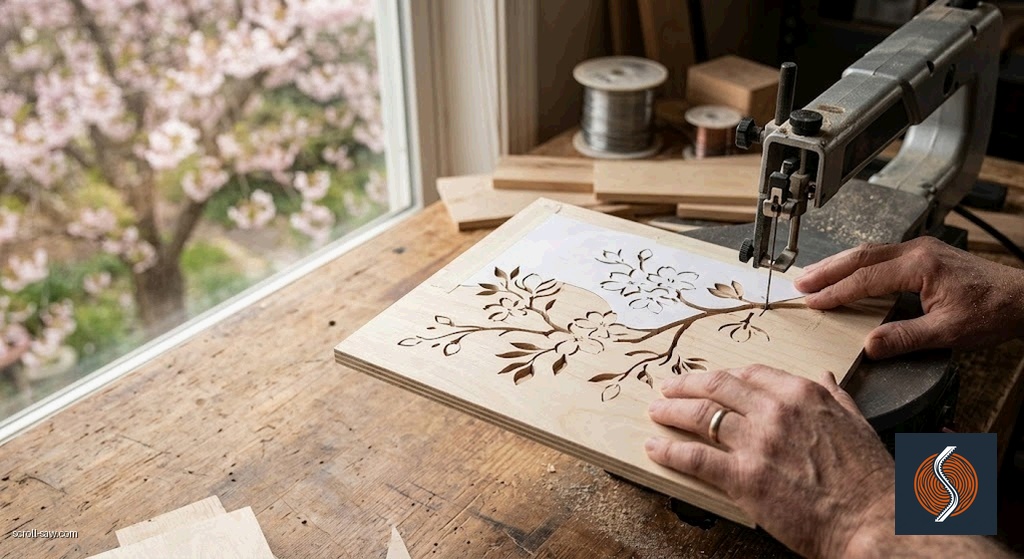
A cherry tree scroll saw pattern captures the Japanese cherry tree (sakura) or flowering cherry silhouette—branches loaded with blossoms—or the tree’s bare winter form. Both versions have distinctive visual appeal. The blossom version is one of the most popular spring and Japanese-motif scroll saw subjects.
Cherry blossom (sakura) patterns have particularly strong market appeal: Japanese cultural motifs are consistently popular in home décor, and the blossom aesthetic translates beautifully to scroll saw fretwork.
Short answer: 1/4-inch Baltic birch plywood for blossom fretwork detail, #3 reverse-tooth blade for fine blossom cutting, pale wood (maple or birch) for painted pink-on-natural look, or dark wood (walnut) for dramatic silhouette presentation.
Cherry tree pattern styles
Full blossom tree. Tree with branches filling the pattern with circular blossom shapes. Fretwork openings represent blossom clusters or individual flowers.
Bare winter tree. Branching pattern with no blossoms. Dramatic silhouette.
Single blossom branch. Detail of one branch with blossoms. Smaller pattern, more focused.
Japanese-style sakura. Stylized Japanese art interpretation. Asymmetric composition with hanging blossoms.
Blossom silhouette with text. Cherry blossom and Japanese or English text (“Sakura,” “Spring,” name).
Seasonal décor. Spring-themed pattern, used seasonally (April-May prime sale period).
Year-round décor. Cherry blossom pattern framed as permanent art piece.
Design considerations
Blossom vs. background. Cherry blossom patterns can be either:
-
Blossoms as solid wood: the blossom areas are the wood; sky and negative space are cutouts.
-
Blossoms as cutouts: the blossom areas are cut away; background wood remains. Less common but dramatic with backlit presentations.
Branch structure. Branches must be thick enough to be structural. Very fine branching is fragile. Main trunk and primary branches at least 1/4-inch width; secondary branches at least 1/8-inch.
Blossom representation. Options:
-
Circle cutouts representing blossom clusters.
-
Five-petal flower shapes.
-
Stylized cloud shapes.
-
Text or pattern fills.
Composition. Asymmetric compositions (strong Japanese aesthetic) or symmetric (more Western formal style).
Stock selection
Baltic birch plywood (standard for blossom work):
-
Cross-grain construction handles branch cuts in all directions.
-
Fine grain on face.
-
1/4-inch for most patterns.
-
1/8-inch for very fine blossom detail.
Light hardwood (maple, birch) for:
-
Natural pale wood color complements painted pink blossoms.
-
Clear finish + painted blossoms: pink acrylic on natural maple.
Dark hardwood (walnut) for:
-
Dramatic high-contrast silhouette.
-
No painting needed; walnut’s natural color reads as ink-brush painting.
-
Best for Japanese-style artistic presentations.
Cherry (the actual wood species):
-
Appropriate poetic match.
-
Warm pink-brown natural tone.
-
Clear finish produces beautiful results.
Blade choice
Standard blossom work in 1/4-inch plywood: #5 reverse-tooth. Olson FR49202.
Fine blossom detail or 1/8-inch stock: #3 reverse-tooth.
Very fine Japanese-style work: #2/0 or #1 blade.
Simple silhouette or bare winter tree: #5 or #7 depending on stock thickness.
Production runs: Pegas Regular Scroll #7.
Cutting sequence
-
Attach pattern with 3M Super 77. Optional ScotchBlue Painter’s Tape 2090 under the pattern on clear-finish stock.
-
Drill all interior entry holes. Every blossom cutout requires an entry.
-
Cut smallest blossom details first. Work from finest to coarsest detail.
-
Cut branch negative spaces. Sky areas between branches.
-
Cut perimeter. Tree outline or pattern boundary.
-
Sand while pattern attached.
-
Peel pattern.
Finishing cherry blossom patterns
Natural walnut, clear finish:
-
Dark wood reads as Japanese ink painting.
-
Satin polyurethane.
-
Minimal work; wood does the aesthetic work.
Natural maple with painted blossoms:
-
Clear coat maple background.
-
Dry-brush pink or white acrylic on blossom areas.
-
Represents the sakura color on natural wood.
Full painted:
-
Brown branches, pink or white blossoms, blue or sky-gray background (optional).
-
Multiple thin coats.
-
Reads as folk art or decorative.
Frame for display:
-
Japanese-style frame (dark lacquered frame).
-
Simple natural wood frame.
-
Or frame into a shadow box for depth.
Light box presentation:
-
Mount blossom fretwork over LED light source.
-
Illuminated blossom pattern reads dramatically.
-
White or warm LED behind blossoms.
Japanese cultural context
Sakura (cherry blossom) is Japan’s national flower. The annual blossom season (hanami) is one of Japan’s most celebrated cultural events.
In Japanese aesthetics, sakura symbolizes:
-
Mono no aware: the bittersweet awareness of impermanence (the blossoms last only 1-2 weeks).
-
Renewal: spring following winter.
-
Beauty: the blossoms are beautiful precisely because they are brief.
Japanese-influenced cherry blossom patterns tap into this aesthetic tradition. The patterns look best when the composition respects asymmetry and negative space, consistent with Japanese aesthetics.
Where to source patterns
Steve Good’s blog has cherry blossom and Japanese-style patterns.
Big Book of Scroll Saw Woodworking includes nature and tree patterns.
Japanese-motif scroll saw pattern books.
Etsy has cherry blossom scroll saw patterns available for download.
Graphic design resources: Japanese brush painting SVG patterns adapted for scroll saw.
Display applications
Wall art. Framed cherry blossom pattern as permanent décor.
Spring seasonal. Displayed April-May; stored other months.
Japanese room accent. Room decorated in Japanese aesthetic style.
Tea room or meditation space. Appropriate cultural decor.
Wedding décor. Sakura-themed weddings commonly use cherry blossom imagery.
Corporate or business décor. Japanese-style business settings.
Gift for Japan enthusiasts. Cherry blossom scroll saw piece as cultural gift.
Common problems and fixes
Branches too fragile. Branch width too narrow. Enlarge pattern or increase minimum branch width.
Blossoms unreadable. Blossom shapes too small. Enlarge pattern.
Bare winter tree looks uninteresting. Branching not dramatic enough. Study reference photographs of bare cherry tree silhouettes; increase branch drama.
Cutting drift in fine branches. Long cuts in thin elements. Short, deliberate cuts; verify blade condition.
Finish pooled in blossom cutouts. Too-thick coat. Multiple very thin coats with full drying time.
Pattern asymmetry lost. Cutting was too symmetric. Preserve designed asymmetry in the pattern; don’t correct it.
Frequently asked questions
Is a cherry blossom pattern hard to cut? Full blossom fretwork is intermediate to advanced. Simple blossom silhouettes are beginner-friendly. The difficulty scales with blossom density and branching complexity.
What wood reads best for Japanese aesthetic? Dark walnut for dramatic ink-painting effect. Or pale maple for traditional Japanese paper/fabric palette.
Can I sell cherry blossom pieces? Strong market in Japanese-heritage communities, spring seasonal markets, and Japanese-aesthetic home décor customers. Prices $25-150.
Should I frame or float the piece? Floating (piece mounted on a backing board with a small gap) emphasizes the dimensional nature of the fretwork. Standard framing also works.
Can I backlight a cherry blossom pattern? Excellent application. Place light behind the piece for illuminated blossom effect. The fretwork openings glow.
Is the cherry tree pattern religious or cultural? Cultural rather than religious in Japanese context. Suitable for any setting without religious connotation.
Can I make a full tree scene (blossoms + ground)? Yes. Full scene with ground, grass, and background adds context. More complex design but more complete artwork.
References
-
Fox Chapel Publishing, Big Book of Scroll Saw Woodworking.
-
Steve Good, Scrollsaw Workshop (blog).


