
Classic Fretwork Scroll Saw Patterns: The Traditional Art Form Explained
Classic Fretwork Scroll Saw Patterns: The Traditional Art Form Explained
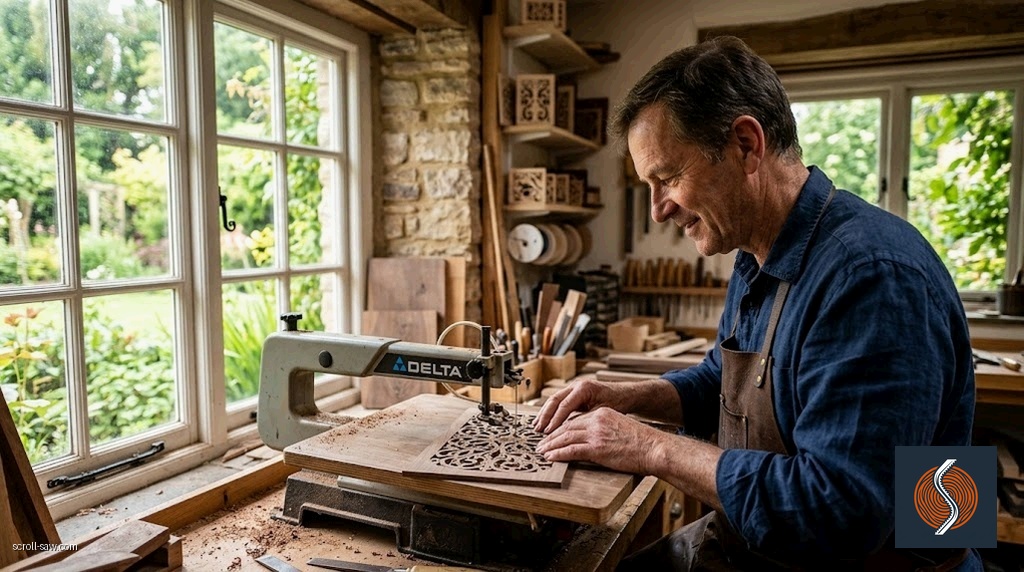
Classic fretwork is decorative pierced wood work with a long tradition in furniture ornamentation, architectural detail, and decorative art. Before the scroll saw was a hobby tool, it existed specifically for fretwork production. Victorian-era fretwork, Moorish geometric patterns, and architectural gingerbread trim are all classic fretwork traditions.
Classic fretwork patterns share specific characteristics: geometric or organic interlaced designs, consistent negative space (the cut-away portions), and continuous surface wood framing the design elements.
Short answer: 1/8 to 1/4-inch stock (Baltic birch plywood or thin hardwood), fine blades (#2/0 to #3 depending on detail), systematic cutting sequence from interior to exterior, traditional finishes.
What defines classic fretwork
Pierced design. The pattern’s decorative elements are achieved through cutting away (piercing) material. What remains is the solid wood; what’s cut away defines the design.
Continuous wood frame. The remaining solid wood forms a continuous structure—no isolated islands of wood without structural connection.
Consistent negative space. The proportions of solid wood to open space, and the size of individual openings, are consistent throughout the design.
Design vocabulary. Classic fretwork uses specific design motifs:
-
Geometric: diamonds, squares, stars, hexagons.
-
Organic: vines, leaves, scrolls, flowers.
-
Combined: organic forms in geometric framework.
-
Gothic revival: pointed arches, tracery.
-
Moorish: complex geometric star patterns.
-
Art Nouveau: flowing curves.
-
Victorian: dense complex patterns in various themes.
Historical traditions
Victorian fretwork (1850-1900). High point of powered fretwork production. Treadle-powered fret saws enabled production of elaborate interior décor. Fretwork screens, shelving brackets, architectural panels, mirror frames.
Moorish/Islamic geometric. Mathematical precision in star polygon patterns. Complex interlocking star and polygon arrangements. No living figures (Islamic geometric tradition).
Chinese lattice. Formalized geometric lattice designs used in Chinese architecture and furniture. Window screens, room dividers.
Gingerbread trim. American Victorian exterior architectural fretwork. Porch brackets, gable ornaments, window surrounds. Usually painted white.
Chippendale fretwork. 18th-century furniture fretwork in Chinese Chippendale style. Geometric lattice in furniture galleries and chair backs.
Arts and Crafts. Late 19th-century reaction to Victorian excess. Simpler, nature-inspired fretwork motifs.
Stock selection for classic fretwork
1/8-inch Baltic birch plywood. Standard for delicate fretwork:
-
Cross-grain construction handles cuts in all directions.
-
Consistent density.
-
Thin for lacy appearance.
1/4-inch Baltic birch plywood. For more substantial fretwork:
-
More structural.
-
Less delicate appearance.
Thin hardwood veneer. For premium pieces:
-
Walnut veneer (1/8-inch): dark dramatic tone.
-
Cherry veneer: warm tone.
-
Requires backing support during cutting.
Solid thin hardwood. For premium appearance:
-
1/8-inch cherry, walnut, or maple in small dimensions.
-
Grain direction must align with pattern for structural strength.
Blade selection
Fine Victorian fretwork: #2/0 or #1 blade. Narrow kerf, tight turns.
Standard fretwork: #3 reverse-tooth. Olson FR49202.
Larger geometric fretwork: #5 reverse-tooth.
Extended cutting sessions: Pegas Modified Geometry #12. Cool-running.
Production fretwork: Pegas Regular Scroll #7 or equivalent fine blade.
Blade tension for fretwork
Fretwork requires higher blade tension than general scroll saw work:
Test: press blade sideways at midpoint. Deflection should be under 1/16 inch for fretwork (less than the 1/8-inch standard).
Why: fine fretwork cuts are short and frequently change direction. Loose blades wander in direction changes.
Risk: over-tensioning breaks blades. Increase tension gradually.
Pattern preparation
-
Print at exact intended size. Verify against ruler.
-
Verify all openings are connected to the exterior. No floating island of cut-out material.
-
Verify all solid wood elements are connected. No isolated islands of solid wood.
-
Mark all drill entry points. Every interior opening needs a drill entry.
-
Number the interior cut sequence. For complex patterns with many openings, number them in cutting order.
-
Attach pattern with 3M Super 77. Optional ScotchBlue Painter’s Tape 2090 underneath for clear-finish stock.
Drilling entry holes
Drill all entry holes before cutting begins. Drilling after cutting risks cracking the fretwork.
Drill bit size: 1/16-inch for fine blades (#2/0 to #3); 3/32-inch for larger blades.
Drill position: in the center of each interior opening. Far enough from the cut line that the hole doesn’t show in the finished cut.
Drill press for accuracy. Handheld drill for large patterns.
Cutting sequence for fretwork
-
Central interior cuts. Start in the middle of the pattern; work outward.
-
Smaller interior openings first. Fine detail while surrounding wood supports the structure.
-
Larger interior openings. After fine detail is complete.
-
Pattern perimeter last. The outer boundary cut removes the last connection to the main stock. Cut perimeter last to preserve support throughout.
Speed and feed for fretwork
Speed: medium-slow (600-1,000 SPM) for fine fretwork. Slower for very fine blades.
Feed: very slow and deliberate. Fretwork is not a rushing task.
Direction changes: slow down approaching direction changes; turn smoothly.
Take breaks: fretwork requires sustained focus. 30-45 minute sessions with breaks.
Finishing classic fretwork
Clear finish (traditional for fine work):
-
Satin polyurethane: multiple very thin coats. Avoid pooling in openings.
-
Oil finish: penetrating; doesn’t pool.
-
Shellac: traditional period-appropriate finish.
Dark stain: emphasizes traditional appearance.
Painted: occasionally painted for architectural fretwork.
Unfinished (some traditions): some fretwork intended to age naturally (softwood gingerbread trim, cedar fretwork).
Gilded: gold leaf on select fretwork elements. Traditional in Moorish and Gothic revival contexts.
Classic fretwork applications
Framed wall art. Fretwork panel in a matching wood frame.
Mirror frame. Fretwork panel surrounding a mirror.
Screen or room divider. Structural fretwork panels creating visual separation.
Furniture embellishment. Fretwork panels applied to furniture doors, backs, or galleries.
Shelf brackets. Decorative fretwork brackets supporting shelves.
Clock surround. Fretwork panel surrounding a clock face.
Architectural gingerbread. Porch brackets, gable ornaments.
Decorative box tops. Fretwork lid on a wooden box.
Where to source classic fretwork patterns
Scroll Saw Workbook, 3rd Ed by John Nelson includes traditional fretwork patterns.
Big Book of Scroll Saw Woodworking has fretwork sections.
Historical fretwork pattern books (often early 20th century, now in public domain) provide Victorian patterns.
Steve Good’s blog has fretwork patterns.
Specialty fretwork books cover geometric and organic traditions.
Antique woodworking magazines (reprinted collections) have Victorian fretwork patterns.
Common problems and fixes
Fretwork broke during cutting. Bridge too thin or cutting sequence wrong. Plan bridges at minimum 1/16-inch; cut interior to exterior.
Cutting accumulated drift. Many direction changes cause drift. Take breaks; verify blade condition.
Pattern line burned onto wood. Slow feed generating heat with adhesive. Cut slightly faster; sand promptly.
Fretwork looks muddy. Too much solid wood vs. openings. Verify design proportions; ensure openings are large enough to read.
Finish pooled in openings. Too-thick coat. Multiple very thin coats.
Eye fatigue. Fine fretwork over long sessions. Take breaks; consider magnifying lamp.
Frequently asked questions
Is classic fretwork harder than modern scroll saw patterns? Depends on the pattern. Simple geometric fretwork is intermediate. Victorian elaborate fretwork is advanced. The difficulty scales with complexity.
What’s the finest fretwork I can cut on a scroll saw? With #2/0 blades, openings as small as 1/8-inch are possible in 1/8-inch stock. Below that requires mechanical cutting or laser.
Can I reproduce Victorian fretwork patterns? Yes. Many Victorian patterns are in the public domain (pre-1926 designs). Reproduction is legal.
Is fretwork faster to cut than silhouette patterns? No—usually slower. Fretwork has many interior cuts requiring individual drill entries and cutting passes.
Can I sell fretwork pieces? Yes. Framed fretwork art, decorative panels, and mirror frames sell at premium prices. $30-300 depending on size and complexity.
Do I need special skills for classic fretwork? Intermediate to advanced scroll saw skills. The technique is standard; the challenge is the sustained precision over complex patterns.
What’s a good first classic fretwork project? A simple geometric pattern (diamond or square lattice) in a 4x6-inch format. Single pattern element repeated consistently. Builds technique without the complexity of organic or Victorian fretwork.
References
-
John Nelson, Scroll Saw Workbook, 3rd Ed, Fox Chapel Publishing.
-
Fox Chapel Publishing, Big Book of Scroll Saw Woodworking.
-
Steve Good, Scrollsaw Workshop (blog).
-
Historical Victorian fretwork pattern references (public domain).


